Homeostasis and response
Work through one section at a time. Higher-only material is labelled explicitly; optional challenges can also use Foundation content.
 GCSE BIOLOGY · AQA TRILOGYTutor dashboardSaves on this device
Your answers save automatically as you work.
Saved in this browser on this device.
How does your body react quickly, keep glucose under control and coordinate reproduction? Build the story from receptors and reflexes to hormones, then practise explaining the evidence.
Supported GCSE version · Clear examples, worked calculations and optional challenges.
Work through one section at a time. Higher-only material is labelled explicitly; optional challenges can also use Foundation content.
Regulation of internal conditions so cells and enzymes work properly.
A change detected by a receptor.
A cell or structure that detects a stimulus.
Receives information and coordinates a response.
A muscle or gland that carries out a response.
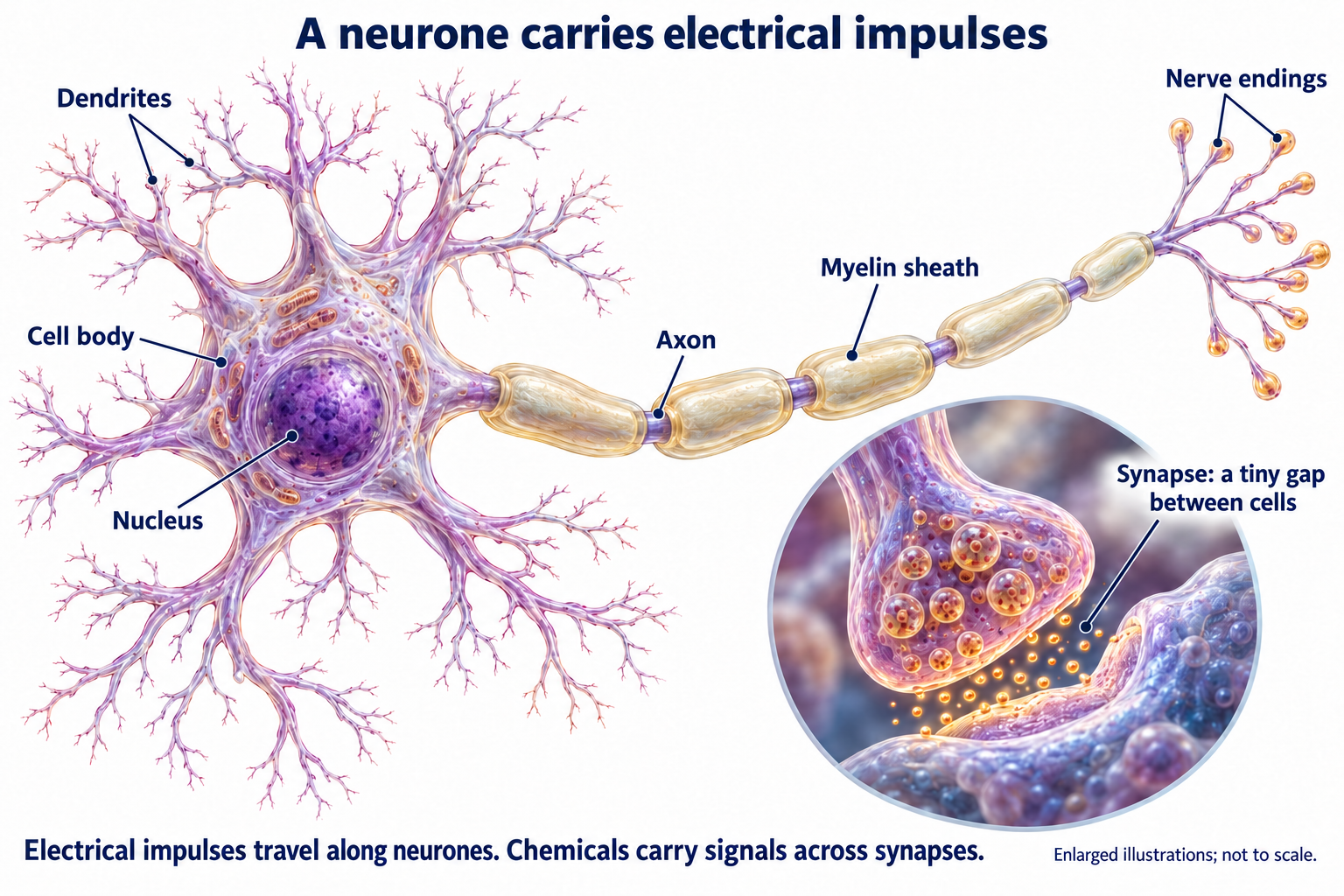
A nerve cell carrying electrical impulses.
Central nervous system: brain and spinal cord.
A gap between neurones where a chemical carries the signal.
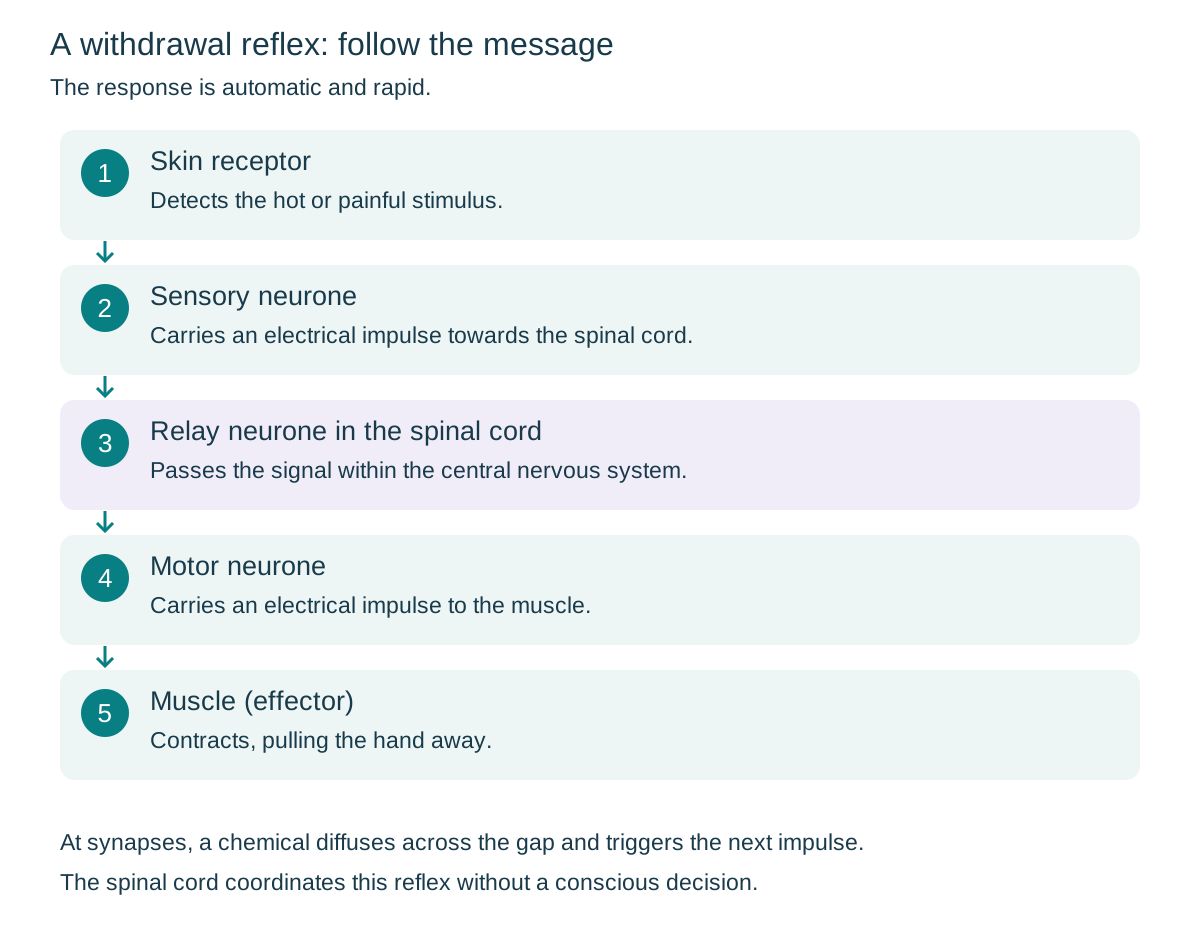
A rapid automatic response without a conscious decision.
A chemical messenger released by a gland into blood.
An organ whose cells respond to a particular hormone.
A hormone that lowers blood glucose concentration.
A storage carbohydrate made from glucose.
Higher only: a hormone that raises blood glucose concentration.
A response that opposes a change.
Release of an egg from an ovary.
A pituitary hormone that helps eggs mature.
A pituitary hormone that triggers ovulation.
Methods that reduce the chance of pregnancy.
Higher only: fertilisation outside the body, followed by embryo transfer.
Higher only: rate of energy use for essential processes at rest.
A factor kept the same to make a comparison fair.
Your cells work best when conditions stay within a suitable range. Homeostasis means regulating conditions inside a cell or organism so it can work properly, even when things change inside or outside it.
Your body regulates temperature, blood glucose concentration and water levels. These conditions matter for enzyme activity and other cell functions. An optimum is the level at which something works best. Homeostasis does not mean a condition never changes.
Control happens automatically. It may use fast electrical signals in nerves or chemical signals called hormones. A warm room is an external change; glucose entering your blood after a meal is an internal change.
A control system has three main parts:
For example, when body temperature rises, receptors detect the change. A coordination centre sends signals to sweat glands. Sweat evaporates from the skin, transferring energy away and helping temperature fall. This example helps explain control; you do not need detailed temperature-control mechanisms for this Trilogy topic.
Cold conditions slow enzyme reactions because particles move more slowly and collide successfully less often. Very high temperatures can change an enzyme's active site so the substrate no longer fits: the enzyme is denatured.
For question HR.10, use these original exercise results. The person exercises from minute 0 to minute 2, then rests.
| Minutes | Temperature / °C |
|---|---|
| 0 | 37.0 |
| 2 | 38.0 |
| 4 | 37.5 |
| 6 | 37.1 |
| 8 | 37.0 |
If temperature falls from 38.0 °C to 37.5 °C in 2 minutes, the fall is 0.5 °C. Mean fall per minute = 0.5 ÷ 2 = 0.25 °C per minute. Use the time interval, not just the final time.
The first 12 questions retain the introductory tasks. Any original 1.x reference in a hint refers to the corresponding HR.x question here. The rest of this worksheet extends the topic.
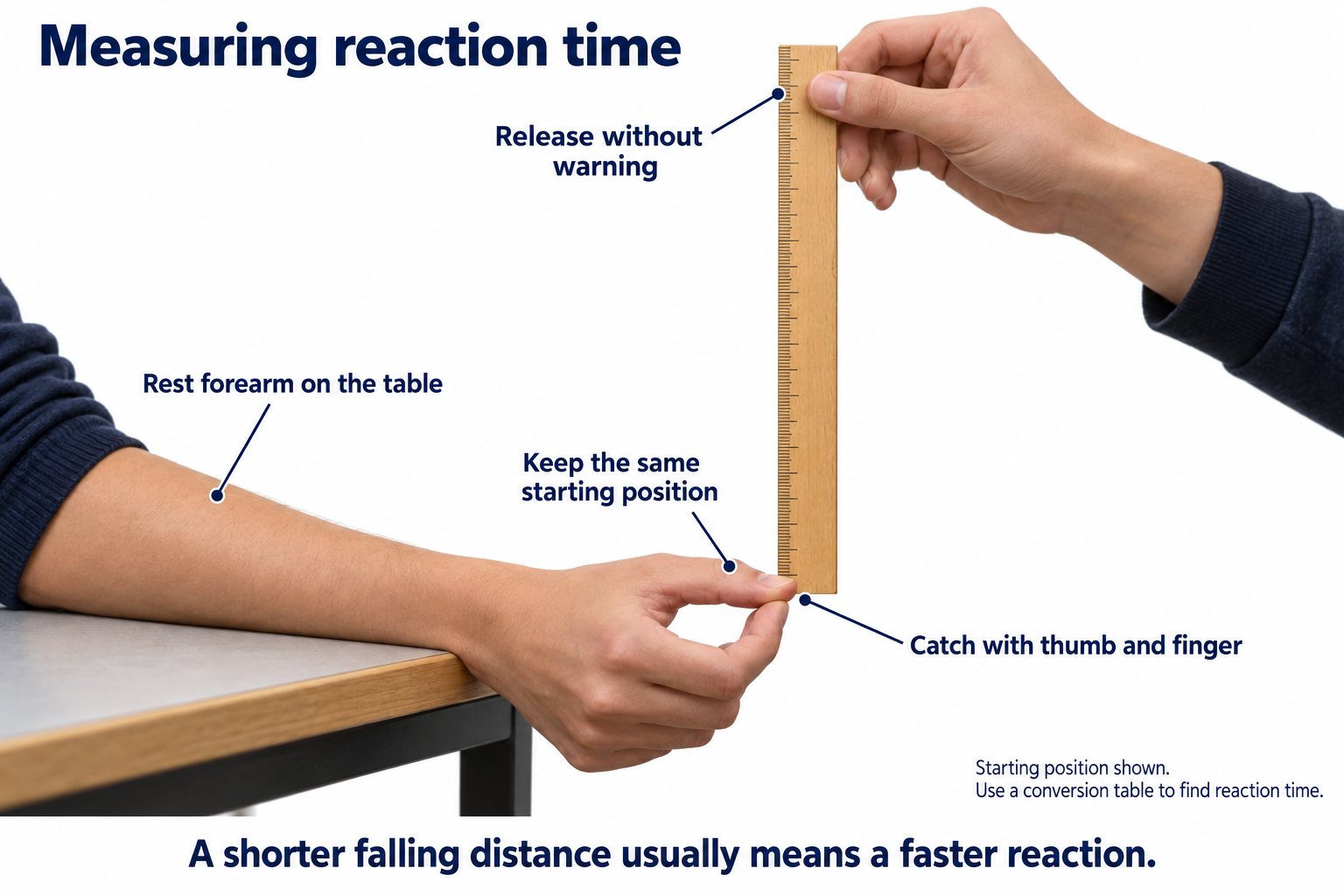
Imagine catching a falling ruler. Receptors in your eyes detect it moving. Messages travel along nerve cells called neurones as electrical impulses. Your central nervous system processes the information and sends impulses to muscles in your fingers, which contract.
The central nervous system (CNS) is the brain and spinal cord. Long neurones carry impulses between receptors, the CNS and effectors. Their long extensions help messages travel over a distance; many are insulated, helping impulses travel quickly.
A sensory neurone carries impulses from a receptor towards the CNS. A motor neurone carries impulses from the CNS to an effector. A relay neurone links neurones inside the CNS.
A reflex is a rapid, automatic response that does not involve the conscious part of the brain. You do not have to decide to pull your hand away from something painfully hot. Acting quickly helps reduce damage.
A synapse is the tiny gap between neurones. When an impulse reaches the end of a neurone, a chemical is released. It diffuses across the gap and triggers an electrical impulse in the next neurone. Electrical impulses travel along neurones; chemicals carry the signal across synapses.
Aim: investigate how one factor affects human reaction time. Here we compare catching a ruler in quiet conditions with catching it while counting backwards aloud. Use willing volunteers who can stop at any time.
The independent variable is whether the catcher counts aloud. The dependent variable is catch distance, or reaction time found using a suitable distance-to-time conversion chart. A longer distance means a slower response. Distance and time are not directly proportional, so do not label centimetres as seconds.
Keep the ruler away from faces and feet; do not use a heavy metal ruler. Do not test effects of drugs, sleep deprivation or dangerous distractions. Do not collect private health information. Keep results anonymous.
| Trial | Quiet / cm | Counting aloud / cm |
|---|---|---|
| 1 | 16 | 24 |
| 2 | 18 | 26 |
| 3 | 17 | 25 |
| 4 | 16 | 24 |
| 5 | 18 | 26 |
Quiet mean = (16 + 18 + 17 + 16 + 18) ÷ 5 = 17 cm. Counting mean = 125 ÷ 5 = 25 cm. Counting increased the mean catch distance by 8 cm. These results suggest a slower response during this counting task; they do not prove that every distraction has the same effect on everyone.
Check an unusual result and record a reason before excluding it. Repeating trials helps reveal random variation. More volunteers improve how well the results represent a group. A bar chart is suitable for comparing the two named conditions; label the axis with the measured quantity and units.
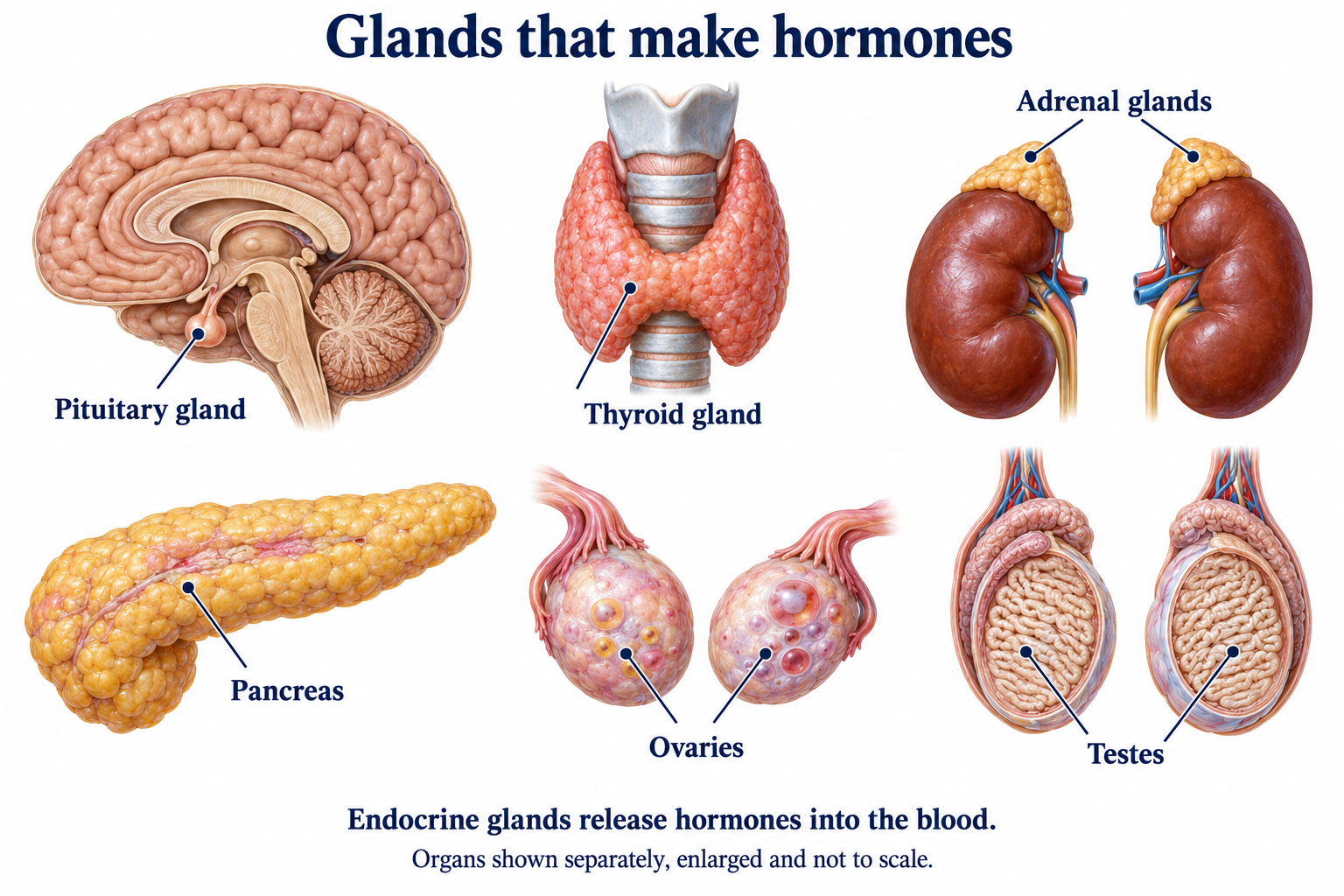
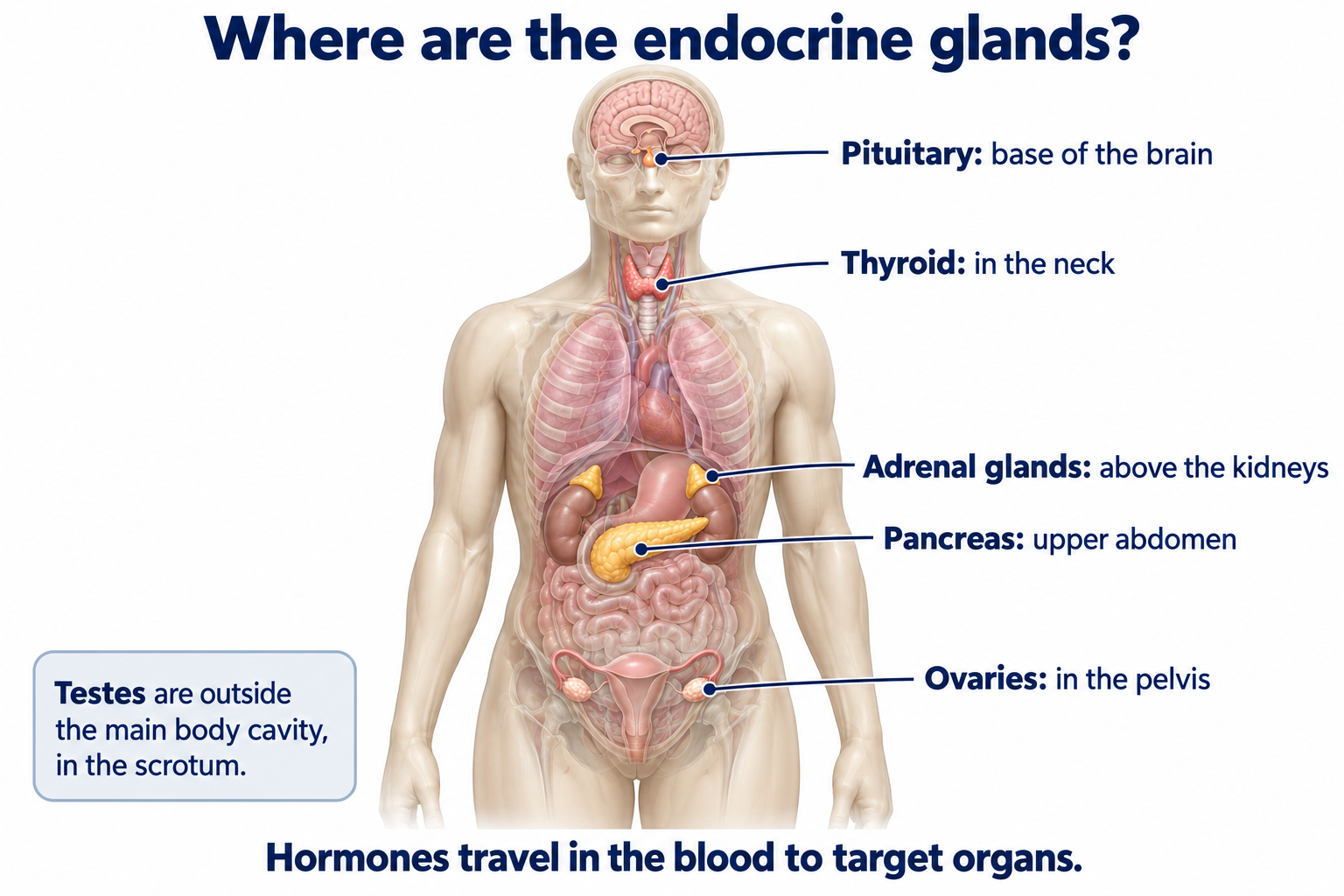
The endocrine system is a collection of glands. They release hormones straight into the bloodstream. Blood carries the hormones around the body, but only target cells with suitable receptors respond.
Hormonal responses are usually slower to start and last longer than nervous responses. Nerves send impulses to particular effectors; hormones travel in the blood.
The pituitary gland sits at the base of the brain. It is often called a master gland because some of its hormones stimulate other endocrine glands.
| Gland | Position |
|---|---|
| Pituitary | At the base of the brain |
| Thyroid | In the neck |
| Adrenal glands | On top of the kidneys |
| Pancreas | In the abdomen, near the stomach |
| Ovaries | In the pelvis, one on each side of the uterus |
| Testes | In the scrotum, outside the main body cavity |
After a carbohydrate-containing meal, digestion supplies glucose and blood glucose concentration may rise. The pancreas monitors the concentration and releases insulin when it is too high.
Insulin causes glucose to move from the blood into body cells. In liver and muscle cells, excess glucose is converted to glycogen for storage. Blood glucose concentration falls towards its normal range.
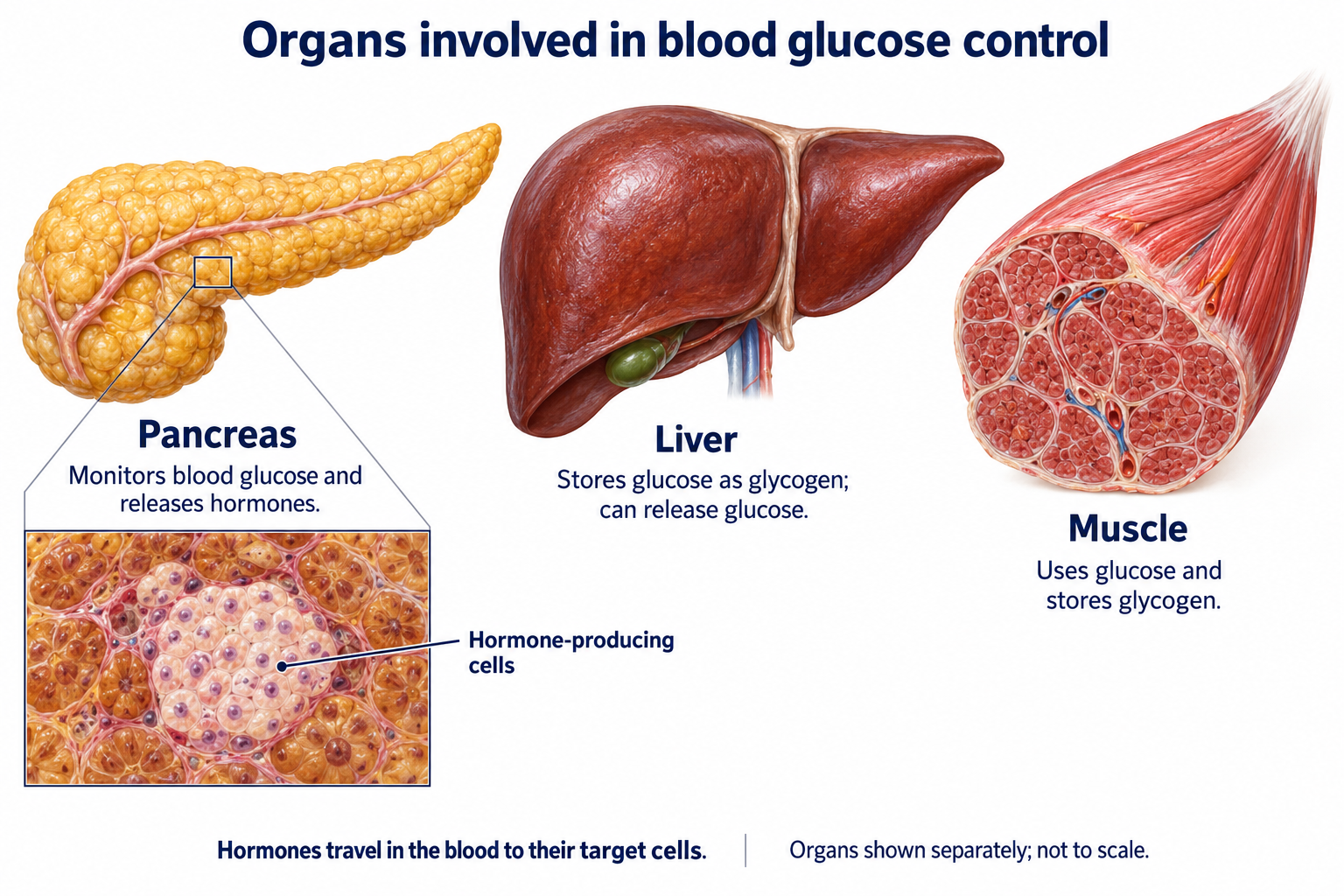
If blood glucose becomes too low, the pancreas releases glucagon. This makes the liver convert glycogen to glucose and release glucose into the blood. Insulin and glucagon have opposite effects.
This is negative feedback: the response opposes the original change. As glucose returns towards the suitable range, the stimulus for releasing the correcting hormone decreases.
Diabetes affects control of blood glucose. Type 1 and Type 2 have different causes, so their management differs.
| Feature | Type 1 | Type 2 |
|---|---|---|
| Main problem | The pancreas does not make enough insulin. | Body cells respond less well to insulin. |
| Result | Blood glucose can remain too high. | Blood glucose can remain too high. |
| Common management | Insulin injections and checking glucose. | A carbohydrate-controlled diet and regular exercise; medicines may also be used. |
| Risk factors | Not caused simply by eating sugar. | Obesity increases risk, but does not mean someone will definitely develop it. |
Use evidence carefully. A link between obesity and Type 2 diabetes is a risk, not a judgement about a person. Genetics and other factors matter too. Support should be practical and respectful, without blaming people.
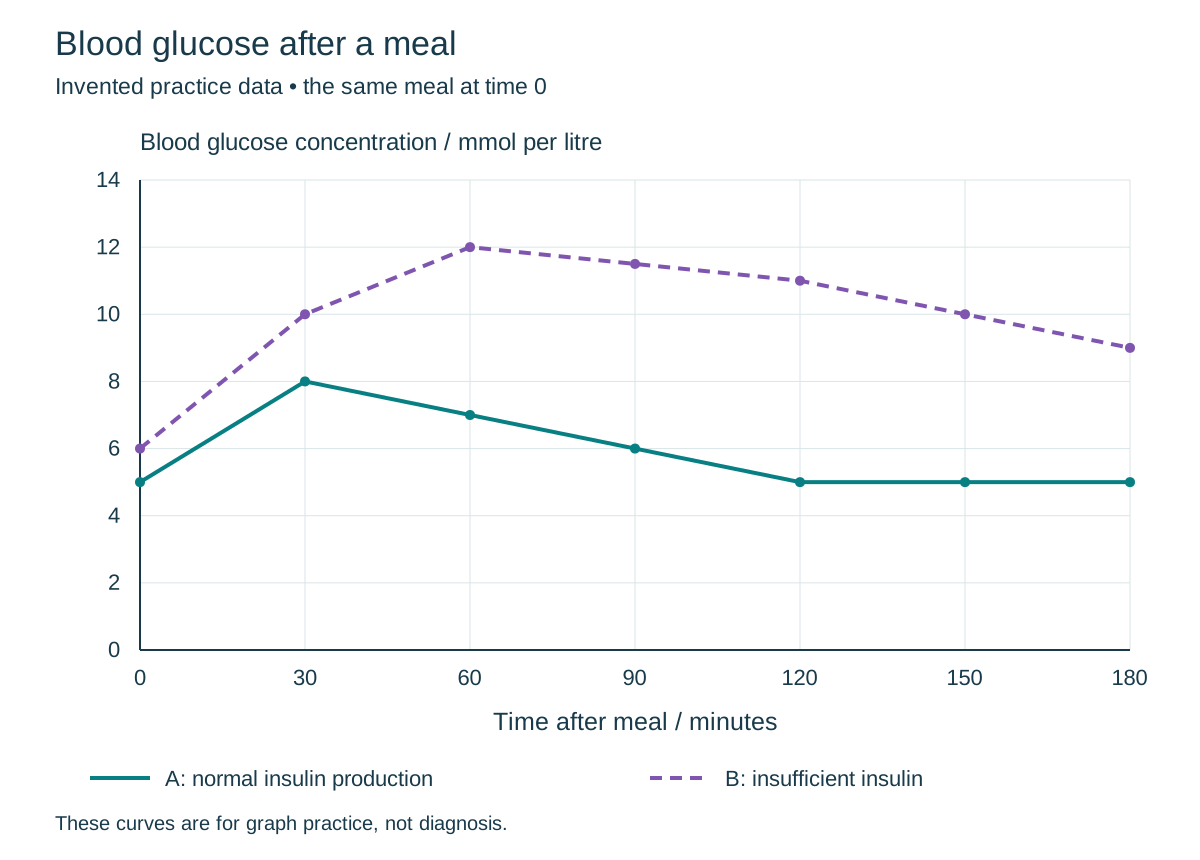
To compare curves, use numbers and times. “B is higher” is less useful than “At 60 minutes, B is 12 mmol/L and A is 7 mmol/L”. The unit mmol/L describes concentration; you only need to read it correctly here.
At puberty, reproductive hormones help the body become able to reproduce. They also cause secondary sex characteristics, such as facial hair, breast development or a deeper voice. Timing varies between people.
Testosterone is made by the testes and stimulates sperm production. Oestrogen is made mainly by the ovaries. Eggs begin to mature after puberty. Ovulation is the release of an egg from an ovary.
An egg enters an oviduct. If a sperm fertilises it, an embryo may later implant in the uterus lining. These are different events: releasing an egg is not the same as fertilisation.
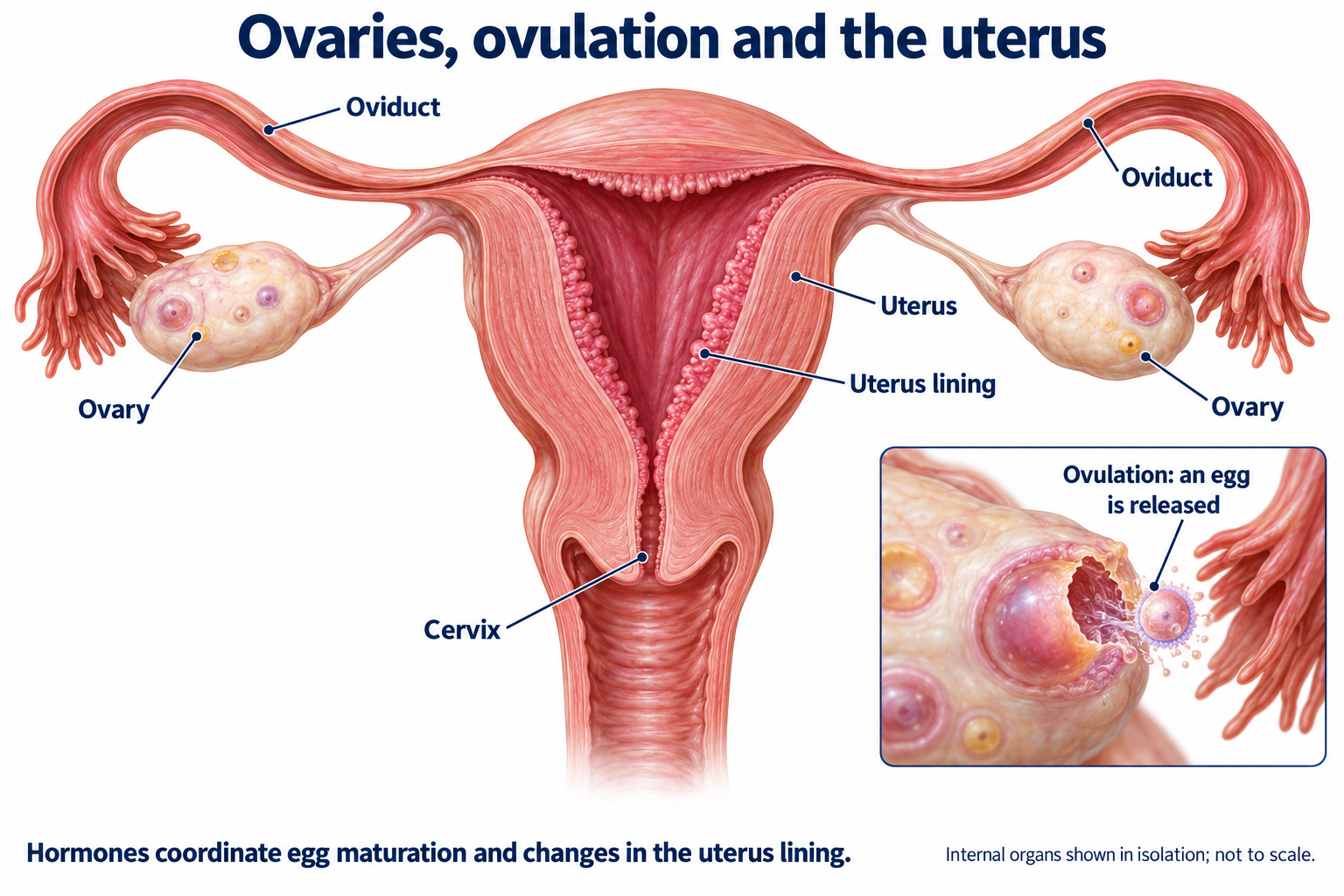
The menstrual cycle prepares the uterus for a possible pregnancy. A 28-day cycle is a useful example, but real cycles vary. Day 1 is the start of bleeding, when the uterus lining is shed.
| Hormone | Where it is released | Main role |
|---|---|---|
| FSH — follicle stimulating hormone | Pituitary gland | Helps an egg mature in an ovary. |
| LH — luteinising hormone | Pituitary gland | Triggers ovulation. |
| Oestrogen | Ovary | Helps build and maintain the uterus lining. |
| Progesterone | Ovary after ovulation | Helps maintain the uterus lining. |
FSH stimulates an egg to mature and the ovary to make oestrogen. Rising oestrogen inhibits FSH release. High oestrogen stimulates an LH surge, which triggers ovulation. Progesterone then helps maintain the uterus lining and inhibits FSH and LH. If progesterone and oestrogen fall, the lining breaks down and FSH can rise to begin another cycle.
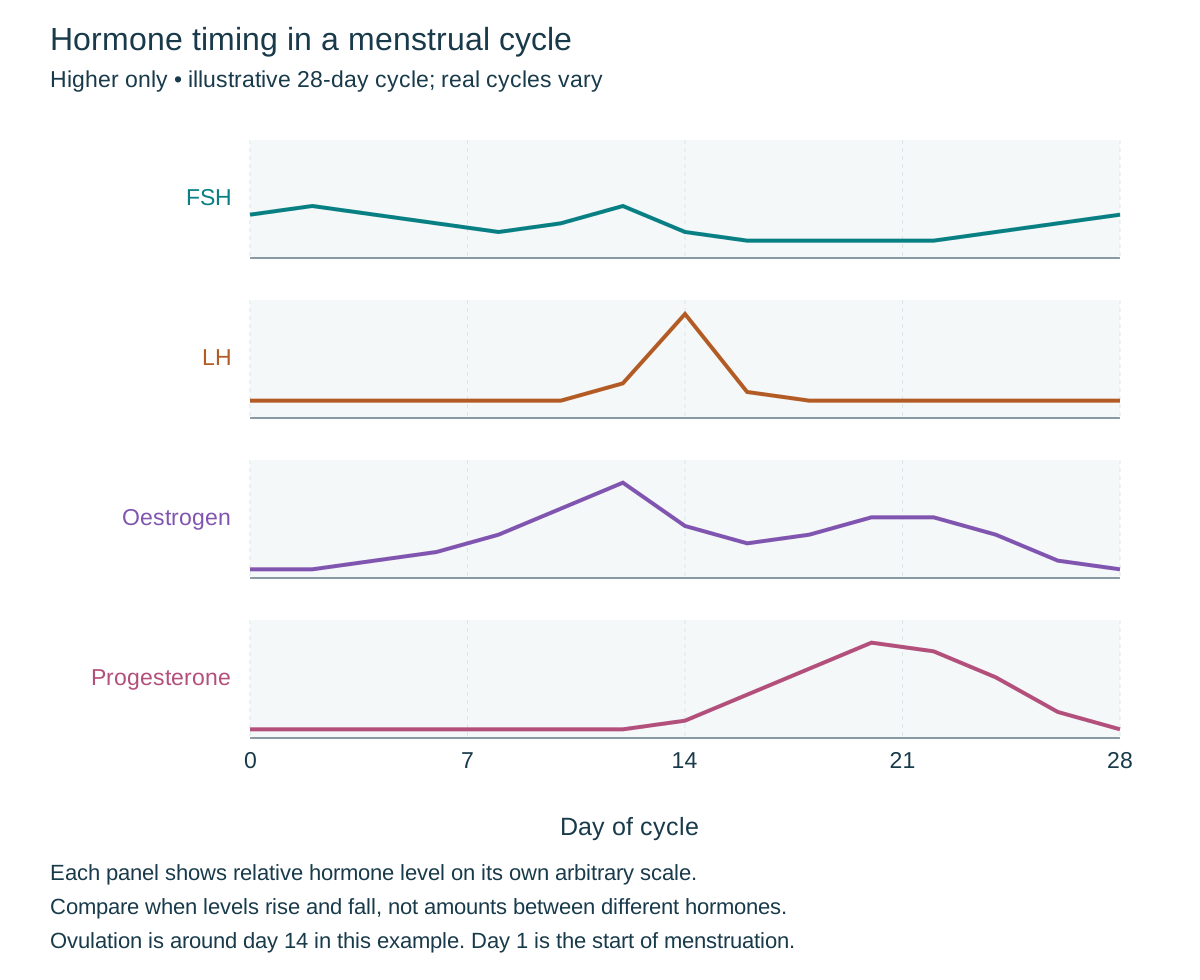
Contraception reduces the chance of pregnancy. Hormonal methods change hormone signals; non-hormonal methods work in other ways.
| Method | How it works | Point to consider |
|---|---|---|
| Oral contraceptive pill | Hormones inhibit FSH, so eggs do not mature; ovulation is prevented. | Must be taken as directed; does not protect against sexually transmitted infections (STIs). |
| Injection, implant or patch | Slow-release progesterone-like hormone inhibits egg maturation or release. | Works over a longer period; possible side effects and access matter. |
| Condom or diaphragm | Forms a barrier so sperm do not reach an egg. | Condoms also reduce STI transmission; correct use matters. |
| Intrauterine device/system | A device in the uterus; some release a hormone. Devices prevent pregnancy by affecting sperm/fertilisation and may prevent implantation. | Long-lasting; fitting and removal need a trained professional. |
| Spermicide | Kills or disables sperm. | Often used with a barrier; does not give reliable STI protection. |
| Avoiding intercourse around fertile days | Avoids sex when an egg may be present in an oviduct. | Timing ovulation is uncertain; cycles vary. |
| Sterilisation | Blocks sperm ducts or oviducts so sperm and egg cannot meet. | Intended to be permanent; involves a procedure. |
Evaluate effectiveness, possible side effects, convenience, cost, access and STI protection. Science provides evidence about effects and risks; personal values and religious beliefs also influence choices. There is no single method that suits everyone.
Some people have difficulty becoming pregnant. If eggs do not mature and release normally, fertility drugs containing FSH and LH may help. Fertilisation may then happen inside the body.
In vitro fertilisation (IVF) means fertilisation outside the body:
IVF can offer a chance of pregnancy, but success is not guaranteed. Treatment can be emotionally and physically stressful, expensive and time-consuming. Multiple pregnancies increase risks for the pregnant person and babies. Transferring fewer embryos reduces that risk.
People may disagree about unused embryos, cost and access. Evaluate arguments respectfully and separate evidence from personal values. Better microscopes and laboratory techniques helped make this treatment possible.
Adrenaline is released by the adrenal glands in frightening or stressful situations. It increases heart rate and helps deliver more glucose and oxygen to the brain and muscles. This prepares the body for “fight or flight”.
Thyroxine is released by the thyroid gland. It increases basal metabolic rate — the rate of energy use for essential processes while at rest. It is also important for growth and development.
Thyroxine is controlled by negative feedback. When its level is low, signals from the brain and pituitary stimulate the thyroid to release more. A higher thyroxine level reduces this stimulation, so secretion falls. The response opposes the change.
For describe questions, state what happens. For explain, connect a cause to its effect. For evaluate, weigh evidence and limitations before giving a justified conclusion.
For a six-mark response, plan a logical route. A reflex explanation might follow the message from receptor to muscle. A practical plan should identify variables, explain the method, control other factors and describe how results will be processed.
If 18 of 60 treatment cycles result in a birth, percentage success = (18 ÷ 60) × 100 = 30%. This is a group result, not a promise of what happens to one individual.
Higher-only sections are labelled. Optional challenge questions at the end test application with less help; challenge does not automatically mean Higher-only.
Start with the 51 main questions. Higher-only questions are labelled. You can complete this topic over several sessions; your answers save as you go. Use a hint if you get stuck, then compare your work with an example answer. Your tutor can mark written answers.
Use the method and practice data from the reaction-time section. Explain how you would check whether counting aloud changes reaction time.
| Trial | Quiet / cm | Counting aloud / cm |
|---|---|---|
| 1 | 16 | 24 |
| 2 | 18 | 26 |
| 3 | 17 | 25 |
| 4 | 16 | 24 |
| 5 | 18 | 26 |
I would compare the same volunteer catching a ruler quietly and while counting. I would keep the zero position, hand and finger gap the same, give equal practice and take five readings per condition. I would counterbalance order across several volunteers, use a light plastic ruler away from faces and calculate means. The example means are 17 cm and 25 cm, suggesting slower responses while counting. Individual differences and practice effects limit the conclusion.
When connected with your pupil code, your answers save online for Kevin to see. Click Submit to Kevin when you have finished. Downloads are optional.
Connect with your pupil code above to submit.
Use a scientific idea and a specific example in your reflection.