Using resources
Work through one section at a time. Higher-only material is labelled explicitly; optional challenges can also use Foundation content.
 GCSE CHEMISTRY · AQA TRILOGYTutor dashboardSaves on this device
Your answers save automatically as you work.
Saved in this browser on this device.
Clean water, useful metals and everyday products all depend on resources. Compare how we obtain them, reduce waste and judge the environmental cost of our choices.
Supported GCSE version · Clear examples, worked calculations and optional challenges.
Work through one section at a time. Higher-only material is labelled explicitly; optional challenges can also use Foundation content.
A resource available in limited amounts or replaced too slowly for our use.
A resource that can be replenished on a useful human timescale if managed appropriately.
Meeting present needs while allowing future generations to meet theirs.
Water safe to drink, with sufficiently low levels of harmful microbes and dissolved substances.
Water containing only H₂O molecules.
Removing dissolved salts from water.
Using pressure to push water through a membrane that blocks most dissolved salts.
The condensed liquid collected during distillation.
Material left behind after evaporation or another separation.
A mass that no longer changes after further heating, cooling and weighing.
Liquid wastewater leaving a treatment stage.
The settled solid-rich material separated from sewage.
Without oxygen.
Using oxygen.
Using plants to take up metal compounds, then processing the plant material to obtain metal.
Using bacteria to help produce a solution of metal compounds from low-grade material.
A study of environmental impacts throughout a product’s life.
A factor of ten difference in size.
A resource is something we use to meet a need. We use Earth’s resources for warmth, shelter, food and transport. Timber, water and metal ores are natural resources. Agriculture increases supplies of food, cotton, wool and timber. Chemistry helps turn raw materials into useful products such as medicines, fertilisers, plastics and fuels.
| Example | What changes? |
|---|---|
| Timber from managed forests | Growing trees can supplement wood from natural forests. |
| Cotton grown on farms | Agriculture provides fibre for clothing. |
| Polyester clothing | A synthetic polymer can replace or be blended with natural fibres. |
| Synthetic rubber | Can supplement natural rubber collected from rubber trees. |
Finite resources exist in limited amounts or are replaced far too slowly for our rate of use. Fossil fuels and metal ores are finite. A renewable resource can be replenished on a useful human timescale, such as sustainably grown timber. Renewable does not mean unlimited: forests can be used faster than they regrow.
Sustainable development meets today’s needs without preventing future generations from meeting theirs. It involves using fewer raw materials and less energy, reducing waste and limiting damage to ecosystems. A process can be improved without becoming completely impact-free.
For example, a chemist may develop a process that uses less energy, produces less waste or makes a useful material from a waste stream. When comparing resources, consider how quickly they are used, how quickly they are replaced and the consequences of extraction.
Potable water is water safe to drink. It must contain sufficiently low levels of harmful microbes and dissolved substances. It may still contain harmless dissolved minerals. Pure water, in chemistry, contains only H₂O molecules.
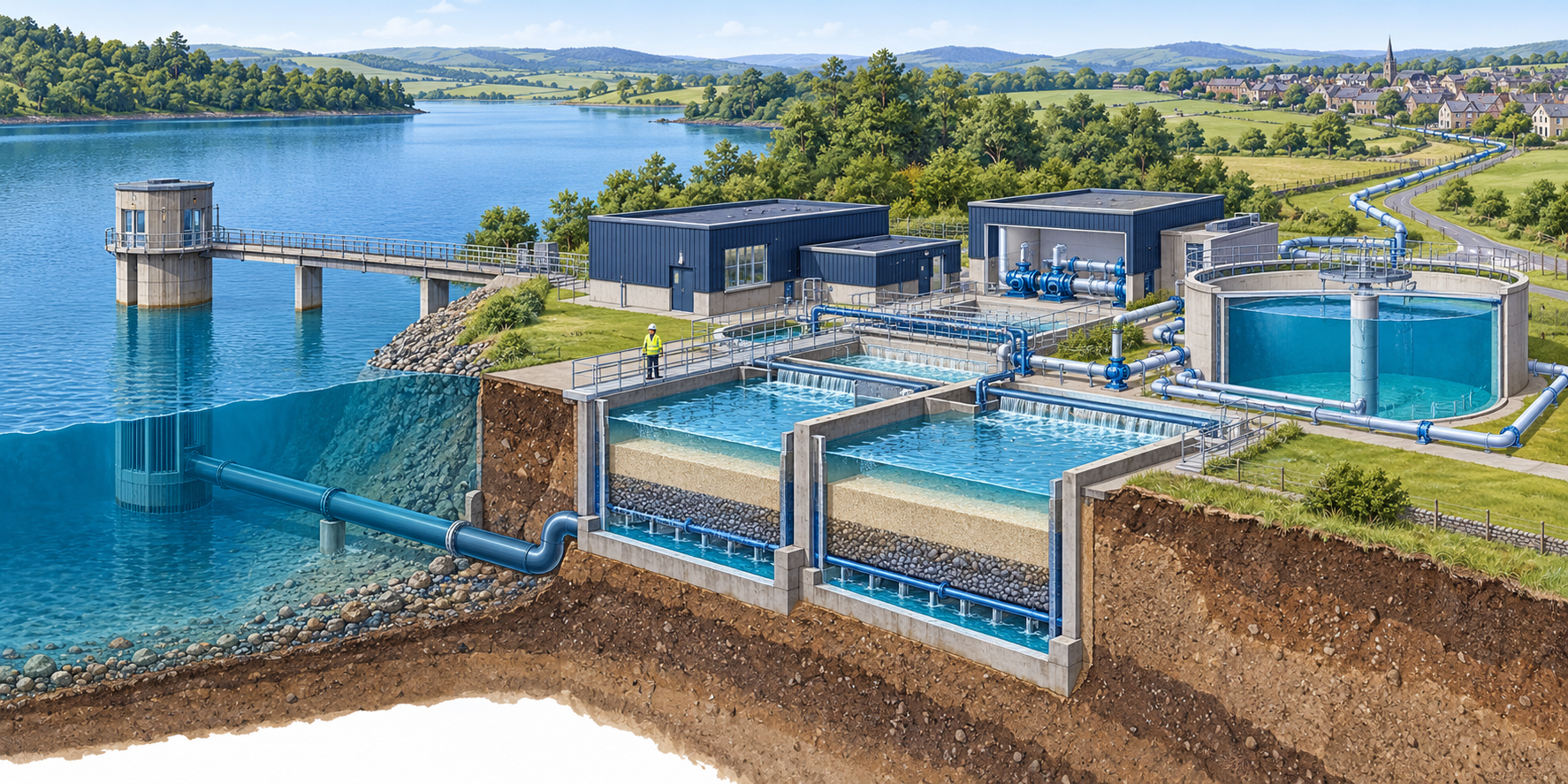
Clear-looking water is not automatically safe: microbes and dissolved chemicals may be invisible. Never taste a laboratory water sample to test it. A pH near 7 and little visible residue do not, by themselves, prove potability.
Rain provides much of the UK’s fresh water. It collects in rivers, lakes, reservoirs and underground. Compared with seawater, fresh water usually contains much less dissolved salt. Choose a suitable source, then use treatment matched to its contaminants.
| Step | Purpose |
|---|---|
| Choose the source | Start with suitable freshwater and monitor its quality. |
| Filter beds | Remove insoluble particles such as small suspended solids. |
| Sterilise/disinfect | Kill harmful microorganisms using chlorine, ozone or ultraviolet light. |
Filtering does not remove all dissolved substances and does not guarantee that all microbes are destroyed. Sterilisation controls microbes; it does not remove salt. Groundwater may contain fewer suspended solids than river water but can still contain dissolved substances and microbes, so it must be assessed and treated.
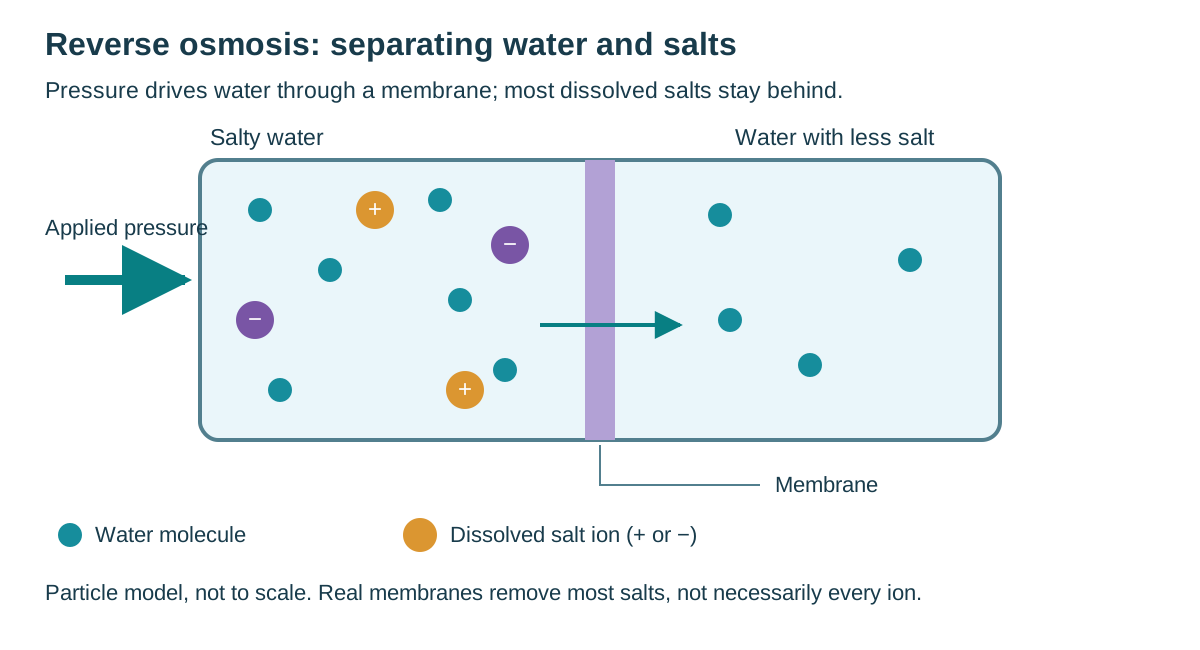
Desalination removes dissolved salts from seawater or other salty water. Ordinary filter paper is not enough because dissolved ions pass through with the water.
Distillation: heat water so it boils; cool the vapour so it condenses; collect the liquid water. The non-volatile dissolved salts remain behind. Reverse osmosis: use high pressure to push water through a membrane that allows water through but blocks most dissolved salts.
Both methods need substantial energy: heating for distillation or pumping for reverse osmosis. Costs, local energy supply, freshwater availability and disposal of concentrated salty waste matter. In a place with suitable groundwater, filtration and sterilisation may be easier than desalination. In a dry coastal area, seawater may be abundant even though treatment is more demanding.
This required practical includes pH, dissolved solids and purification by distillation. Use labelled samples supplied by your teacher, such as tap water, a safe dilute salt solution and distilled water. Do not collect or handle raw sewage for a school investigation.
pH: place a small sample in a clean container. Use universal indicator with its colour chart or a calibrated pH probe. Rinse the probe with distilled water between samples and gently blot it to avoid transferring one sample into another. Record readings consistently and repeat measurements.
Keep sample volumes, equipment and testing conditions comparable. Do not add indicator to the sample that will later be weighed for dissolved solids: the indicator itself adds material. Label separate portions for each test.
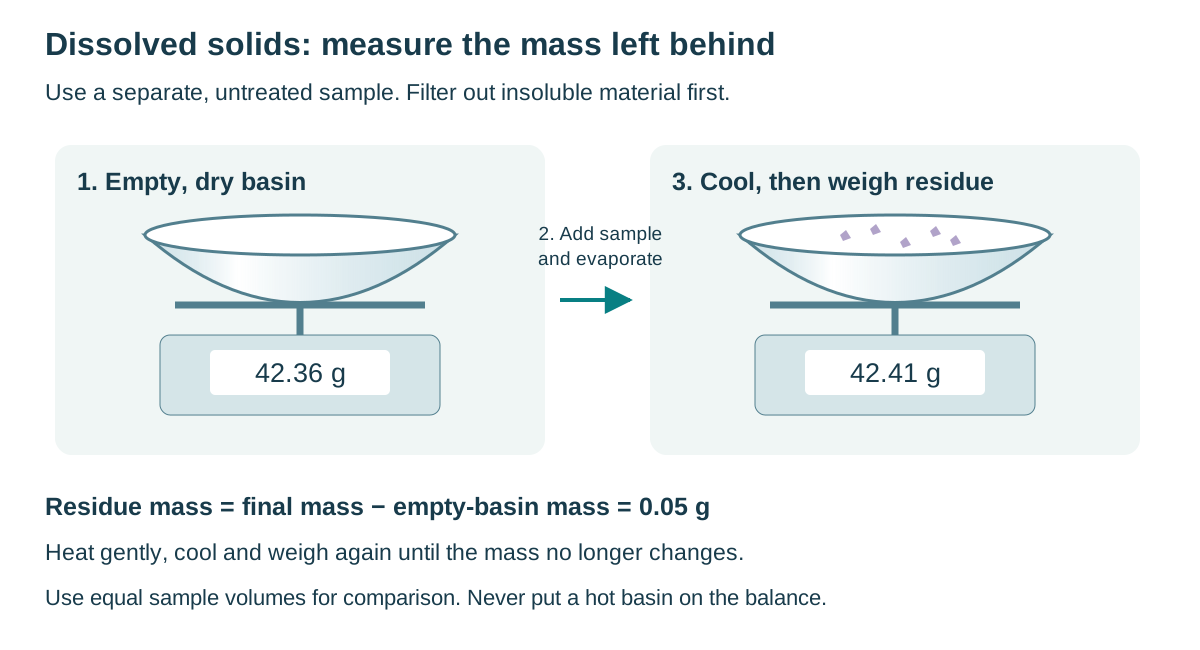
If a sample contains insoluble particles, first filter it and measure a known volume of the filtrate. Otherwise the residue would include suspended solids as well as dissolved ones.
Weigh a clean, dry evaporating basin. Add a measured volume of water, such as 25.0 cm³. Heat gently so water evaporates without spitting. Allow the basin to cool, then weigh it again. Reheat gently, cool and reweigh until the mass is constant. The extra mass is the dry residue from the sample.
Use equal sample volumes for a direct comparison of residue masses. Repeat with fresh portions and compare the results. A small residue is hard to measure accurately: a balance reading to 0.01 g cannot justify many decimal places. Any volatile substances that evaporate with the water are not measured by this residue method.
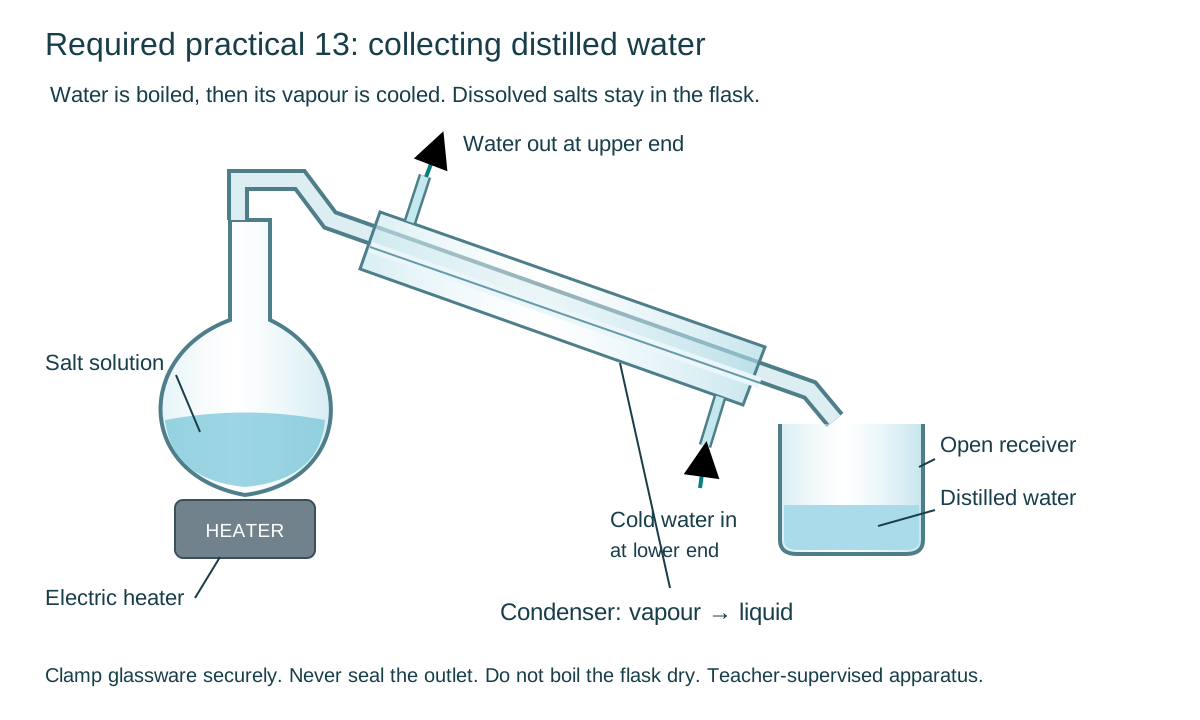
Place a teacher-approved salt solution in the distillation flask. Assemble and clamp the glassware securely. A teacher may add anti-bumping granules before heating. Start the cooling water: it enters the condenser’s lower end and leaves the upper end, filling the jacket. Heat gently. Water vapour passes along the inner tube, loses energy to the cooling water and condenses. Collect the distillate in a clean receiver.
Do not seal the apparatus or boil the flask dry. Hot glass looks like cold glass: allow it to cool before handling. Use an appropriate electric heater and keep electrical connections dry. A small sample of the distillate can be evaporated to compare its residue with the original water. Distillation can remove non-volatile salts, but it is not a complete test for every possible contaminant.
Wastewater comes from homes, farms and industry. Sewage and agricultural wastewater can contain organic matter and harmful microbes. Industrial wastewater may also contain harmful chemicals that need specialised treatment.
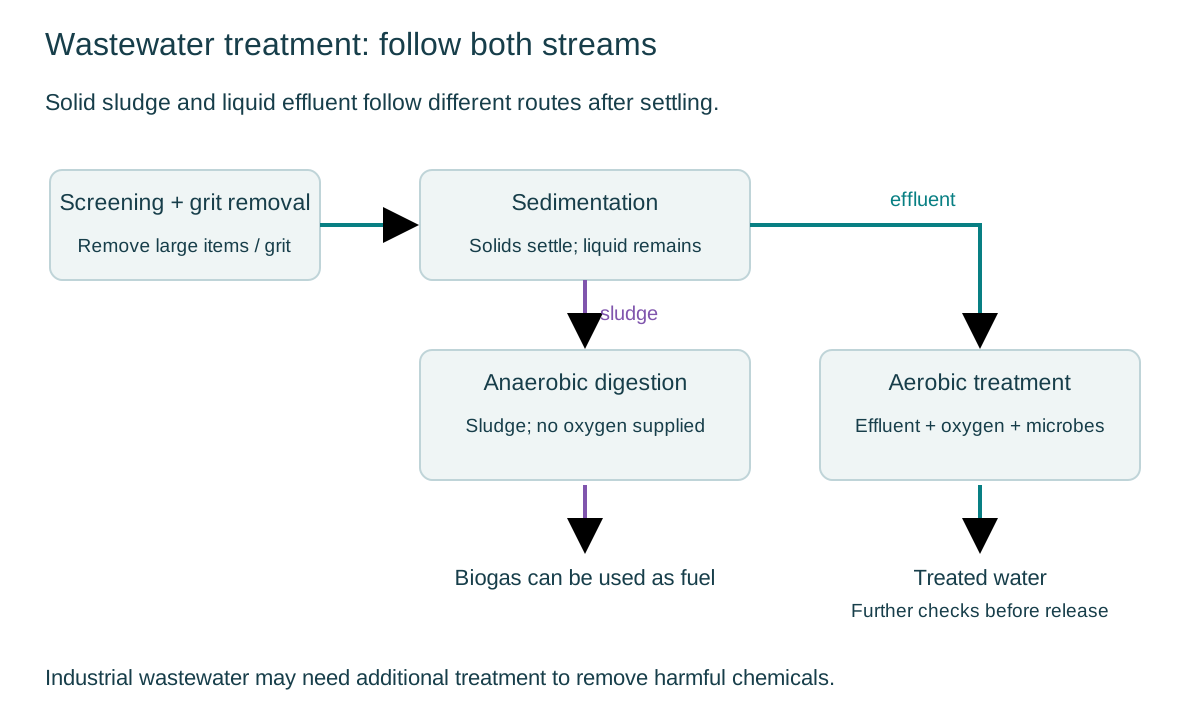
Screening and grit removal take out large objects and grit. Sedimentation allows solids to settle as sewage sludge, leaving liquid effluent above. The sludge is treated by anaerobic digestion, without oxygen supplied; this can produce useful biogas. The effluent receives aerobic biological treatment: oxygen helps microbes break down organic matter.
Treated wastewater can be released only when it meets appropriate environmental requirements. It is not automatically drinking water. Producing potable water from wastewater may need more treatment and monitoring than using a clean groundwater source.
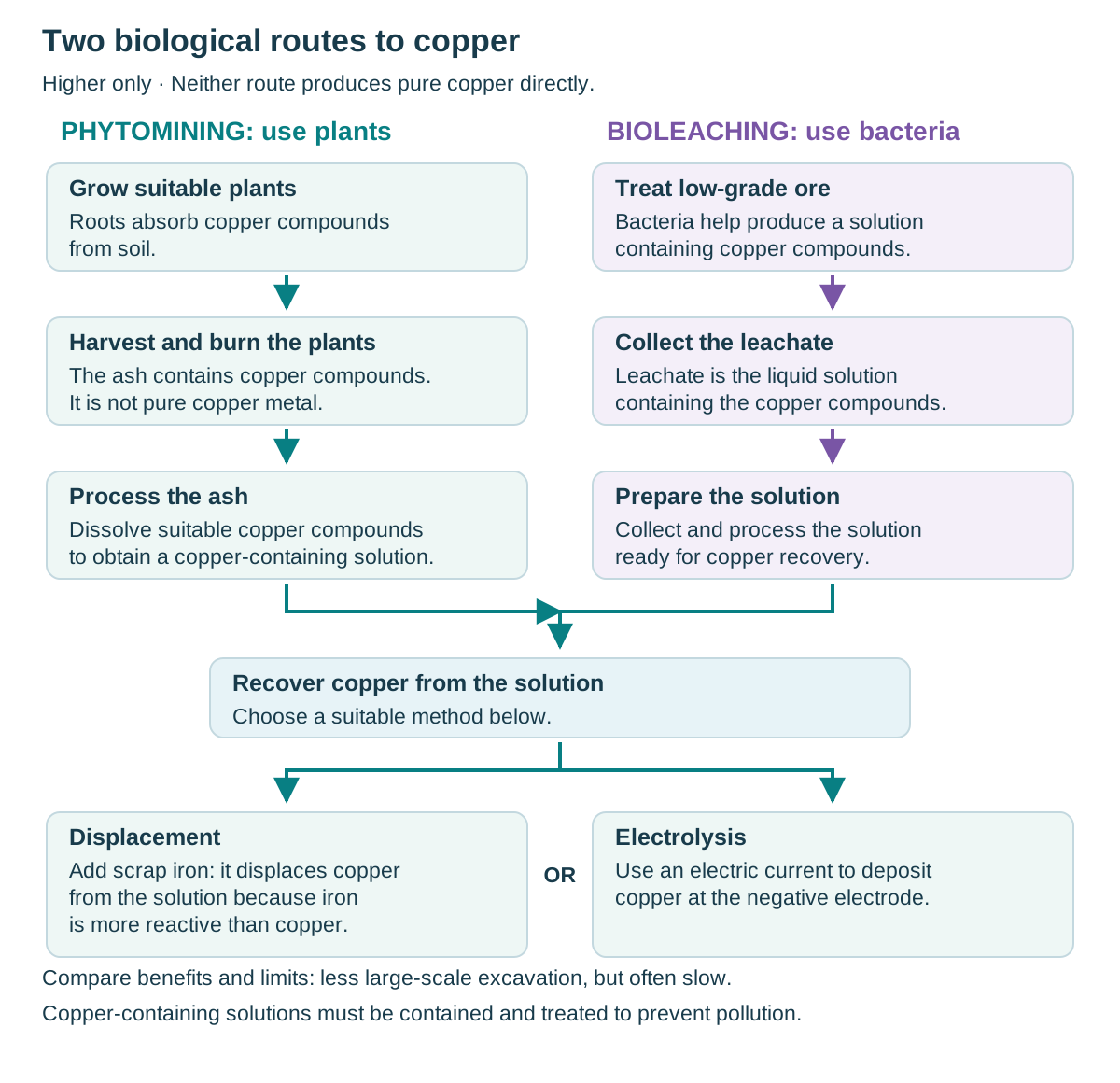
Higher only. A low-grade ore contains a small proportion of useful metal compound. As rich copper ores become scarcer, processing low-grade sources becomes more important. Moving huge quantities of rock can damage landscapes and use energy.
| Method | Main stages |
|---|---|
| Phytomining | Grow plants that absorb metal compounds from the soil → harvest plants → burn them → collect ash containing metal compounds → process the compounds to obtain metal. |
| Bioleaching | Use bacteria to help produce a solution containing metal compounds from low-grade material → collect this leachate → recover the metal. |
Neither method produces a lump of pure copper directly from a leaf or a bacterium. Copper compounds must be processed. Copper can be obtained from a solution by displacement with scrap iron or by electrolysis. For displacement: iron + copper sulfate → iron sulfate + copper. Iron is more reactive than copper.
Biological methods can reduce large-scale digging and may use less energy, but are often slow. They can require land, controlled conditions and treatment of contaminated solutions. Compare the information in the question rather than claiming one method is always best.
A life cycle assessment (LCA) compares environmental impacts throughout a product’s life. It considers more than carbon emissions: water use, resource use, waste, pollution and land damage also matter.
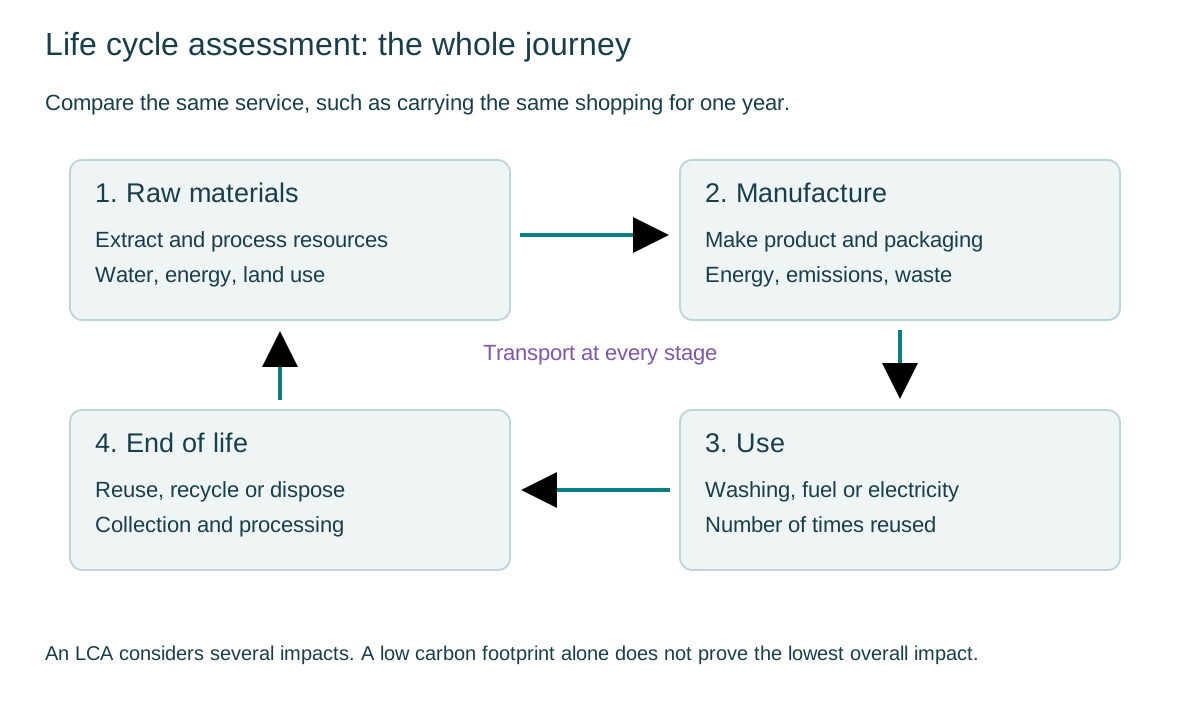
The four main stages are extracting and processing raw materials; manufacturing and packaging; use and operation; and disposal or recovery at the end of life. Include transport and distribution between stages. A reusable bag may have a larger manufacturing impact but a smaller impact per shopping trip if it is used many times.
Energy used, water used and masses of materials or waste can often be measured. It is harder to attach one number to harm caused by different pollutants or damage to habitats. Deciding how much weight to give each impact involves value judgements.
A company could select only the stage where its product looks best, ignore transport or assume an unrealistic number of reuses. Compare studies with the same boundaries and task. Ask who funded the study, how the data were measured, what was left out and whether uncertainty was reported.
| Action | Example | Why it helps |
|---|---|---|
| Reduce | Buy less unnecessary packaging | Avoids some raw-material extraction and manufacture entirely. |
| Reuse | Wash and refill a glass bottle | Uses the same product again without remaking its material. |
| Recycle | Crush and melt a used glass bottle | Processes the material into a new product. |
Metals, glass, building materials, clay ceramics and most plastics rely on limited raw materials. Mining and quarrying can damage habitats, create waste and change landscapes. Production also uses energy, often from finite fuels. Reducing demand, reuse and recycling can lower these impacts, though collection, transport and processing still use resources.
Glass bottles can be reused if they can be safely cleaned and refilled. For recycling, glass is collected, sorted, crushed and melted to make new glass products. Colour sorting may be needed to produce the required colour and quality.
Metals can be collected, sorted, melted and recast or reshaped. Different metals or unwanted contaminants may need separation to achieve the required properties. Some scrap steel can be mixed with iron from a blast furnace, reducing the amount of new iron that must be extracted from ore.
A material does not need the same amount of separation for every use. High-purity electrical copper needs tighter control of impurities than some lower-grade uses. Recycling saves finite resources and often energy, but it is not “free”: transport, cleaning and melting have costs and environmental impacts.
Start with the 40 main questions. Higher-only questions are labelled. You can complete this topic over several sessions; your answers save as you go. Use a hint if you get stuck, then compare your work with an example answer. Your tutor can mark written answers.
Two teacher-provided samples look clear. Sample A has pH 7.0 and leaves 0.02 g residue from 25.0 cm³. Sample B has pH 6.8 and leaves 0.20 g from the same volume. Plan how you would check these results, distil B and compare its distillate with the original sample. Explain why these results alone cannot confirm safe drinking water.
I would use separate portions for pH and residue measurements, calibrate and rinse the pH probe, and repeat with clean equipment. I would filter any suspended solids, evaporate equal measured volumes in pre-weighed basins, cool and weigh to constant mass. B leaves ten times more residue for the same volume. I would distil B with clamped glassware, cooling water entering the lower condenser end and an open receiver, never boiling dry. I would repeat the residue test on an equal volume of distillate. A smaller residue supports salt removal, but microbes and other harmful chemicals need separate checks. I would wear eye protection and never taste samples.
When connected with your pupil code, your answers save online for Kevin to see. Click Submit to Kevin when you have finished. Downloads are optional.
Connect with your pupil code above to submit.
Use a scientific idea and a specific example in your reflection.