Quantitative chemistry
Work through one section at a time. Higher-only material is labelled explicitly; optional challenges can also use Foundation content.
 GCSE CHEMISTRY · AQA TRILOGYTutor dashboardSaves on this device
Your answers save automatically as you work.
Saved in this browser on this device.
How much should a reaction make? Learn to count atoms, track mass and use measurements to make reliable chemical calculations.
Supported GCSE version · Clear examples, worked calculations and optional challenges.
Work through one section at a time. Higher-only material is labelled explicitly; optional challenges can also use Foundation content.
Atoms are rearranged, so the total mass of all reactants equals the total mass of all products.
A number in front of a formula that multiplies every atom in it.
A small number within a formula, such as the 2 in H₂O.
The sum of the relative atomic masses in a formula; it has no unit.
An experiment in which material can enter or leave.
The sum of results divided by how many results there are.
The highest result minus the lowest result.
An estimate of how much a measurement may differ from the value being measured.
The substance dissolved in a solvent.
The amount of solute per volume of solution; this topic uses g/dm³.
An amount containing 6.02 × 10²³ stated particles.
The ratio of amounts given by the coefficients in a balanced equation.
The reactant that runs out and limits the amount of product.
More reactant than is needed, so some remains after the reaction.
When wood burns, ash is left behind. That does not mean most of the matter has vanished: gases have moved into the air. In every chemical reaction, atoms are rearranged. No atoms are created or destroyed.
The law of conservation of mass says that the total mass of the reactants equals the total mass of the products. Count all substances, including gases entering or leaving the apparatus.
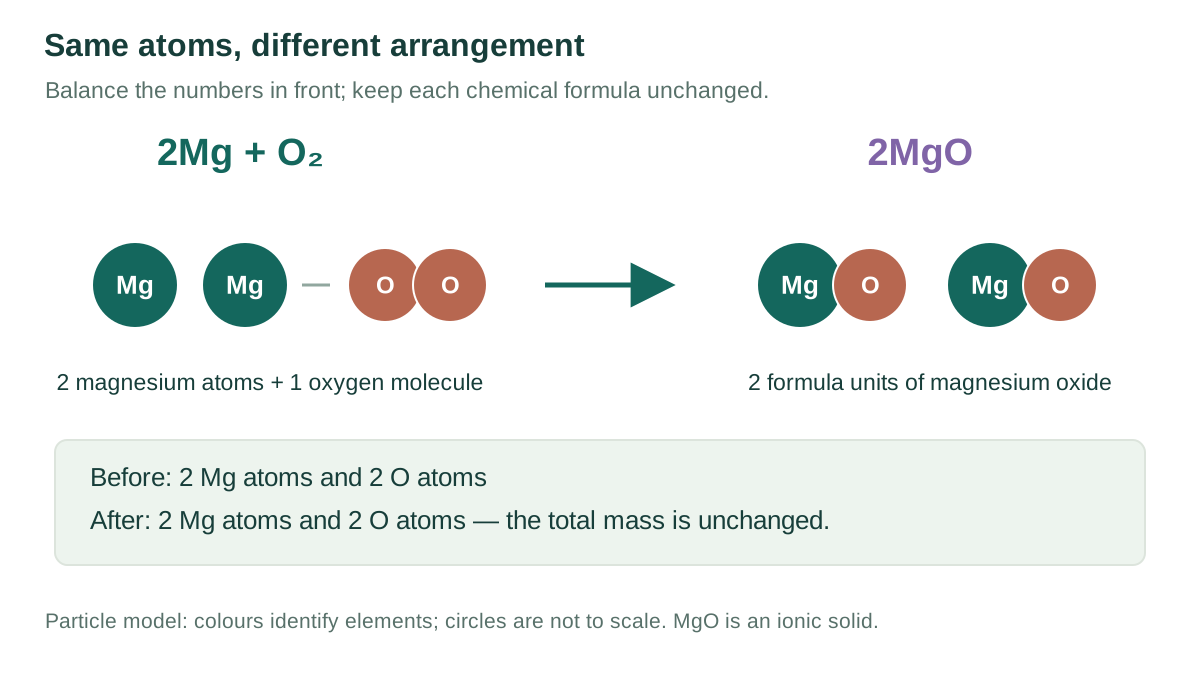
A small number within a formula tells you how many atoms of that element occur in one molecule or formula unit. H₂O contains two H atoms and one O atom. A number in front multiplies the whole formula: 2H₂O represents four H atoms and two O atoms.
Balance equations by changing the numbers in front. Never change a correct formula to make the counts match: H₂O₂ is hydrogen peroxide, a different substance from water.
Use the smallest whole-number coefficients. In 2Mg + O₂ → 2MgO, the atom counts are Mg: 2 each side; O: 2 each side.
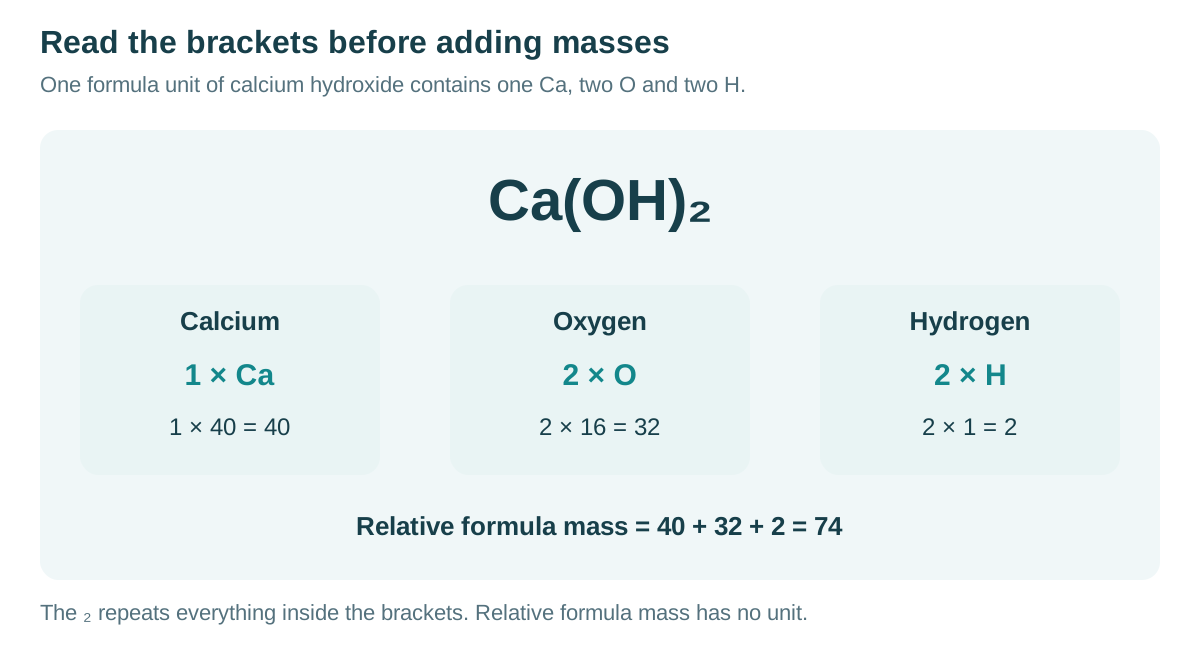
The relative atomic mass, Aᵣ, is the average mass of an atom compared with one-twelfth of the mass of a carbon-12 atom. This average takes account of the element’s isotopes. The relative formula mass, Mᵣ, adds the Aᵣ values of every atom in a formula. Both are relative values and have no unit.
In a balanced equation, include the coefficient when comparing total relative masses. For 2Mg + O₂ → 2MgO: left = 2 × 24 + 32 = 80; right = 2 × 40 = 80.
| Formula | Atoms to count | Mᵣ |
|---|---|---|
| NaCl | 1 Na and 1 Cl | 23 + 35.5 = 58.5 |
| Mg(NO₃)₂ | 1 Mg, 2 N and 6 O | 24 + 28 + 96 = 148 |
Fertilisers contain nitrogen, but not every gram of fertiliser is nitrogen. Percentage by mass tells you how much of the compound’s mass comes from a particular element.
Percentage by mass = (total Aᵣ contribution of the element ÷ Mᵣ of compound) × 100
If the element occurs more than once, count every atom. In NH₄NO₃ there are two nitrogen atoms. With Aᵣ values N 14, H 1 and O 16, Mᵣ = 80, so nitrogen percentage = 28 ÷ 80 × 100 = 35%.
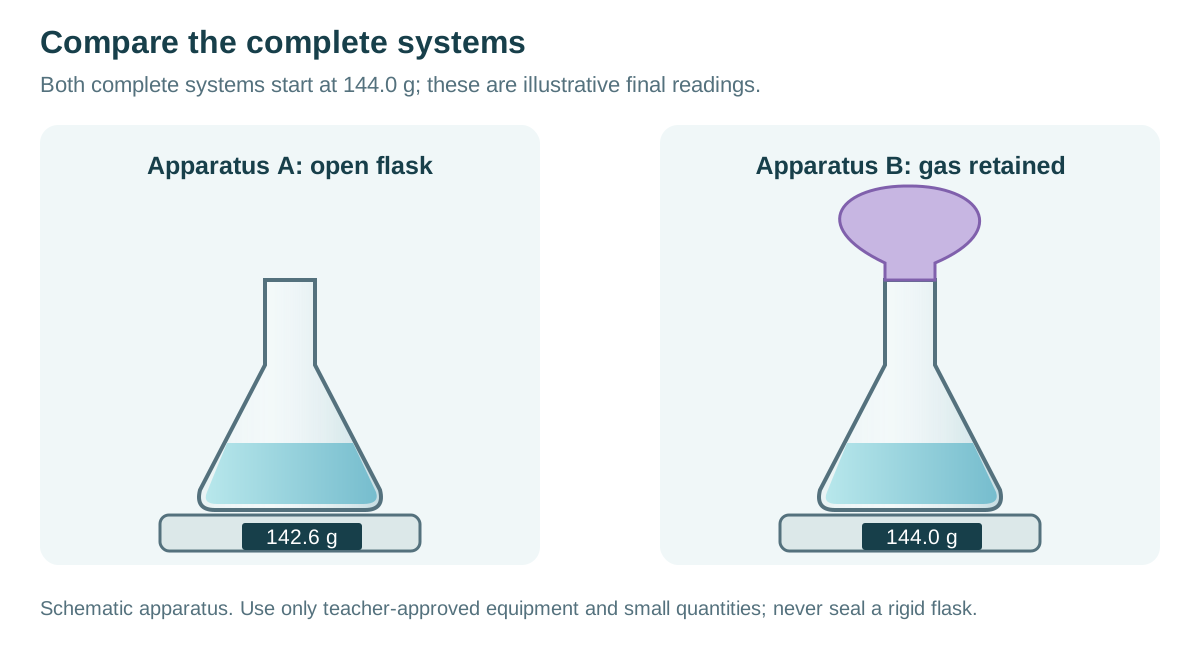
An open system can exchange substances with its surroundings. If a gas escapes, less matter remains on the balance. If oxygen from the air reacts with a metal, extra matter joins the sample and its mass rises.
Example 1: Mg reacts with O₂ to form MgO. The solid gains mass because it contains oxygen atoms from the air.
Example 2: CaCO₃ → CaO + CO₂. Heating calcium carbonate produces carbon dioxide, which escapes from an open container. The solid loses mass, but solid + escaped gas still have the original total mass.
For a mass-against-time graph, read both axes and units. A decreasing line may show gas leaving. A plateau means the measured mass has stopped changing; check the experiment before deciding whether the reaction has finished.
Real measurements are not perfectly exact. A balance reading to 0.01 g cannot show every smaller change. Repeating a measurement helps reveal its spread, but a consistently incorrect balance can give repeated, incorrect results.
Mean = sum of readings ÷ number of readings. Range = highest − lowest. One estimate of uncertainty from repeated readings is half the range. State which method you used; it does not account for every possible error.
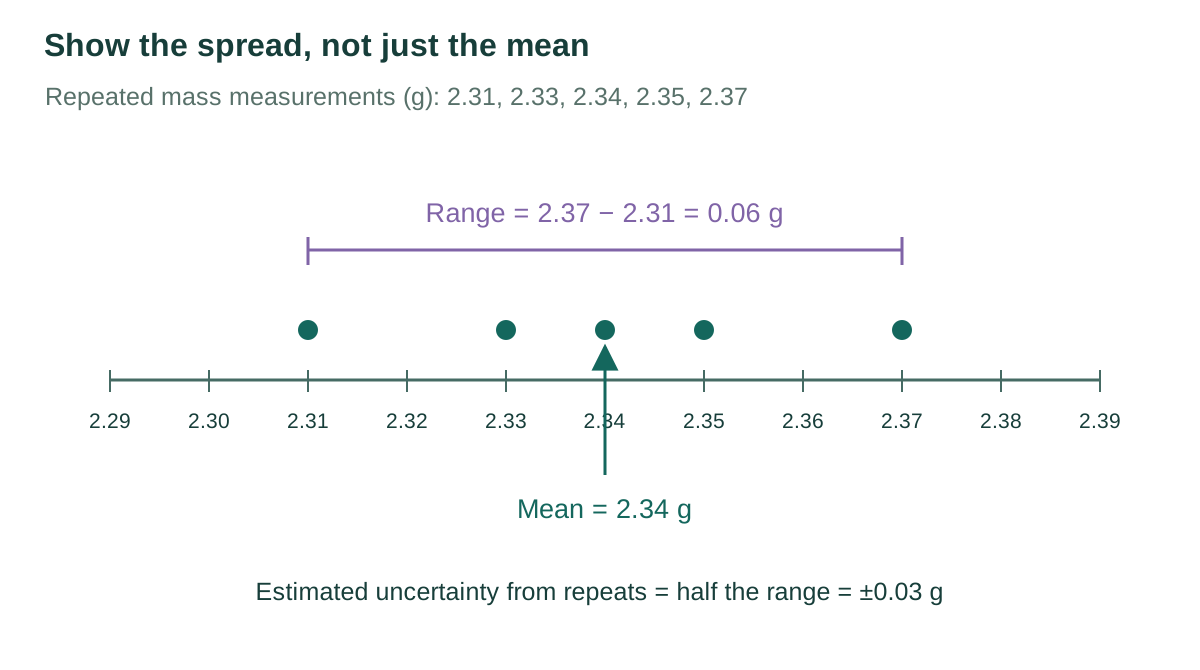
Plot individual readings or use a suitable chart to show their distribution. A smaller spread usually indicates more repeatable measurements. Investigate an unusual result: record the reason if a known method error justifies exclusion. Do not remove a result simply because it does not fit your prediction.
Improve a mass experiment by using a suitable balance, checking its zero, keeping all material on the balance, avoiding spills and allowing hot apparatus to cool before weighing. Repeat the procedure and compare like-for-like measurements.
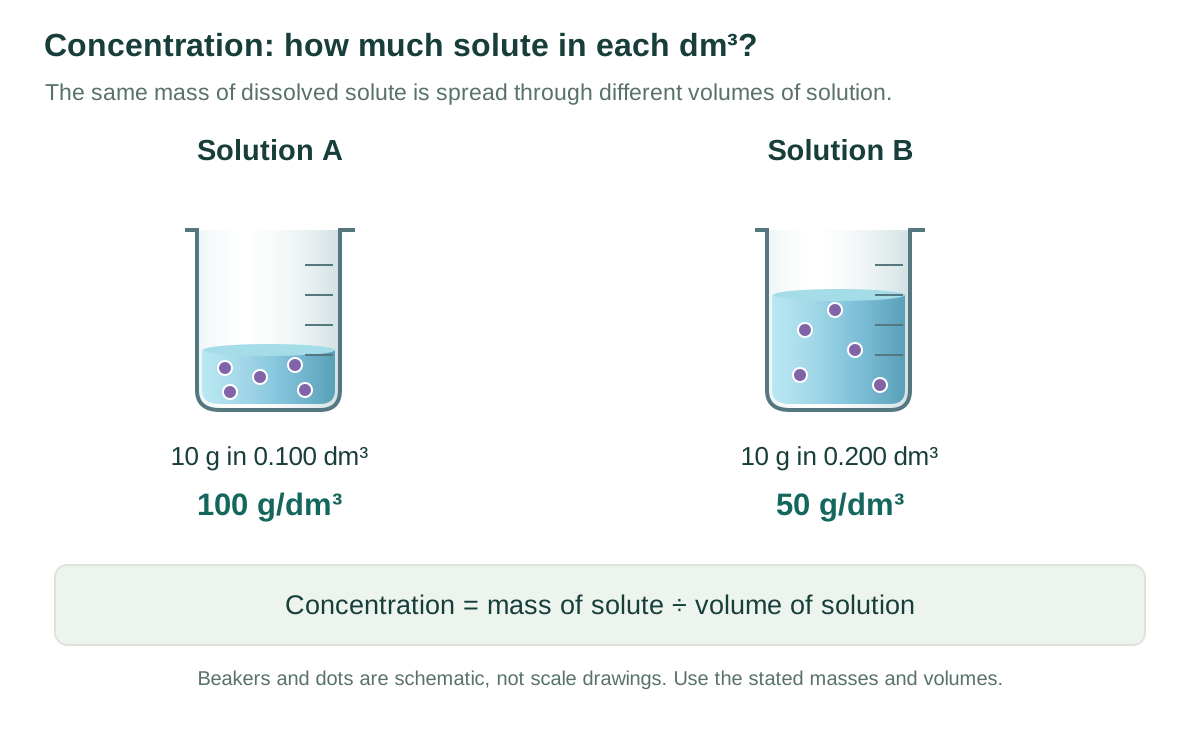
A solute is the substance dissolved. A solvent does the dissolving. Together they form a solution. Concentration in g/dm³ tells you how many grams of solute are in each cubic decimetre of solution.
1 dm³ = 1000 cm³ = 1 litre. To change cm³ to dm³, divide by 1000. For example, 250 cm³ = 0.250 dm³.
Mass of solute (g) = concentration (g/dm³) × volume of solution (dm³).
The volume is the final solution volume, not simply the volume of water poured in. To make a stated volume, dissolve the weighed solute in some water, transfer it without losses, then add water until the final solution reaches the required volume and mix.
Concentration = mass ÷ volume. Rearrange to volume = mass ÷ concentration. With g and g/dm³, the volume is in dm³.
Higher only. A mole is a fixed number of particles, rather like a dozen is 12. One mole contains 6.02 × 10²³ stated particles. This number is the Avogadro constant. Always say what you are counting: atoms, molecules, ions or electrons.
One mole of carbon atoms and one mole of carbon dioxide molecules contain the same number of those particles. A mole of CO₂ molecules contains three times as many atoms in total, because each molecule contains three atoms.
The mass of one mole in grams is numerically equal to Mᵣ (or Aᵣ for individual atoms). Thus one mole of CO₂ has mass 44 g.
Amount (mol) = mass (g) ÷ mass of one mole (g/mol).
Mass (g) = amount (mol) × mass of one mole (g/mol).
Keep extra digits during a calculation; round at the end to the requested significant figures. 0.250 has three significant figures; its leading zero is not significant.
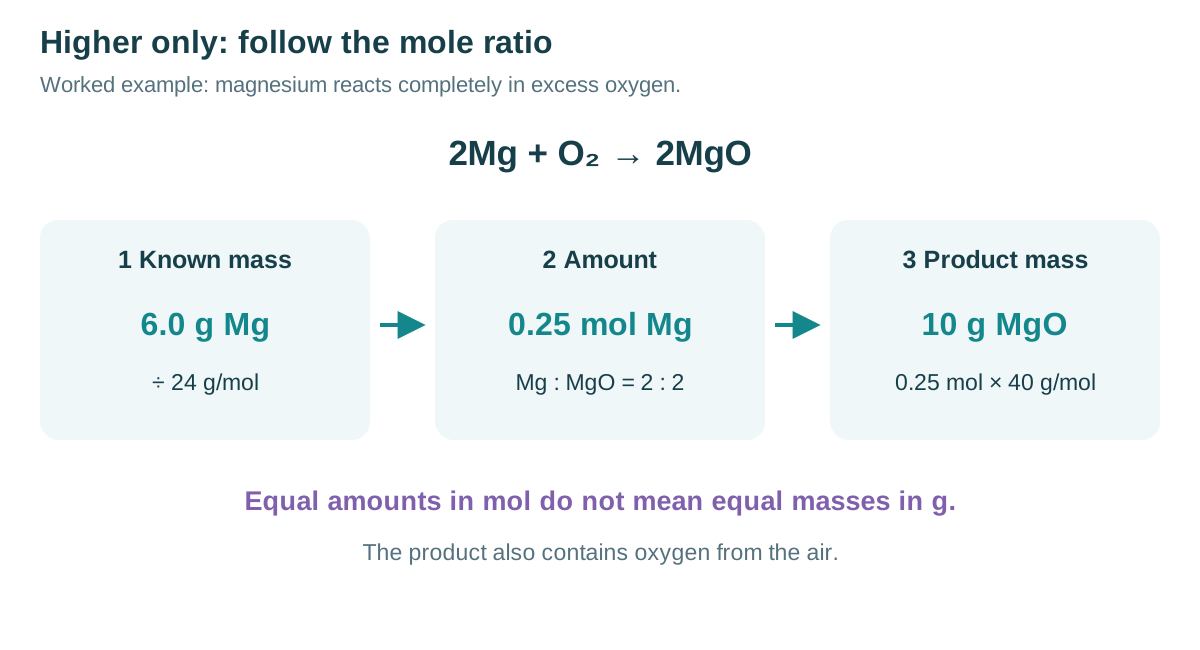
Higher only. The coefficients in a balanced equation give a mole ratio, not a mass ratio. In 2Mg + O₂ → 2MgO, two moles of Mg react with one mole of O₂ to form two moles of MgO.
Check the result: the product has gained 4 g oxygen, so it is reasonable that its mass is greater than the starting metal mass.
Higher only. Experimental masses can reveal the balancing numbers. Convert each mass to moles, divide all amounts by the smallest, then express the ratio as the simplest whole numbers.
Do not use the gram values directly as coefficients. Different substances have different masses per mole. After calculating a ratio, check that each atom is balanced.
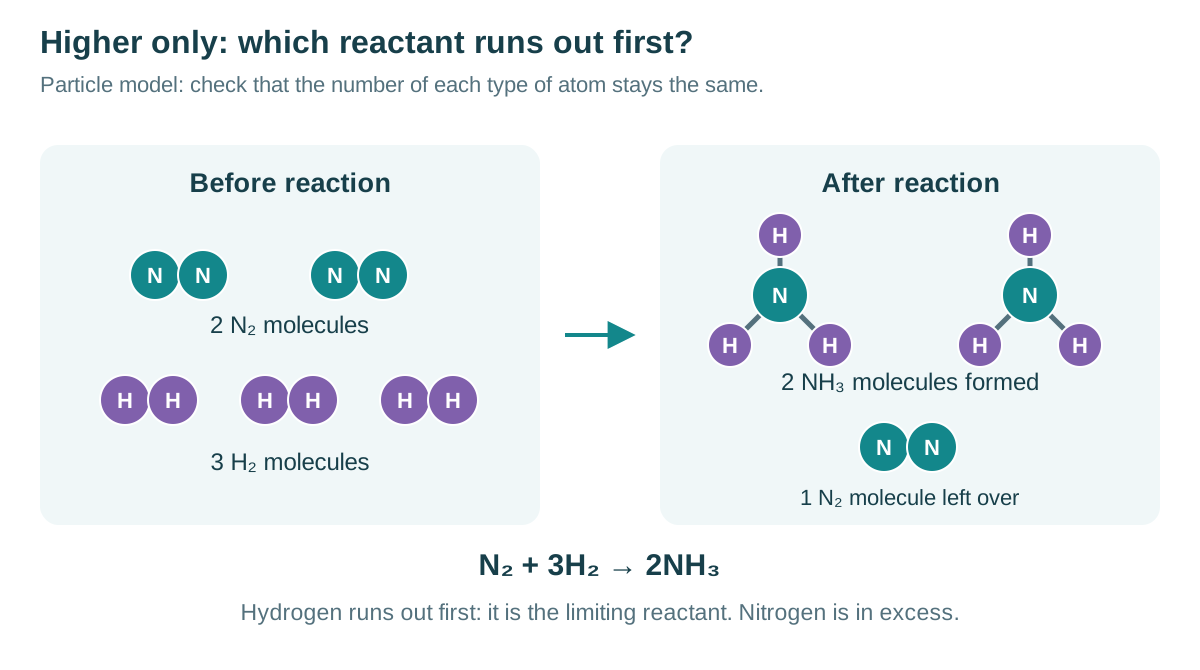
Higher only. A reaction can only continue while all necessary reactants remain. The limiting reactant is used up first and sets the maximum amount of product. Another reactant may be in excess, meaning some remains unused.
To compare given masses, convert both to moles before applying the ratio. Adding more of the excess reactant will not increase product after the limiting reactant has been used up.
Higher only. For a fixed solution volume, increasing the dissolved mass increases concentration. For a fixed dissolved mass, increasing solution volume decreases concentration because the same solute is spread through more solution.
There is no separate required practical in this topic. Its measurement and calculation skills support practicals throughout chemistry. This Trilogy worksheet does not require percentage yield, atom economy, molar gas volumes or mol/dm³ titration calculations.
Start with the 36 main questions. Higher-only questions are labelled. You can complete this topic over several sessions; your answers save as you go. Use a hint if you get stuck, then compare your work with an example answer. Your tutor can mark written answers.
Use the illustration to explain where the missing 1.4 g went in the open system. Then plan two improvements that would make the comparison more reliable. This is a measurement-skills activity, not an additional required practical.
The 1.4 g is gas that escaped into the air; atoms have not disappeared. The gas-retaining apparatus retains the gas so its mass is unchanged. Use the same zeroed balance, weigh complete apparatus before and after mixing, prevent spills, compare at the same temperature and repeat to calculate a mean and range. Only use teacher-approved gas-containing equipment.
When connected with your pupil code, your answers save online for Kevin to see. Click Submit to Kevin when you have finished. Downloads are optional.
Connect with your pupil code above to submit.
Use a scientific idea and a specific example in your reflection.