Magnetism and electromagnetism
Work through one section at a time. Higher-only material is labelled explicitly; optional challenges can also use Foundation content.
 GCSE PHYSICS · AQA TRILOGYTutor dashboardSaves on this device
Your answers save automatically as you work.
Saved in this browser on this device.
Why does a compass turn, how can a coil lift steel, and what makes an electric motor spin? Follow the fields, test the evidence and build clear explanations.
Supported GCSE version · Clear examples, worked calculations and optional challenges.
Work through one section at a time. Higher-only material is labelled explicitly; optional challenges can also use Foundation content.
An end of a magnet where its magnetic force is strongest.
A magnet that produces its own magnetic field and retains its magnetism.
A material that becomes magnetised in another magnetic field.
A region where a magnet or magnetic material experiences a magnetic force.
A field with the same strength and direction throughout a region.
A long coil of wire that produces a magnetic field when current flows.
A solenoid with an iron core; its magnetism can be controlled by the current.
The direction positive charge would flow; opposite to electron flow in a wire.
The force produced when a current-carrying conductor is in a magnetic field. Higher-only here.
A measure of magnetic field strength, symbol B, measured in tesla. Higher-only here.
At right angles: an angle of 90°.
The effect of a force that makes an object rotate about an axis.
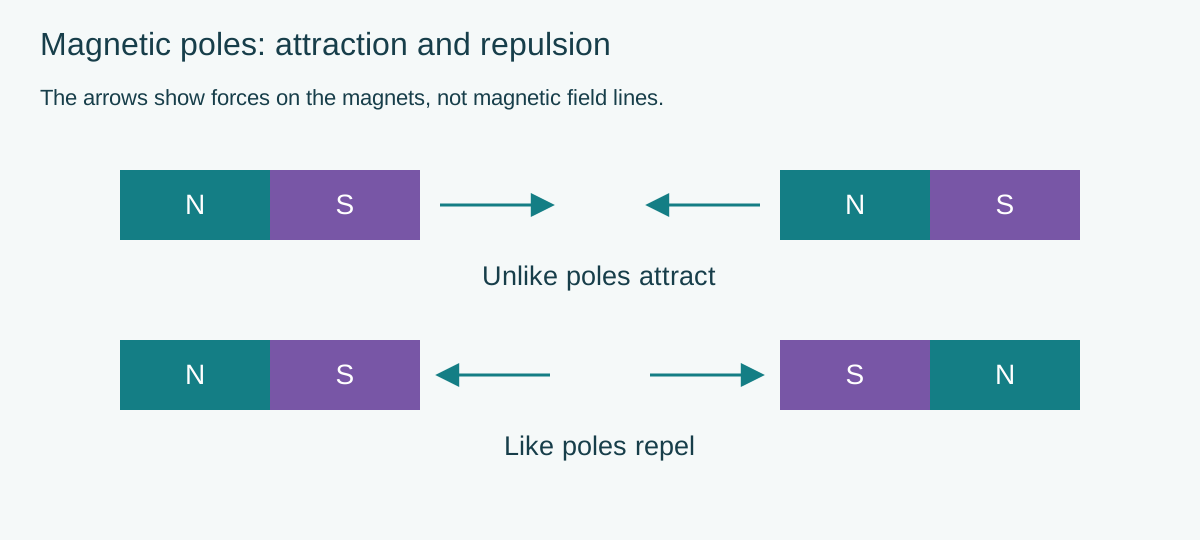
A magnet can pull or push another magnet without touching it. This is a non-contact force. The strongest forces act near its two ends, called poles.
| Poles facing each other | What happens? |
|---|---|
| North and south | Attract: pull together |
| North and north, or south and south | Repel: push apart |
| Permanent magnet | Induced magnet |
|---|---|
| Produces its own magnetic field. | Becomes magnetised when placed in another magnetic field. |
| Keeps its magnetism after the other magnet is removed. | Usually loses most or all of its magnetism quickly when the field is removed. |
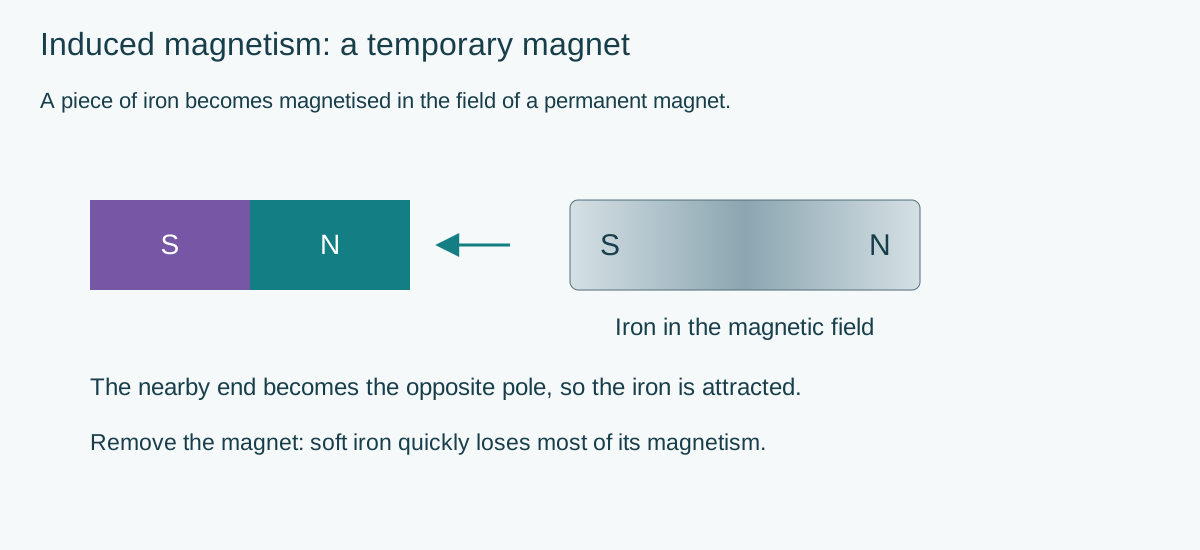
Magnetic materials include iron, steel, cobalt and nickel. Not all metals are magnetic: aluminium and copper are not attracted strongly by an ordinary school magnet.
A magnetic field is a region where a magnet or magnetic material experiences a magnetic force. Field lines are a model: there are no visible lines floating in the air.
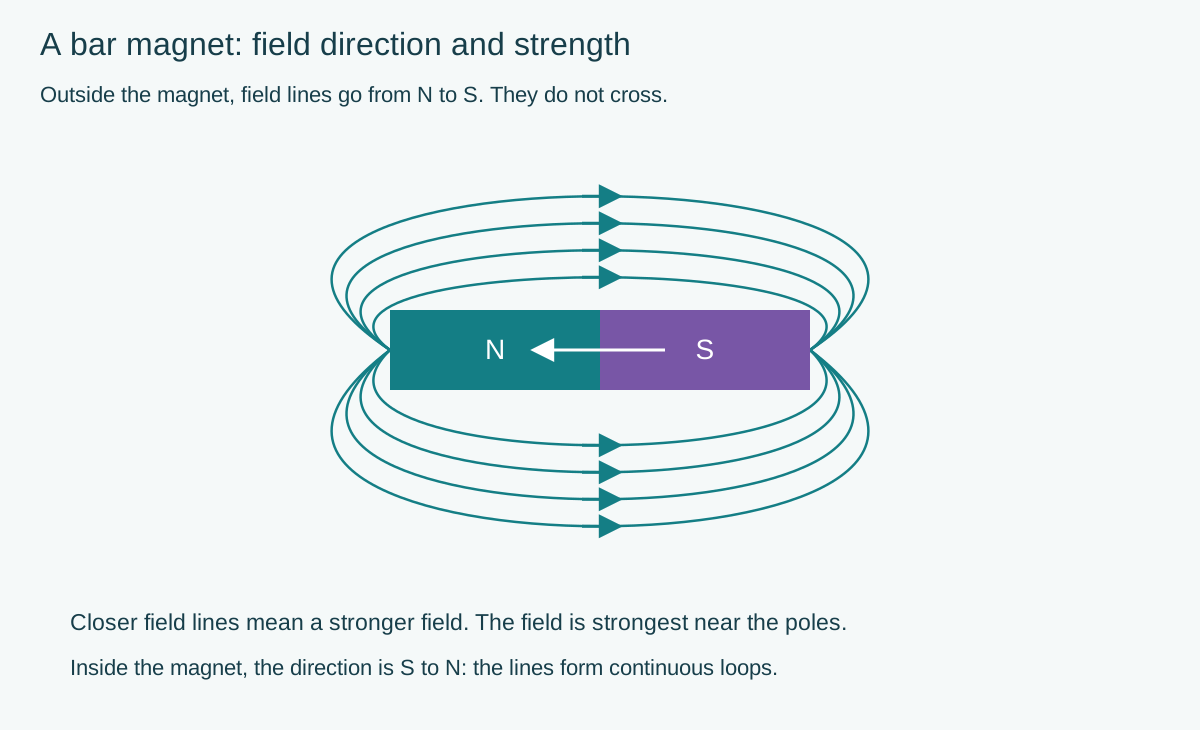
A compass needle is a tiny bar magnet. Its north-seeking end points along the magnetic field at its position.
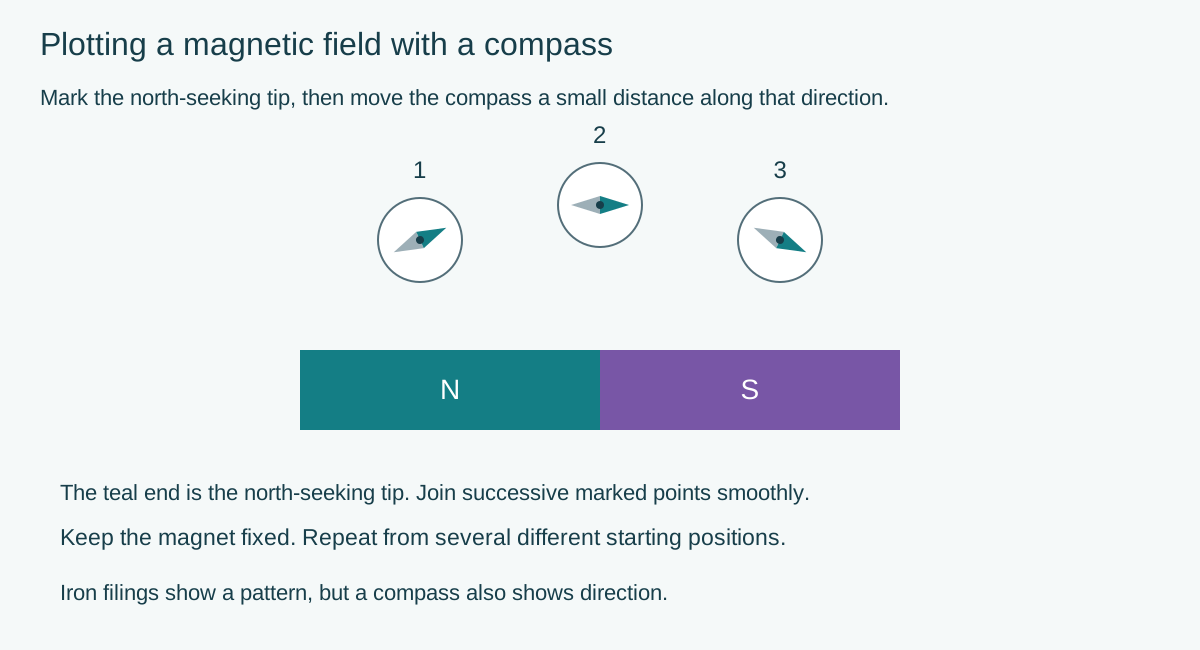
Earth also has a magnetic field. A compass aligning even when no bar magnet is nearby is evidence for this field and a magnetic source within Earth’s core. The core is not a simple solid bar magnet.
A current in a wire produces a magnetic field around it. Place a compass near a wire and switch a low-voltage current on: the needle turns. Reverse the current and its deflection reverses.
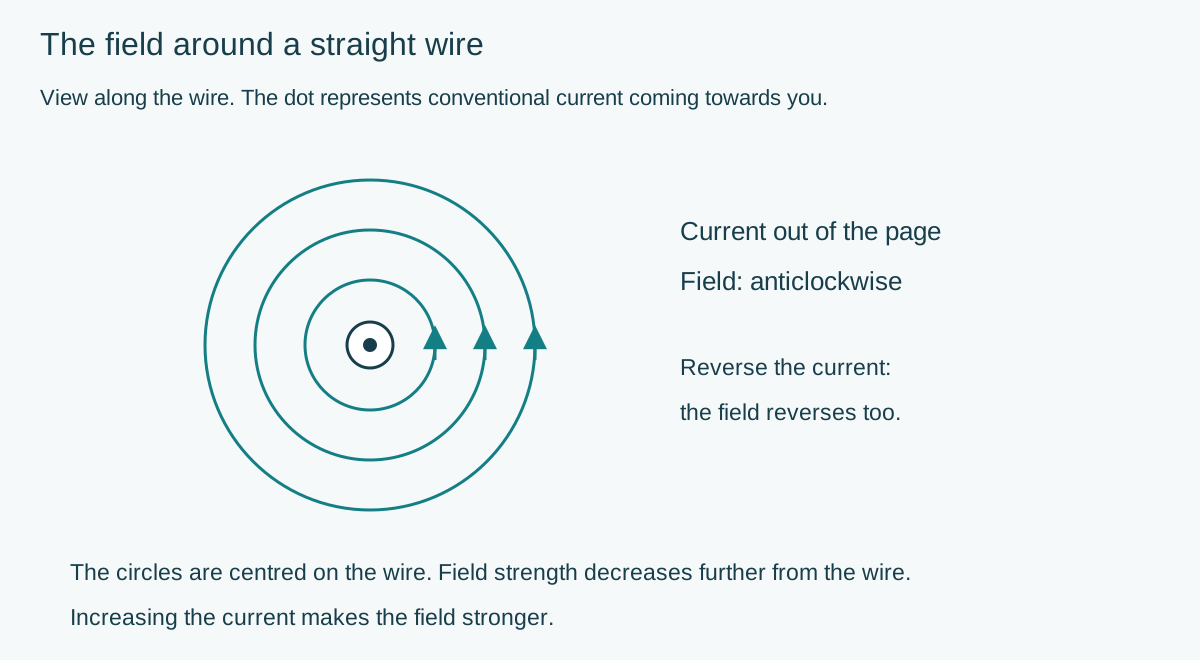
| Change | Effect |
|---|---|
| Increase the current | Stronger field |
| Move further from the wire | Weaker field |
| Reverse the current | Reverse the field direction |
A solenoid is a long coil of wire. The fields from its turns add together. Inside a long solenoid, the field is strong and approximately uniform: it has similar strength and direction across that region.
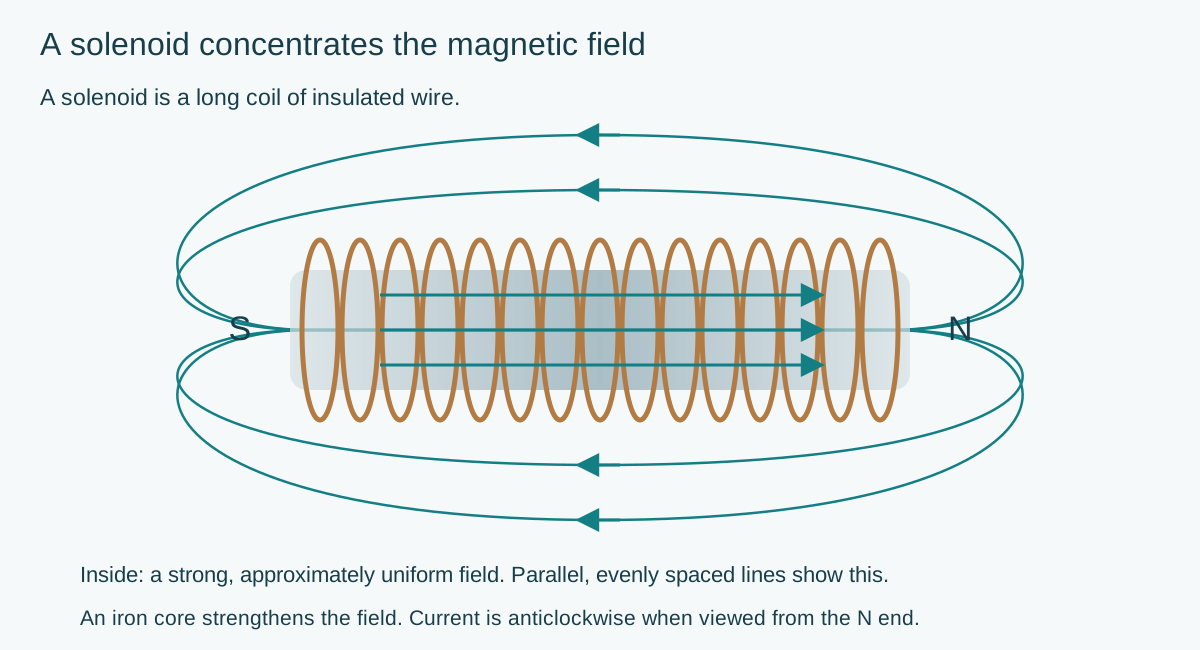
An electromagnet is a solenoid with an iron core. It can be switched on and off, for example to lift and release steel in a scrapyard.
Paper clips give a simple way to compare lifting strength. They do not directly measure magnetic flux density in tesla.
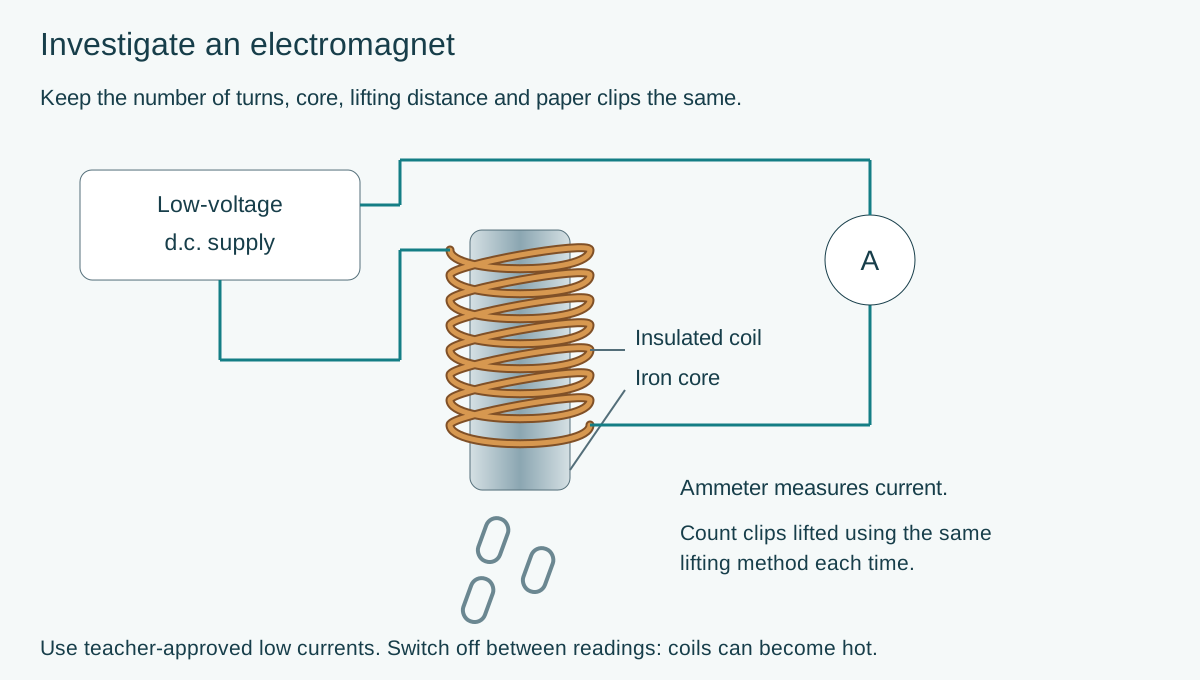
| Variable | Example |
|---|---|
| Change | Current through the coil |
| Measure | Number of identical clips lifted |
| Keep the same | Core, turns, lifting height and clip type |
| Improve reliability | Repeat each current and calculate a mean |
Switch off between readings and keep within the teacher-approved current limit: the coil can get hot. Compare results over the tested range; do not assume that twice the current always lifts exactly twice as many clips.
A current-carrying wire in a magnetic field experiences a force. The magnet experiences an opposite force too. This interaction is the motor effect.
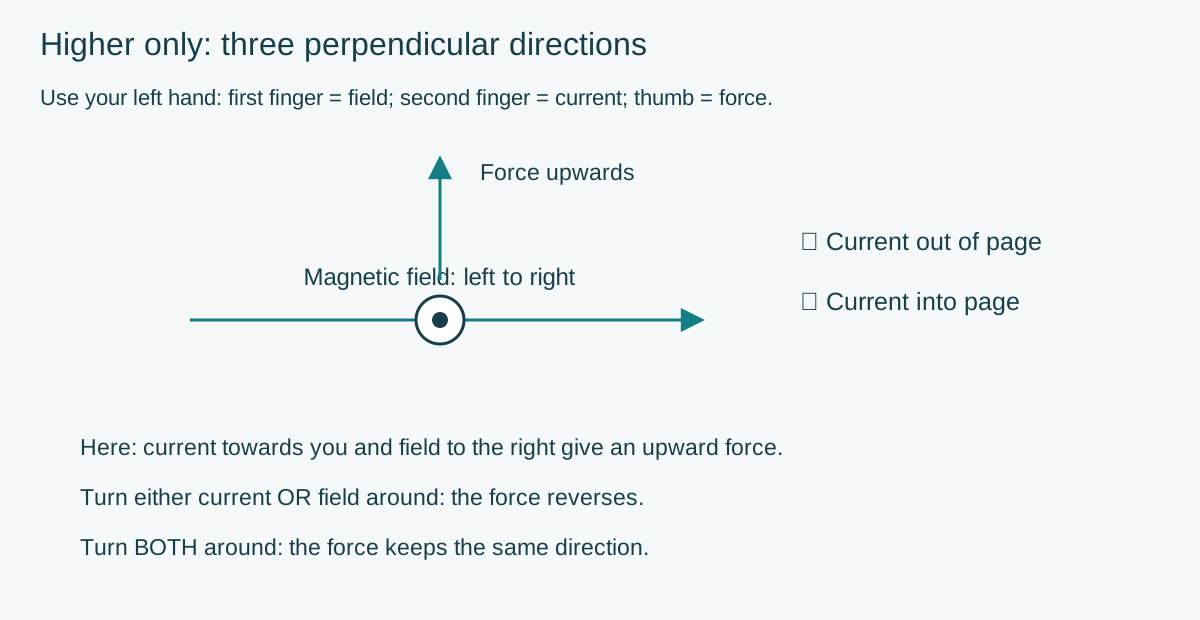
| Left-hand digit | What it represents |
|---|---|
| First finger | Magnetic field, N to S |
| Second finger | Conventional current, positive to negative |
| Thumb | Force or movement |
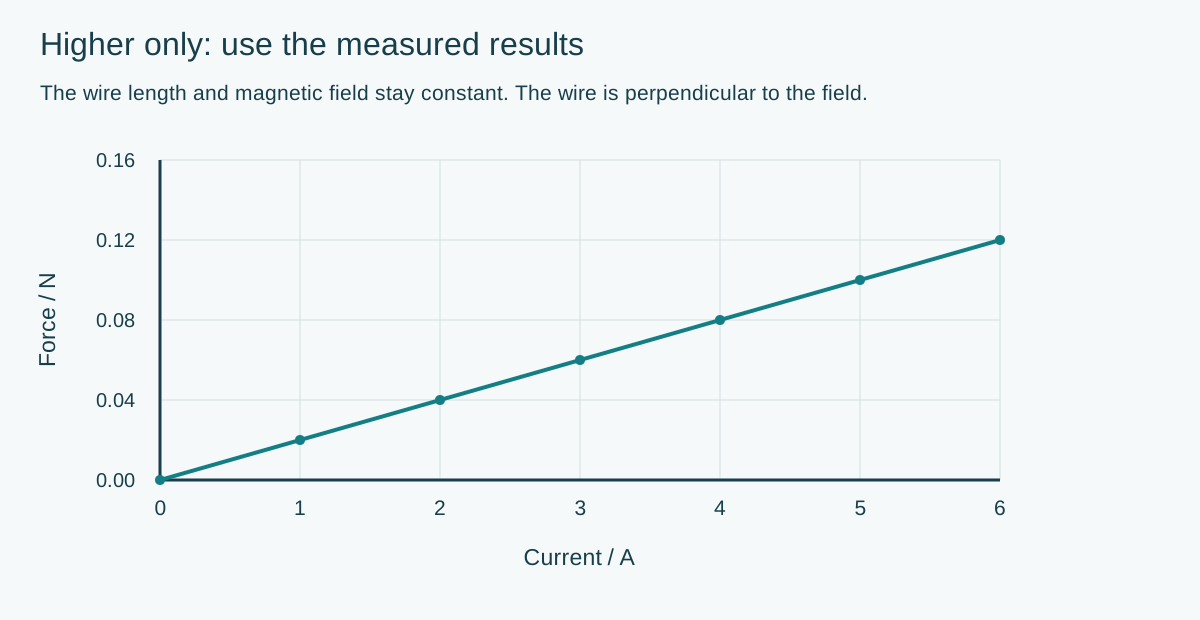
Hold the three digits at right angles. A stronger field, larger current or longer wire within the field gives a larger force. The force is greatest when the current is perpendicular to the field; a wire parallel to the field has no motor-effect force.
| Quantity | Unit |
|---|---|
| Force F | newton, N |
| Magnetic flux density B (field strength) | tesla, T |
| Current I | ampere, A |
| Length of wire in the field l | metre, m |
Rearrange for another quantity: B = F ÷ (I × l), I = F ÷ (B × l), or l = F ÷ (B × I). Only count the wire length actually inside the field.
A rectangular coil has opposite current directions in its two opposite sides. In the same magnetic field, these sides experience forces in opposite directions.
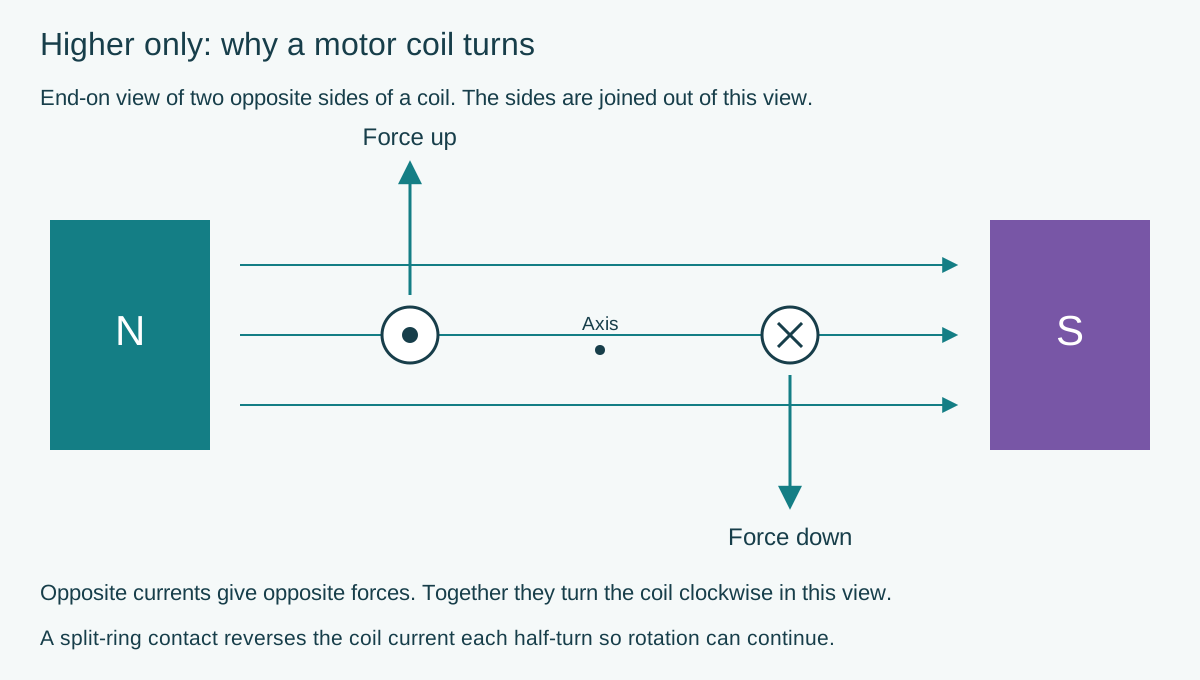
A split-ring contact reverses current in the coil every half-turn. The forces on the two physical sides reverse at the right time, maintaining rotation in one direction. Brushes maintain electrical contact with the rotating ring.
Start with the 30 main questions. Higher-only questions are labelled. You can complete this topic over several sessions; your answers save as you go. Use a hint if you get stuck, then compare your work with an example answer. Your tutor can mark written answers.
A student holds an electromagnet above an iron object and measures the attraction with a force sensor. Current and coil turns stay constant.
| Gap / mm | Force / N |
|---|---|
| 2 | 0.80 |
| 4 | 0.45 |
| 6 | 0.28 |
| 8 | 0.18 |
Attraction decreases as the gap increases. Decrease = 0.80 − 0.18 = 0.62 N. Keep current constant because it affects field strength. Repeat readings at each distance and calculate means to assess variation.
Use the answer boxes for written explanations; these drawing tasks are completed on paper.
When connected with your pupil code, your answers save online for Kevin to see. Click Submit to Kevin when you have finished. Downloads are optional.
Connect with your pupil code above to submit.
Use a scientific idea and a specific example in your reflection.