Energy
Work through one section at a time. Higher-only material is labelled explicitly; optional challenges can also use Foundation content.
 GCSE PHYSICS · AQA TRILOGYTutor dashboardSaves on this device
Your answers save automatically as you work.
Saved in this browser on this device.
Follow energy as it changes stores, calculate the amounts transferred and evaluate the resources we use.
Supported GCSE version · Clear examples, worked calculations and optional challenges.
Work through one section at a time. Higher-only material is labelled explicitly; optional challenges can also use Foundation content.
The object or group of objects chosen for study.
A way energy is held, such as kinetic or chemical.
How energy moves between stores: mechanically, electrically, by heating or radiation.
Energy transferred by a force or by an electric current.
Energy associated with movement.
The increase in length from an elastic object’s original length.
Energy needed to raise 1 kg of a material by 1 °C.
Energy transferred, or work done, each second.
A system across whose boundary no energy is transferred.
Energy spreading into less useful stores, often thermal stores of the surroundings.
The fraction of total input transferred usefully.
A property used to compare how readily materials transfer energy by conduction.
An energy resource replenished on human timescales as it is used.
A supply available when needed; predictability and controllability both matter.
A system is the object or group of objects we choose to study. For a falling ball, we might study the ball and Earth together. Energy is measured in joules (J). It can be stored in different ways and transferred between stores.
| Store | Example |
|---|---|
| Kinetic | A moving bicycle |
| Thermal | Hot water; particles have energy associated with their motion and interactions |
| Chemical | Fuel, food or a battery |
| Gravitational potential | A raised object in a gravitational field |
| Elastic potential | A stretched spring or compressed elastic object |
| Magnetic | Two magnets arranged so that they can move when released |
| Electrostatic | Separated electric charges |
| Nuclear | Atomic nuclei |
Energy moves between stores mechanically (a force does work), electrically (a current flows), by heating or by radiation, such as light or infrared. Sound can also carry energy away through waves.
Work done is energy transferred. For a constant force acting along a displacement, W = F × s (J = N × m). Electrical energy can be found using E = P × t, or E = V × I × t when voltage and current are measured. These links are developed further in Forces and Electricity.
A falling object loses 120 J from its gravitational potential store. Its kinetic store gains 100 J. The remaining 20 J is transferred to thermal stores of the air and object. The total is still 120 J. A bar representing 120 J must equal bars representing 100 J and 20 J combined.
Ek = ½mv², where Ek is kinetic energy in J, mass m is in kg and speed v is in m/s. Square the speed before multiplying. Convert grams to kilograms by dividing by 1,000.
A 500 g trolley moves at 4.0 m/s. Mass = 0.500 kg. Ek = 0.5 × 0.500 × 4.0² = 4.0 J.
For the same speed, doubling mass doubles kinetic energy. For the same mass, doubling speed multiplies kinetic energy by four, because speed is squared. A faster vehicle therefore needs to transfer much more energy when stopping.
Raising a mass transfers energy to its gravitational potential store: Ep = mgh. Use mass in kg, gravitational field strength g in N/kg and vertical height h in m. Use the value of g given in the question.
A 3.0 kg box rises 2.0 m where g = 9.8 N/kg. Ep = 3.0 × 9.8 × 2.0 = 58.8 J. If it falls back with negligible air resistance, this can become kinetic energy.
A spring stores elastic potential energy when stretched or compressed: Ee = ½ke². Spring constant k is in N/m; extension e is in m. Extension is the change from original length, not the whole stretched length. This equation assumes the limit of proportionality has not been exceeded.
A spring with k = 200 N/m extends 5.0 cm. First convert: e = 0.050 m. Ee = 0.5 × 200 × 0.050² = 0.25 J. Doubling the extension would give four times the stored energy, if the spring remains within its proportional range.
Useful rearrangements: h = Ep ÷ (mg); e = √(2Ee ÷ k).
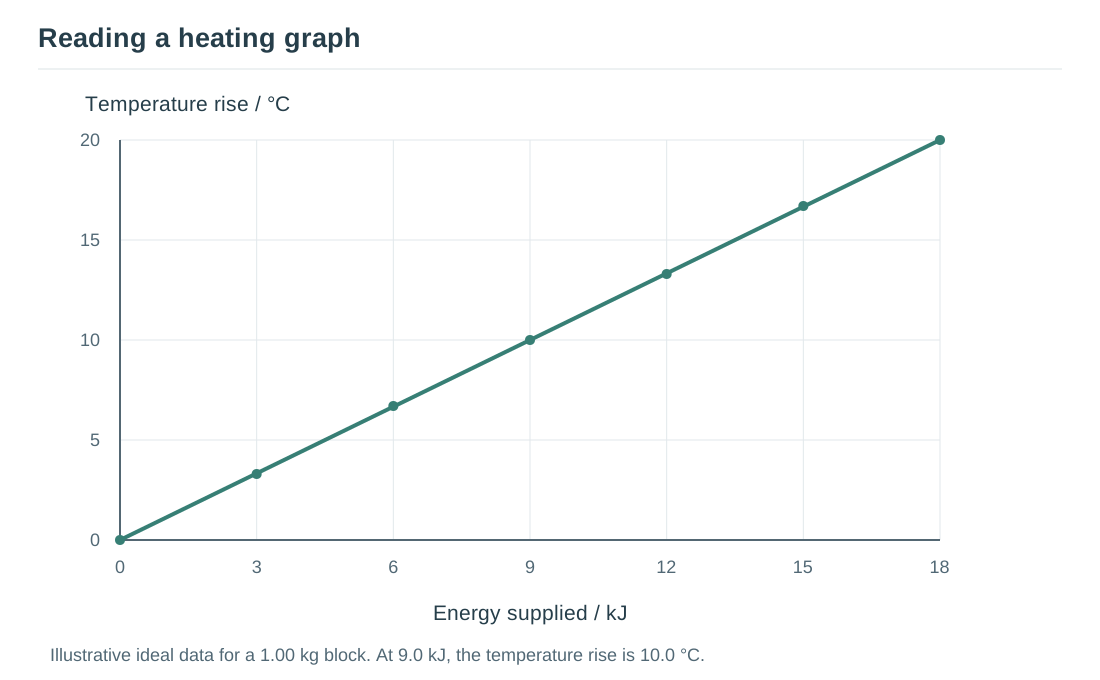
When a material changes temperature without changing state, its thermal energy change can be calculated using ΔE = mcΔθ. The symbol Δ means “change”. Temperature rise = final temperature − initial temperature.
Specific heat capacity tells us how much energy is needed to raise the temperature of 1 kg of a material by 1 °C. A larger c means that the same energy input produces a smaller temperature rise for the same mass.
Heat 0.50 kg of water from 20 °C to 35 °C. Use c = 4,200 J/(kg °C). Δθ = 15 °C. ΔE = 0.50 × 4,200 × 15 = 31,500 J = 31.5 kJ. This is the water’s energy gain; a real heater may supply more because the container and surroundings also gain energy.
Rearrange to c = ΔE ÷ (mΔθ), or Δθ = ΔE ÷ (mc). This equation should not be used alone to calculate energy for melting or boiling at constant temperature.
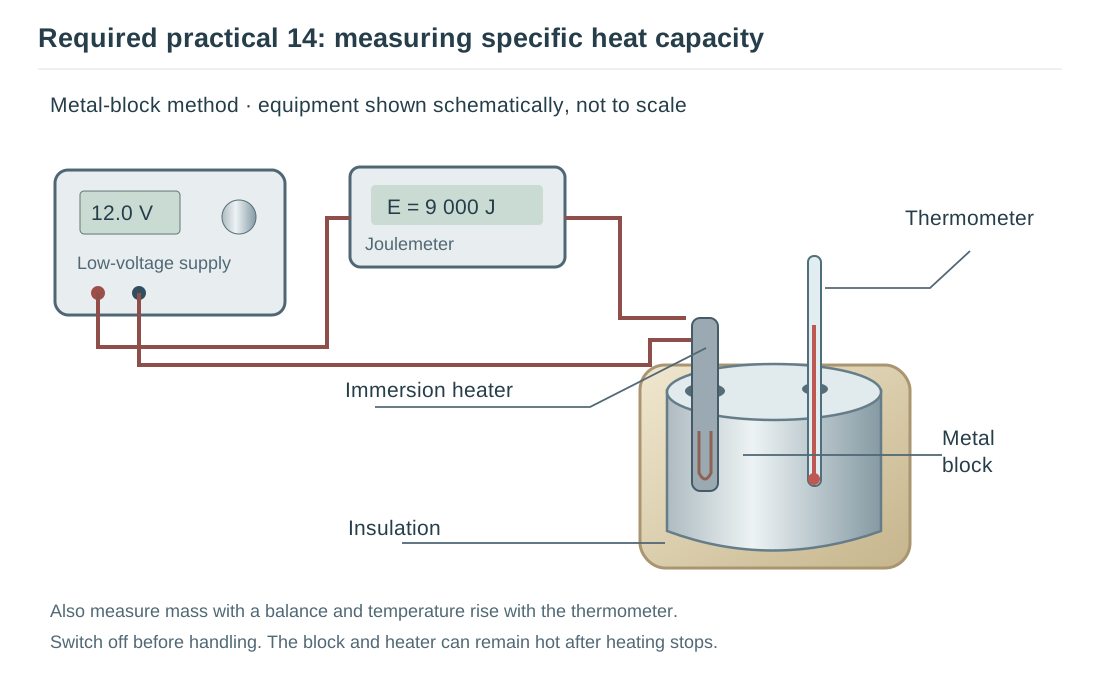
Improve the measurement: insulation reduces energy transferred to the room; good contact helps the thermometer represent the block temperature. Wait for readings to stabilise where appropriate. Some supplied energy warms the heater, thermometer and insulation, so not all of it enters the block. Heat loss often makes the calculated c too high if all input energy is assumed to warm the block.
Safety: use the school’s low-voltage equipment and instructions. Hot blocks and heaters can burn skin; switch off and allow them to cool before handling. Keep liquids away from electrical connections.
Power is energy transferred per second, or work done per second. P = E/t and P = W/t. Power is in watts (W), energy/work in joules (J), and time in seconds (s). One watt means one joule per second.
Two motors can lift the same load through the same height and do the same work. The motor that does it in less time has the greater useful power. A higher-power appliance does not automatically use more total energy: operating time matters.
A 1.5 kW heater operates for 2.0 minutes. P = 1,500 W and t = 120 s. E = Pt = 1,500 × 120 = 180,000 J. To find time instead, use t = E/P.
Energy is conserved: it cannot be created or destroyed. In a closed system, no energy enters or leaves, so its total remains constant even when energy changes store. Choose the boundary carefully: a cooling cup alone loses energy, but the cup and its surroundings together can be treated as a larger system.
Dissipation means energy spreads into less useful stores, often thermal energy in the surroundings. “Wasted” energy has not disappeared; it is simply less useful for the intended task.
Efficiency = useful energy output ÷ total energy input. Alternatively use useful power output ÷ total power input. A decimal of 0.75 means 75%; multiply by 100 to convert to a percentage. Efficiency cannot exceed 1 (100%).
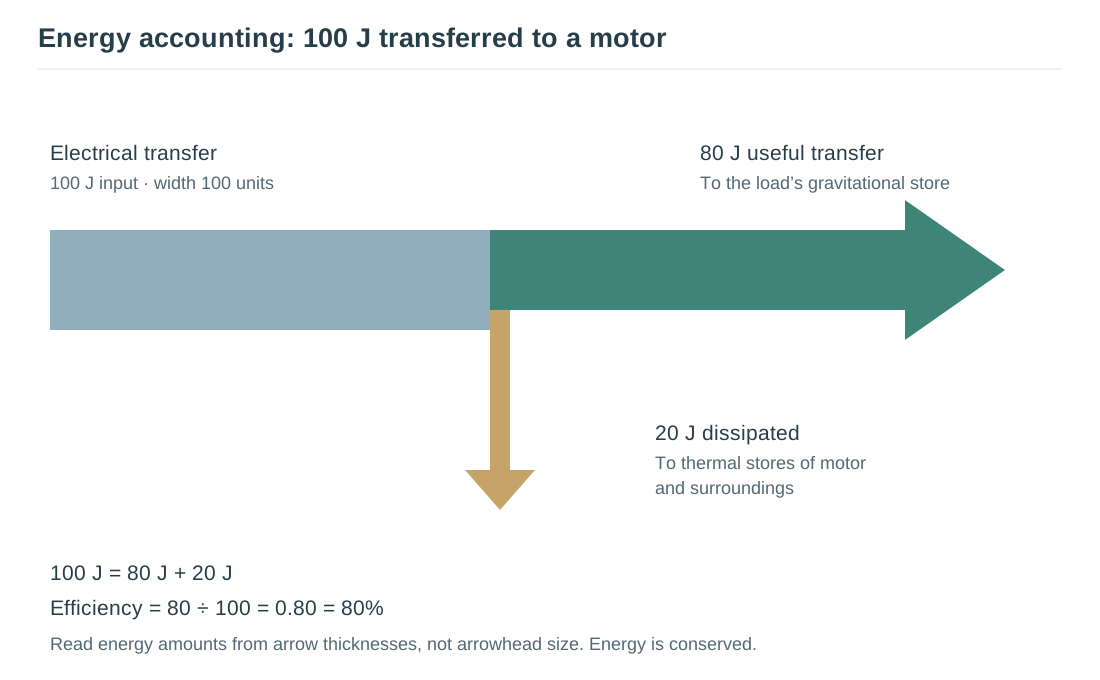
A motor takes 250 W electrically and transfers 180 W usefully. Efficiency = 180 ÷ 250 = 0.72 = 72%. Unwanted output = 250 − 180 = 70 W.
Identify the unwanted pathway, then explain the change. Lubricating moving parts reduces frictional heating, leaving a larger fraction of input available for useful mechanical work. Insulating a hot-water tank reduces transfer to the room, so a larger fraction of the supplied energy remains useful in the water. Compare useful output with total input; reducing input alone does not prove efficiency improved.
Lubrication reduces friction between moving surfaces and so reduces unwanted energy transfer to thermal stores. Thermal insulation reduces unwanted energy transfer from a hotter object to colder surroundings.
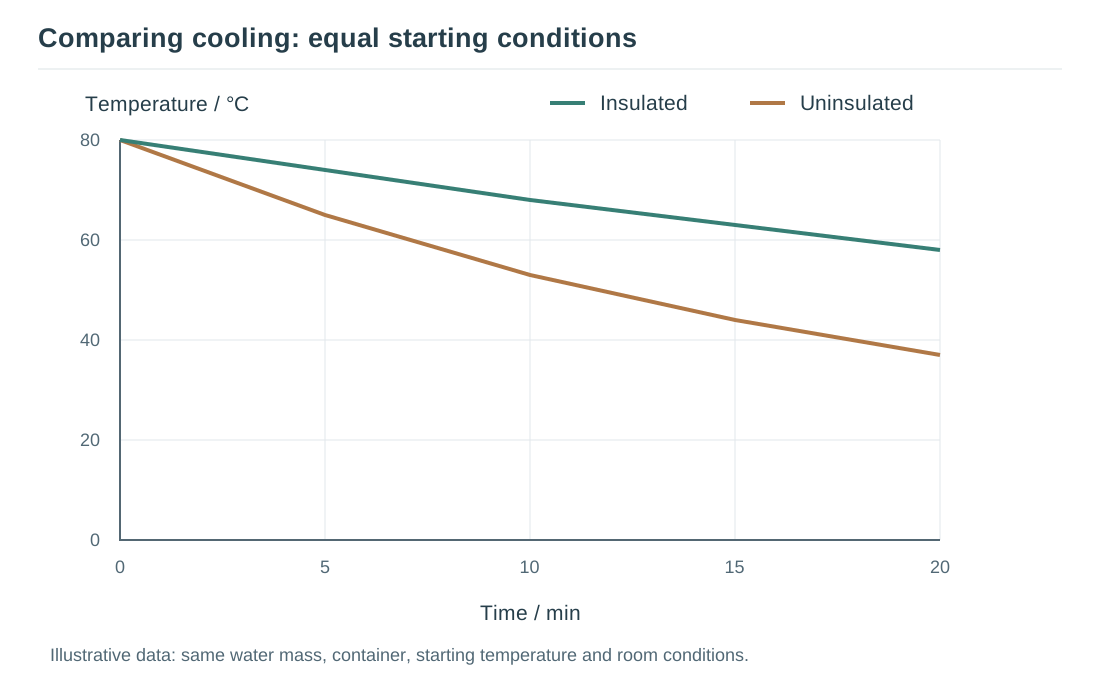
A material with higher thermal conductivity transfers energy by conduction more rapidly under the same conditions. For a wall of the same material and area, increasing thickness reduces the rate of transfer. For walls of equal thickness, lower conductivity reduces transfer. Insulation slows cooling; it does not supply energy or stop all transfer.
To compare insulation fairly, keep water mass, starting temperature, container dimensions, surrounding temperature and measurement times the same. Change only the insulation being investigated. Use repeated measurements, calculate means and consider unusual results.
An energy resource is a source that people use for heating, transport or generating electricity. Renewable resources are replenished on human timescales as they are used. Non-renewable resources have finite reserves and are not replaced quickly enough.
| Resource | Uses and reliability | Important impacts or limits |
|---|---|---|
| Coal, oil and natural gas — non-renewable | Fuel for heating, transport and electricity; can be stored and used when needed. | Burning releases carbon dioxide. Extraction damages habitats; some fuels also release harmful pollutants. |
| Nuclear fuel — non-renewable | Produces steady electricity; output is less flexible than some gas plants. | Low operational carbon emissions, but radioactive waste needs long-term management; construction and decommissioning are costly. |
| Biofuel — renewable when crops are replaced sustainably | Can fuel transport, heating and generators; stored fuel can be used on demand. | Growing crops uses land, possibly competing with food or habitats. Burning emits carbon dioxide; production and transport also have impacts. |
| Wind — renewable | Generates electricity when wind speed is suitable. | Variable output; visual/noise impacts and effects on some wildlife. No fuel burning during generation. |
| Sun — renewable | Solar cells generate electricity; solar heating warms water. | Output depends on daylight and cloud; manufacturing and land use have impacts. |
| Hydroelectricity — renewable | Water released from a reservoir drives turbines; can respond quickly if sufficient water is stored. | Dams flood land and affect river ecosystems. Drought can reduce available water. |
| Tides — renewable | Predictable periodic electricity production. | Not continuous; suitable sites are limited and coastal ecosystems may be affected. |
| Water waves — renewable | Waves drive generators; output depends on sea conditions. | Equipment must withstand storms; effects on marine use and habitats must be considered. |
| Geothermal — renewable | Earth’s internal thermal energy provides heating and, at suitable sites, electricity; often steady. | Useful high-temperature sites are geographically limited; drilling is costly. |
Renewable does not mean reliable every minute, and no energy resource has zero environmental impact. A varied supply, storage, interconnections and demand management can help balance variable output. Detailed construction of power stations is not required in this topic.
Read the date, location, units and source before comparing national or global energy-use data. A percentage share can fall even while the total energy from a resource rises, if overall demand grows faster. Historical trends do not prove that the same trend must continue.
For a fair comparison, consider reliability, total energy available, cost, location, environmental effects and the intended use. A school’s heating choice and a country’s electricity supply need different evidence.
Science can measure emissions and model their effects, but decisions also depend on money, politics, jobs, land ownership, public acceptance and ethical choices. Explain which evidence supports a recommendation and acknowledge its disadvantages.
In an invented region, renewable electricity rises from 20 TWh out of 100 TWh to 45 TWh out of 150 TWh. The renewable share rises from 20% to 30%. Renewable output increases by 25 TWh, not by 10 TWh. The ten-percentage-point change describes the share.
Start with the 35 main questions. Higher-only questions are labelled. You can complete this topic over several sessions; your answers save as you go. Use a hint if you get stuck, then compare your work with an example answer. Your tutor can mark written answers.
A 0.80 kg metal block receives 7,200 J. Its temperature rises from 21 °C to 31 °C. A second group uses the same metal but leaves the insulation off.
Δθ = 10 °C. c = 7,200/(0.80 × 10) = 900 J/(kg °C). Without insulation, more energy heats the surroundings. If all electrical energy is treated as energy gained by the block, the calculated c is too high. Switch off and let the heater/block cool before handling.
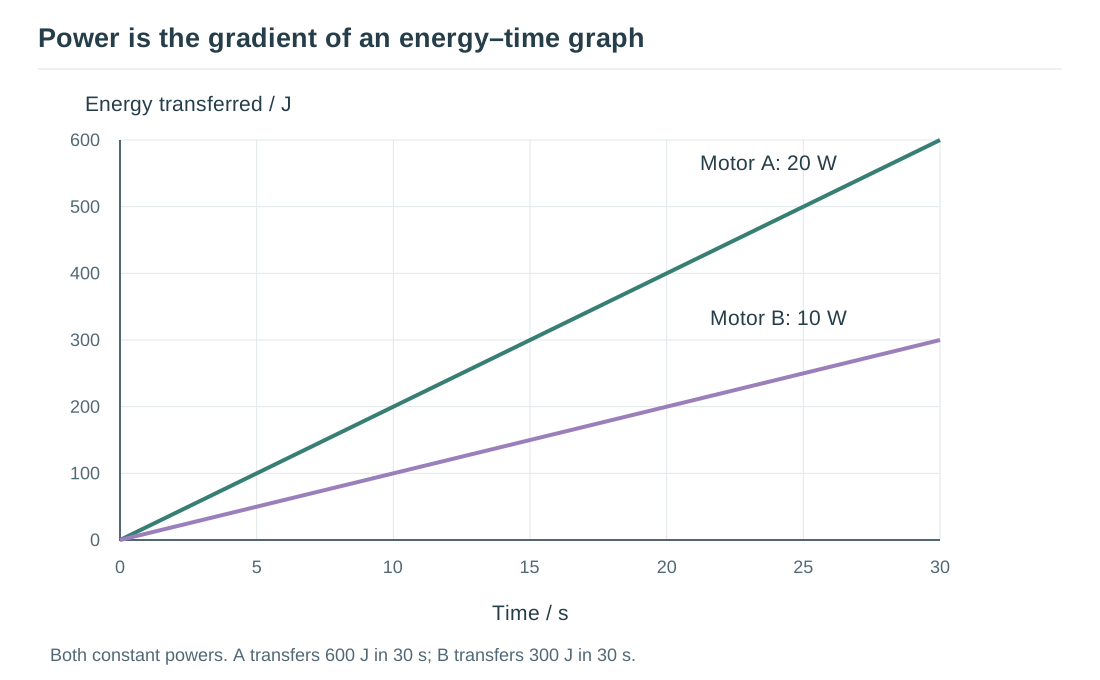
At 30 s, A has transferred 600 J and B has transferred 300 J. Which motor has greater power? How long would B take to transfer 600 J at the same constant power?
A: 600/30 = 20 W. B: 300/30 = 10 W. A has twice the power. B needs t = 600/10 = 60 s.
When connected with your pupil code, your answers save online for Kevin to see. Click Submit to Kevin when you have finished. Downloads are optional.
Connect with your pupil code above to submit.
Use a scientific idea and a specific example in your reflection.