Chemical changes
Work through one section at a time. Higher-only material is labelled explicitly; optional challenges can also use Foundation content.
 GCSE CHEMISTRY · AQA TRILOGYTutor dashboardSaves on this device
Your answers save automatically as you work.
Saved in this browser on this device.
Predict reactions, make useful salts and use electricity to separate compounds. Follow the evidence from what you see in the lab to what happens to particles.
Supported GCSE version · Clear examples, worked calculations and optional challenges.
Work through one section at a time. Higher-only material is labelled explicitly; optional challenges can also use Foundation content.
Gain of oxygen; at Higher tier, loss of electrons.
Loss of oxygen; at Higher tier, gain of electrons.
A list placing substances in order of how readily they react.
A more reactive element takes the place of a less reactive one in a compound.
A substance that neutralises an acid.
A base that dissolves in water and provides hydroxide ions.
An ionic compound formed when an acid’s hydrogen ions are replaced by other positive ions.
The solid left in the filter paper.
The liquid that passes through a filter.
Formation of solid crystals from a solution.
Dissolved in water, shown by (aq).
A liquid or solution containing mobile ions that carry current.
A conductor through which current enters or leaves an electrolyte.
The negative electrode in electrolysis; positive ions move towards it.
The positive electrode in electrolysis; negative ions move towards it.
An electrode that does not take part in the intended reaction.
A negative ion of a halogen, such as Cl⁻, Br⁻ or I⁻.
Formation of ions; acid strength describes how completely this happens in water.
An ion that remains unchanged and is omitted from the overall ionic equation.
When magnesium burns, it gives a bright white light and forms white magnesium oxide. Metal + oxygen → metal oxide. For magnesium: 2Mg + O₂ → 2MgO.
Oxidation means gaining oxygen. Magnesium is oxidised when it forms MgO. Reduction means losing oxygen. Copper oxide is reduced when oxygen is removed to form copper.
A metal oxide is a compound, not a mixture of loose metal and oxygen. A chemical reaction is needed to remove its oxygen.
A reactive metal forms positive ions readily. Metal atoms form positive ions by losing electrons. The more readily this happens, the more reactive the metal.
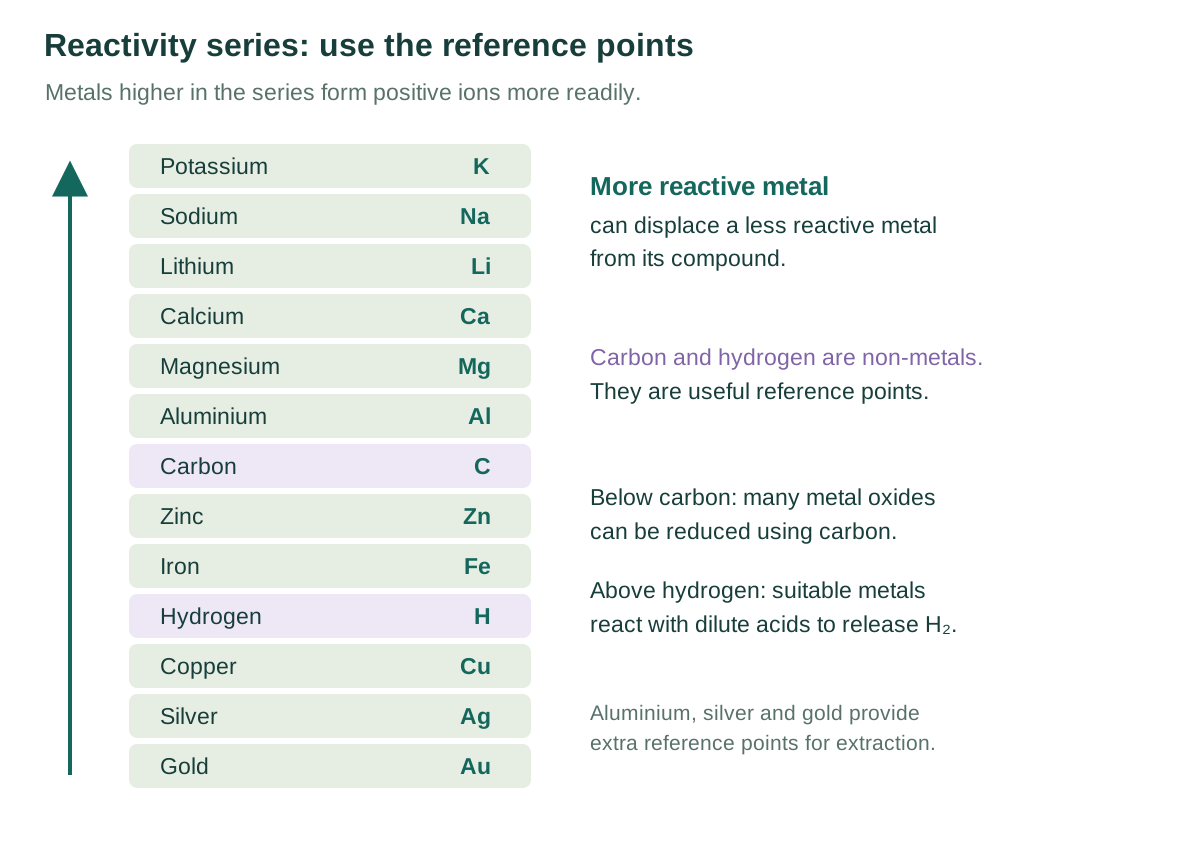
| Metal | With cold water at room temperature | With dilute acid |
|---|---|---|
| Potassium | Very vigorous; may ignite | Too vigorous for a pupil test |
| Sodium | Vigorous; moves across the surface | Too vigorous for a pupil test |
| Lithium | Fizzes; slower than sodium | Very vigorous; not a routine pupil test |
| Calcium | Fizzes; forms a cloudy alkaline solution | Very vigorous; not used for the standard comparison |
| Magnesium | Very slow; little visible change in a short test | Fizzes rapidly |
| Zinc | No visible reaction | Fizzes less rapidly than magnesium |
| Iron | No visible reaction | Slow fizzing |
| Copper | No reaction | No reaction with dilute hydrochloric/sulfuric acid |
Reactive metals with water form a metal hydroxide and hydrogen. For example: 2Na + 2H₂O → 2NaOH + H₂. These examples do not require reactions with steam. Alkali metals and calcium require teacher-controlled demonstrations and appropriate risk assessment.
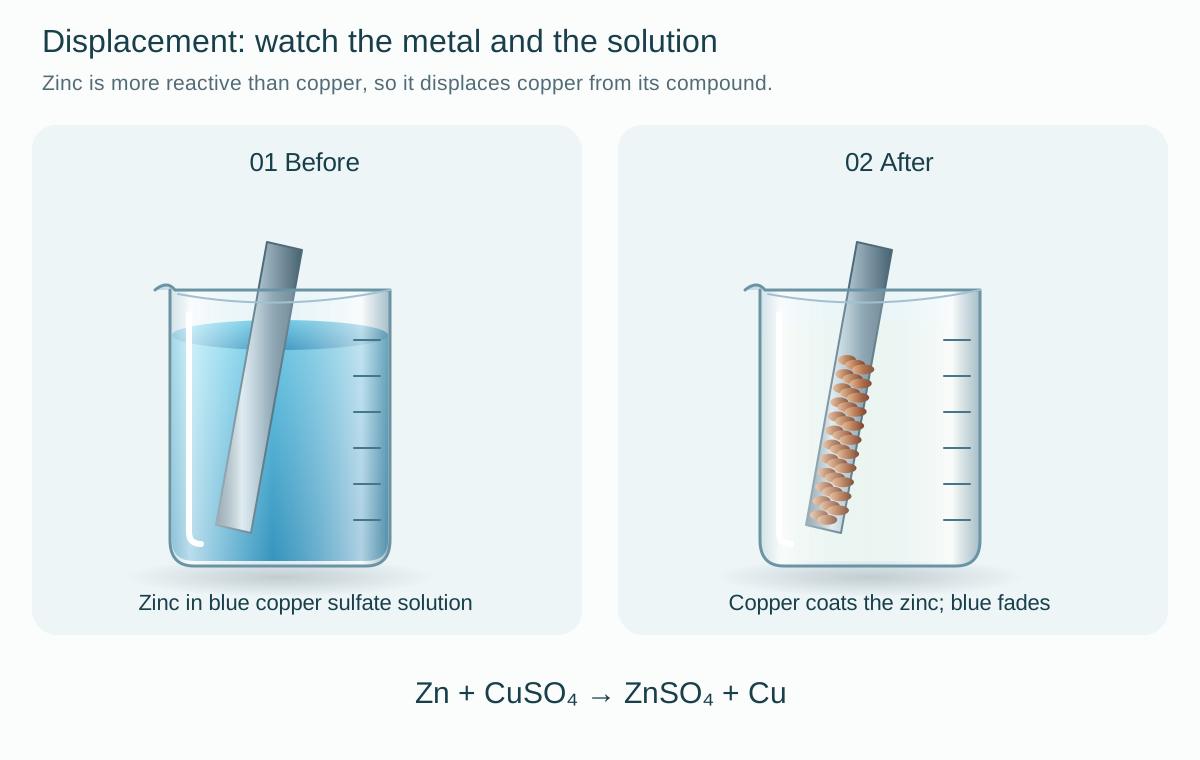
Put zinc in copper sulfate solution and copper is deposited. Zinc is more reactive than copper, so it displaces copper from its compound: Zn + CuSO₄ → ZnSO₄ + Cu.
Copper cannot displace zinc from zinc sulfate because copper is less reactive. A displacement result therefore gives evidence about the order of two metals.
Compare clean surfaces, equal solution volumes and concentrations, similar metal amounts, temperature and observation time. Different surface areas could change the speed and make an observation difficult to interpret.
Very unreactive metals, such as gold, may occur naturally as the element. Most metals occur in compounds in rocks. To extract a metal, separate it from the other elements in its compound.
Many metals below carbon in the reactivity series can be extracted by reducing their oxides with carbon. Carbon takes oxygen from the oxide, leaving the metal. Metals too reactive for this method, such as aluminium, are extracted using electrolysis of molten compounds.
In an unfamiliar extraction question, use the information given rather than memorising every industrial process. Consider whether the reducing agent can remove oxygen, the energy required, cost, waste and environmental effects.
You do not need the detailed stages of a blast furnace in this Trilogy topic. You do need to identify which substance gains or loses oxygen in a supplied equation.
Electrolysis can also be used when the metal would react with carbon during extraction, contaminating the product.
Higher only. A second definition of oxidation and reduction applies even when oxygen is not present: oxidation is loss of electrons; reduction is gain of electrons. Remember OIL RIG.
For zinc displacing copper:
Zn → Zn²⁺ + 2e⁻ (oxidation)
Cu²⁺ + 2e⁻ → Cu (reduction).
The overall ionic equation is Zn + Cu²⁺ → Zn²⁺ + Cu. Sulfate ions stay unchanged and are left out; they are spectator ions.
Check both atoms and charge. Electrons must cancel when half equations are added. Never describe a copper ion gaining electrons as “oxidation” simply because it changes into a metal.
Magnesium, zinc and iron react with dilute hydrochloric or sulfuric acid. Bubbles show hydrogen being made. Copper does not react with these dilute acids under normal classroom conditions.
Metal + acid → salt + hydrogen.
Mg + 2HCl → MgCl₂ + H₂
Zn + H₂SO₄ → ZnSO₄ + H₂
With dilute hydrochloric acid, iron forms iron(II) chloride: Fe + 2HCl → FeCl₂ + H₂. With dilute sulfuric acid it forms iron(II) sulfate.
Hydrogen gives a squeaky pop with a lighted splint at the mouth of a small collected gas sample. Follow teacher instructions; keep flames away from larger hydrogen mixtures and the reaction vessel.
Higher only: these are redox reactions. For magnesium: Mg → Mg²⁺ + 2e⁻, so magnesium is oxidised. Hydrogen ions gain electrons: 2H⁺ + 2e⁻ → H₂, so H⁺ is reduced.
A salt contains a positive ion, usually from a metal, and a negative ion from the acid. The acid decides the ending of the salt’s name.
| Acid | Salt type | Example |
|---|---|---|
| Hydrochloric acid | Chloride | Magnesium chloride |
| Sulfuric acid | Sulfate | Copper sulfate |
| Nitric acid | Nitrate | Calcium nitrate |
A formula must have zero overall charge. For Mg²⁺ and Cl⁻, two chloride ions balance one magnesium ion, so the formula is MgCl₂. For Ca²⁺ and NO₃⁻, the formula is Ca(NO₃)₂; brackets show that the whole nitrate ion is repeated.
| Positive ions | Negative ions |
|---|---|
| Na⁺, K⁺, H⁺ | Cl⁻, NO₃⁻, OH⁻ |
| Mg²⁺, Ca²⁺, Zn²⁺, Cu²⁺, Fe²⁺ | SO₄²⁻, CO₃²⁻ |
| Al³⁺ | O²⁻ |
A base neutralises an acid. Metal oxides and metal hydroxides are bases. An alkali is a base that dissolves in water, such as sodium hydroxide. Copper oxide is a base but is insoluble, so it is not an alkali.
Acid + base → salt + water.
CuO + H₂SO₄ → CuSO₄ + H₂O
HCl + NaOH → NaCl + H₂O
Acid + carbonate → salt + water + carbon dioxide.
CaCO₃ + 2HCl → CaCl₂ + H₂O + CO₂
Carbon dioxide turns limewater milky/cloudy. Bubbles alone do not identify a gas: compare the reactants and carry out the appropriate test.
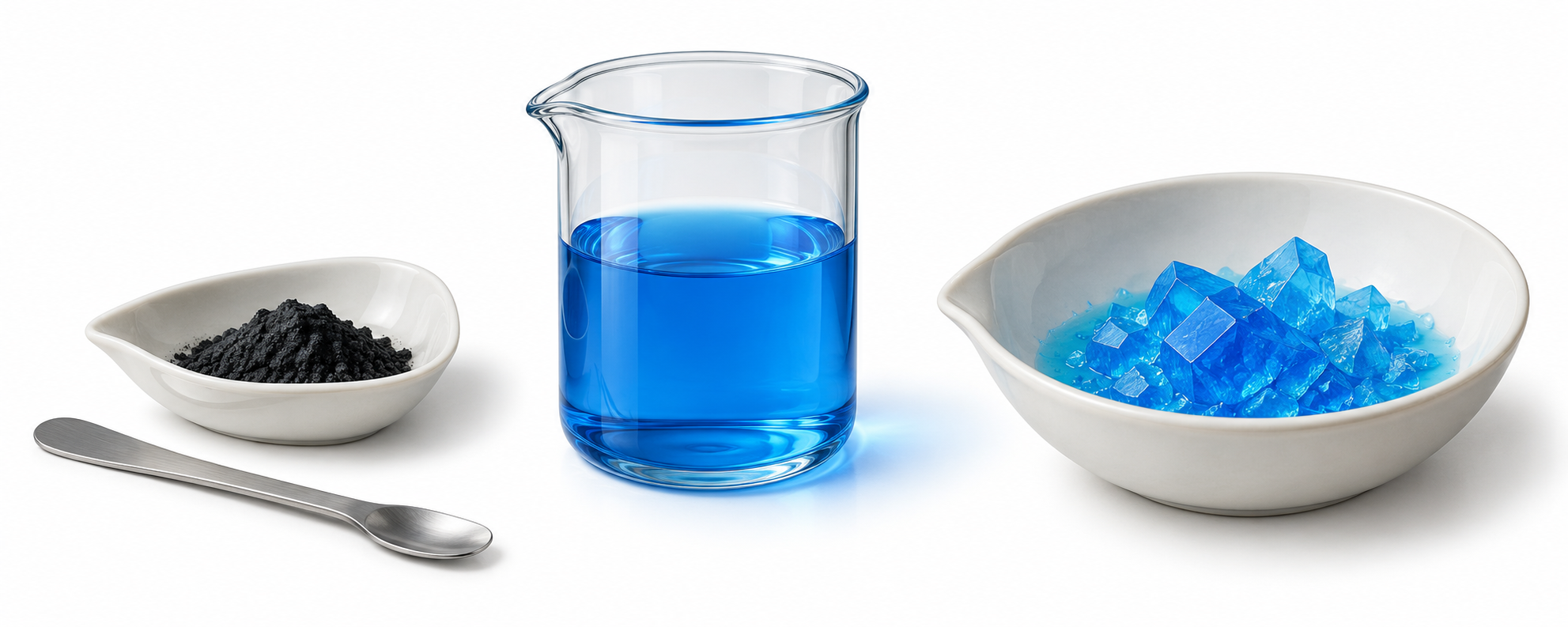
Aim: prepare a pure, dry sample of a soluble salt from an insoluble oxide or carbonate. Here, black copper oxide reacts with dilute sulfuric acid to make blue copper sulfate solution. Work under teacher supervision.
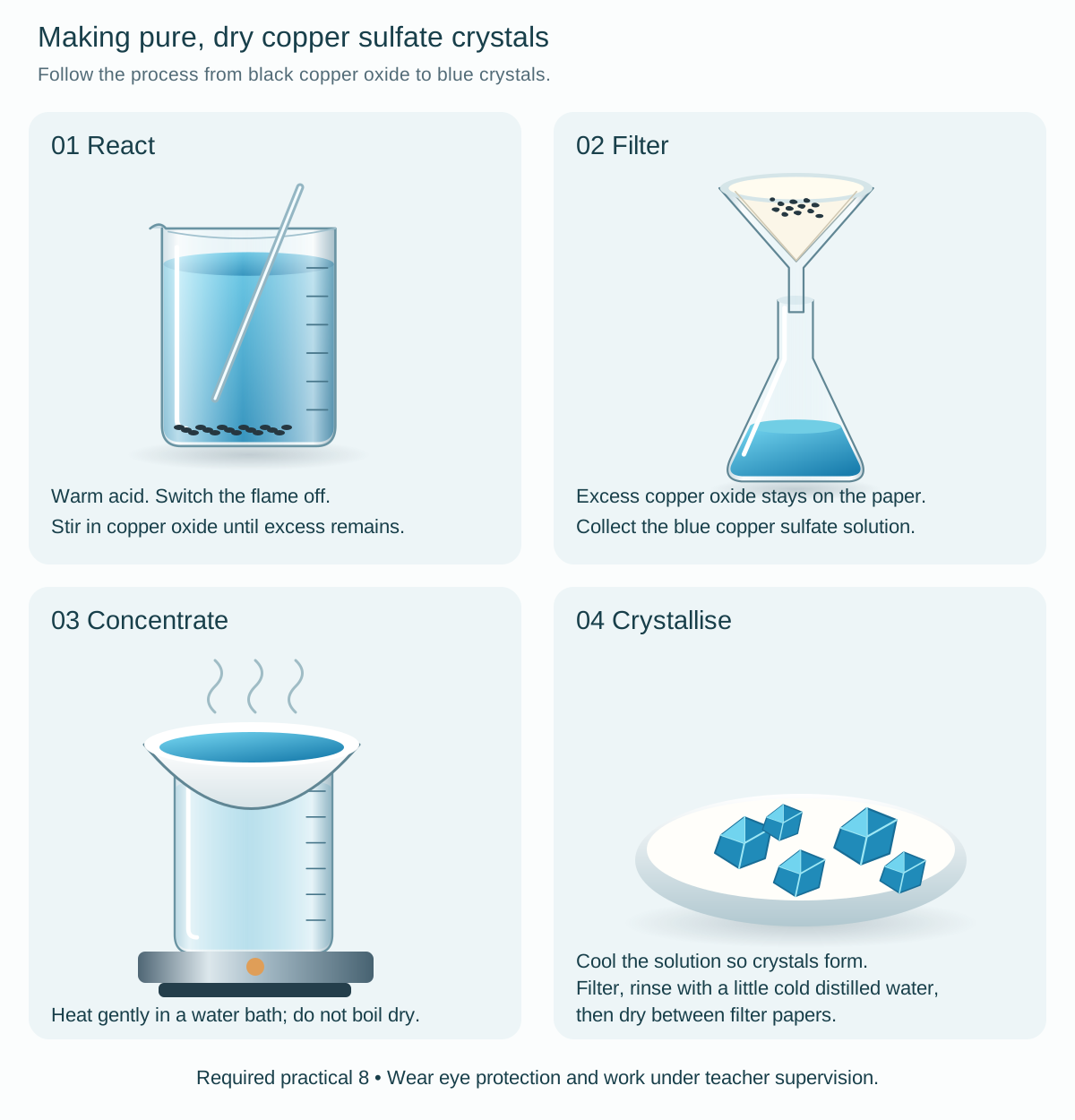
Why it works: adding excess insoluble oxide removes leftover acid, and filtration removes the excess oxide. Cooling allows salt to crystallise without boiling all the water away. Too much rinsing water dissolves the product again.
Safety: wear eye protection; avoid inhaling powder; handle hot glass carefully; use small quantities and appropriate acid concentration. Collect copper-containing waste as instructed rather than pouring it away.
The same logic works for other suitable soluble salts when the acid and insoluble oxide/carbonate are specified. It is not suitable for making a salt by simply filtering a mixture of two soluble reactants.
In water, acids produce hydrogen ions, H⁺. Alkalis contain hydroxide ions, OH⁻. The pH scale describes how acidic or alkaline a solution is: below 7 acidic, 7 neutral, above 7 alkaline.
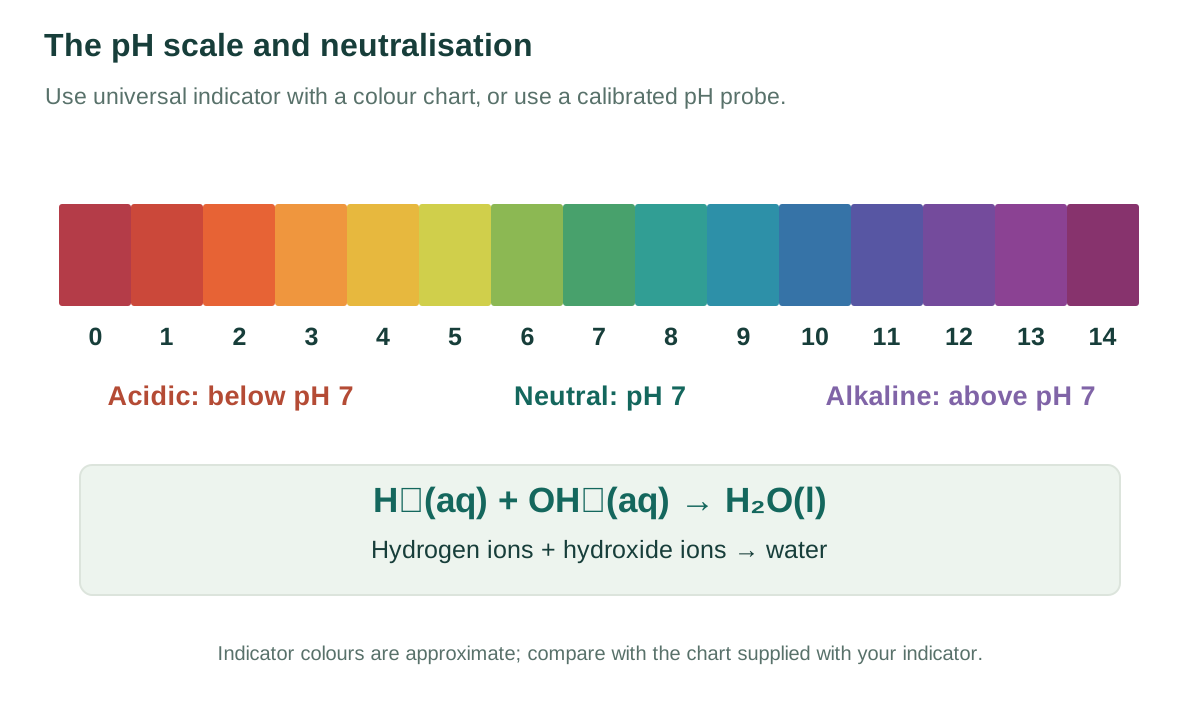
Add a few drops of universal indicator to a small solution sample, or place a drop on indicator paper. Compare the colour with its chart. A pH probe should be calibrated and rinsed between samples to reduce contamination.
During acid–alkali neutralisation, H⁺ and OH⁻ react to form water: H⁺(aq) + OH⁻(aq) → H₂O(l). Adding acid to an alkali lowers the pH; adding enough extra acid eventually makes the mixture acidic.
Higher only. A strong acid is completely ionised in aqueous solution. Hydrochloric, nitric and sulfuric acids are strong acids. A weak acid is only partly ionised; examples include ethanoic, citric and carbonic acids.
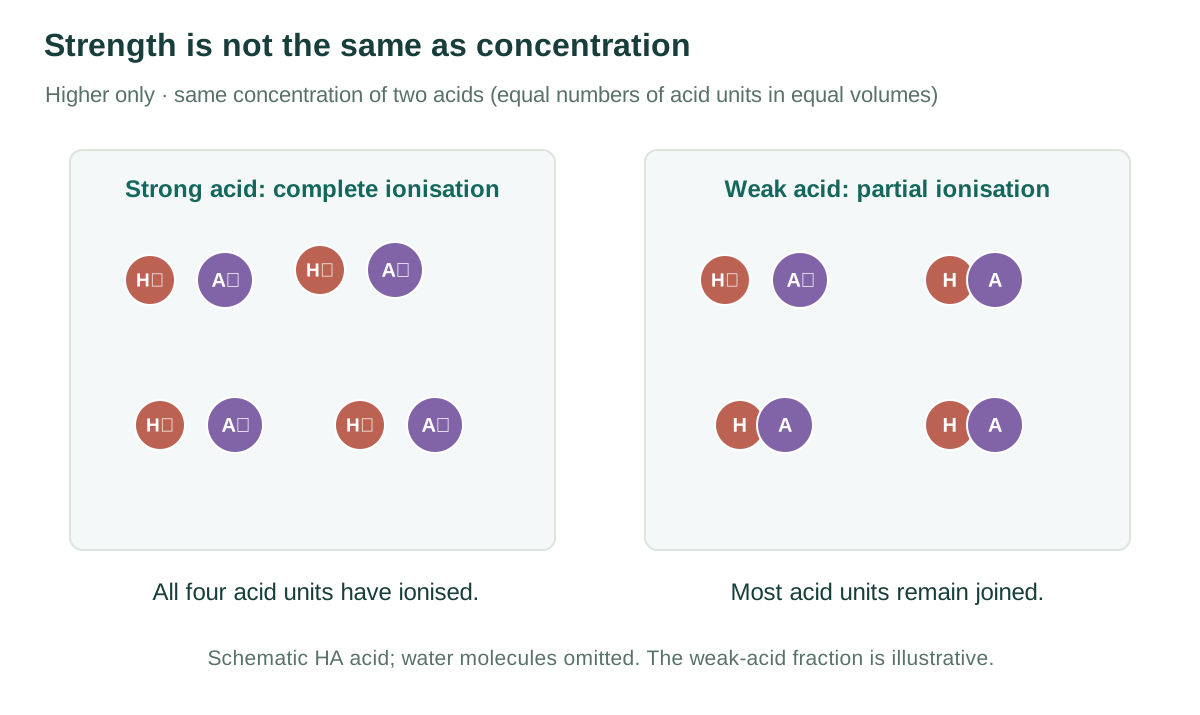
Concentrated/dilute describes how much acid is present per volume of solution. Strong/weak describes the proportion ionised. A strong acid can be dilute; a weak acid can be concentrated.
For acids that can each release one H⁺ ion per molecule, at the same concentration the stronger acid produces more H⁺ ions and has a lower pH. Do not assume strength alone determines pH if concentrations differ.
Electrolysis uses an electric current to break down an ionic compound. The liquid or solution carrying the current is the electrolyte. It must contain ions that can move.
In a solid ionic compound, ions are held in fixed positions, so it does not conduct. When molten or dissolved in water, its ions can move and carry charge. Electrons carry charge through the external wires; ions carry charge through the electrolyte.
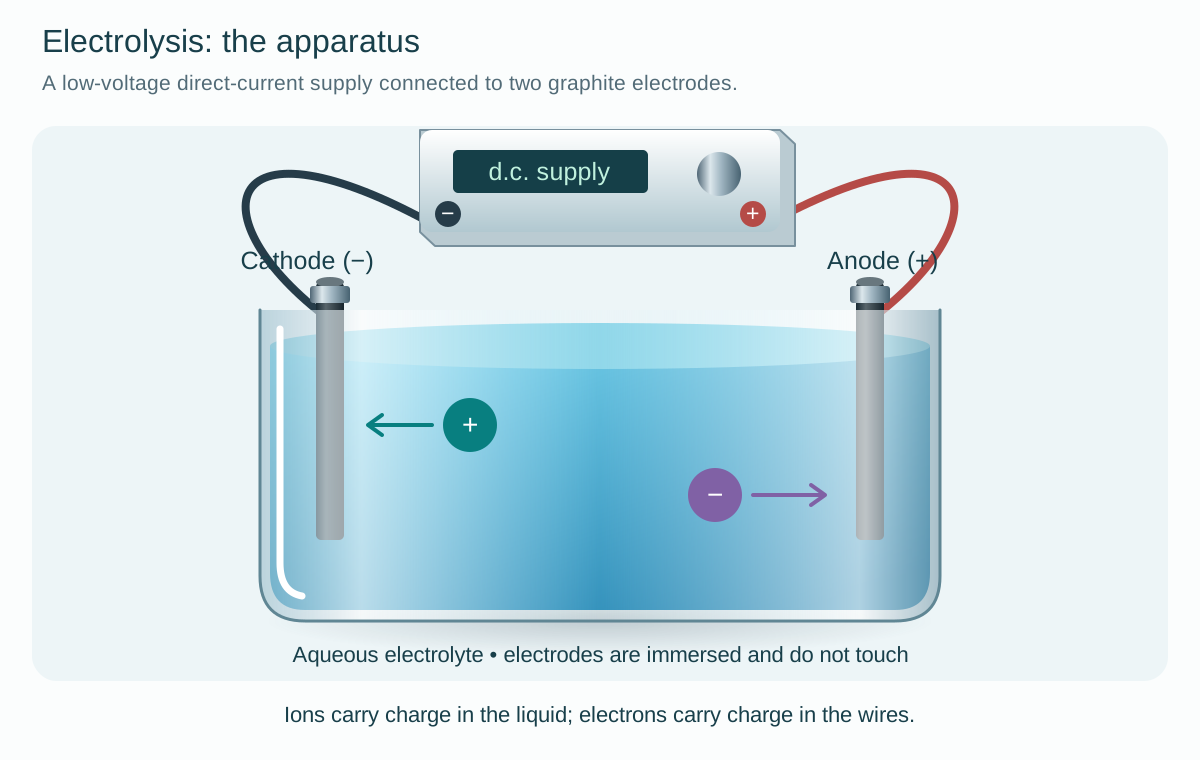
Positive ions move towards the negative cathode. Negative ions move towards the positive anode. At electrodes, ions are discharged and products form. An inert electrode, such as graphite in these classroom investigations, does not take part in the intended reaction.
A molten binary ionic compound contains ions from just two elements. The metal forms at the cathode and the non-metal at the anode.
| Molten compound | Cathode (−) | Anode (+) |
|---|---|---|
| Sodium chloride, NaCl | Sodium | Chlorine |
| Lead bromide, PbBr₂ | Lead | Bromine |
| Magnesium chloride, MgCl₂ | Magnesium | Chlorine |
These are prediction examples, not instructions for unsupervised practical work. Molten compounds require high temperatures, and some products are toxic or very reactive.
Higher only: for molten PbBr₂, Pb²⁺ + 2e⁻ → Pb at the cathode and 2Br⁻ → Br₂ + 2e⁻ at the anode. Each half equation balances atoms and electrical charge.
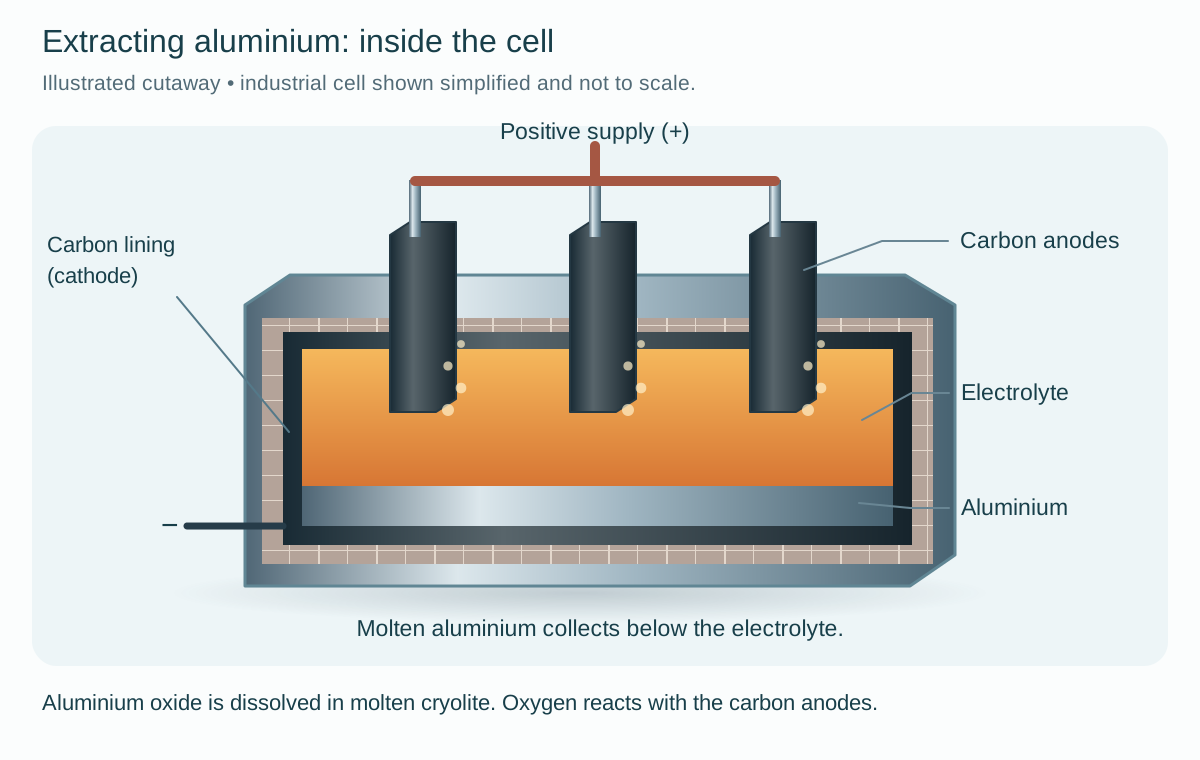
Aluminium is too reactive to be extracted from aluminium oxide by reduction with carbon. Electrolysis is used instead.
Aluminium oxide is dissolved in molten cryolite. The mixture melts at a lower temperature than pure aluminium oxide, reducing the energy needed to keep the electrolyte molten. Electrical energy is still needed to drive electrolysis, making extraction expensive.
Aluminium forms at the negative electrode. Oxygen forms at the positive carbon electrodes. The oxygen reacts with carbon to make carbon dioxide, so the carbon anodes wear away and must be replaced.
Higher only: Al³⁺ + 3e⁻ → Al is reduction. 2O²⁻ → O₂ + 4e⁻ is oxidation. Oxygen then reacts with the carbon anode; the electrode reaction and the reaction consuming carbon are linked but distinct steps.
Aqueous means dissolved in water. Water provides H⁺ and OH⁻ ions as well as the ions from the dissolved compound. This changes which products can form.
| Aqueous solution, inert electrodes | Cathode (−) | Anode (+) |
|---|---|---|
| Copper chloride | Copper | Chlorine |
| Sodium chloride | Hydrogen | Chlorine |
| Copper sulfate | Copper | Oxygen |
| Sodium sulfate | Hydrogen | Oxygen |
These are the product predictions required for this course. Real product proportions can depend on conditions; use the information given in the question. In particular, do not confuse aqueous sodium chloride, which forms hydrogen at the cathode, with molten sodium chloride, which forms sodium.
Aim: investigate products formed when aqueous solutions are electrolysed using inert electrodes. Start with a testable hypothesis, for example: “With inert electrodes, copper sulfate solution will deposit copper at the cathode, but sodium sulfate solution will produce hydrogen there.” This prediction uses the metals’ positions relative to hydrogen.
Variables: change the identity of the electrolyte. Observe the products at each electrode. Keep the voltage, testing time, solution volume and concentration, electrode material, immersed area and spacing consistent where possible. Product identity is different from measuring the rate of gas production.
Gas-test results: hydrogen gives a squeaky pop; oxygen relights a glowing splint; chlorine bleaches damp litmus paper white (blue paper may first turn red). Switch off the current and test only a small collected sample using the teacher’s procedure.
Possible limitations include contaminated electrodes, products dissolving in water, leaks during gas collection and tests carried out on mixed gases. A missing visible deposit or bubble is not enough on its own to show that no reaction occurred.
Higher only. At the cathode, positive ions gain electrons: reduction. At the anode, negative ions lose electrons: oxidation.
| Electrode process | Balanced half equation |
|---|---|
| Copper deposited | Cu²⁺ + 2e⁻ → Cu |
| Hydrogen produced | 2H⁺ + 2e⁻ → H₂ |
| Chlorine produced | 2Cl⁻ → Cl₂ + 2e⁻ |
| Oxygen from hydroxide ions | 4OH⁻ → O₂ + 2H₂O + 4e⁻ |
A question asking what you would observe needs something visible: fizzing, a coloured deposit or a change in solution colour. “Zinc is more reactive” is an explanation, not an observation.
For a practical plan, write the order, quantities or measurements, controls, safety, repeats and how evidence will test the prediction. For a calculation, show the equation or subtraction and give a unit.
Six-mark explanations need linked ideas. For example: “Excess copper oxide remains, showing the acid has reacted. Filtering removes this insoluble solid, leaving copper sulfate solution.” Higher-only labels identify specification content; optional challenges can also assess Foundation ideas.
Start with the 55 main questions. Higher-only questions are labelled. You can complete this topic over several sessions; your answers save as you go. Use a hint if you get stuck, then compare your work with an example answer. Your tutor can mark written answers.
Task 1: Explain the purpose of excess solid, filtration, gentle concentration and cooling in salt preparation.
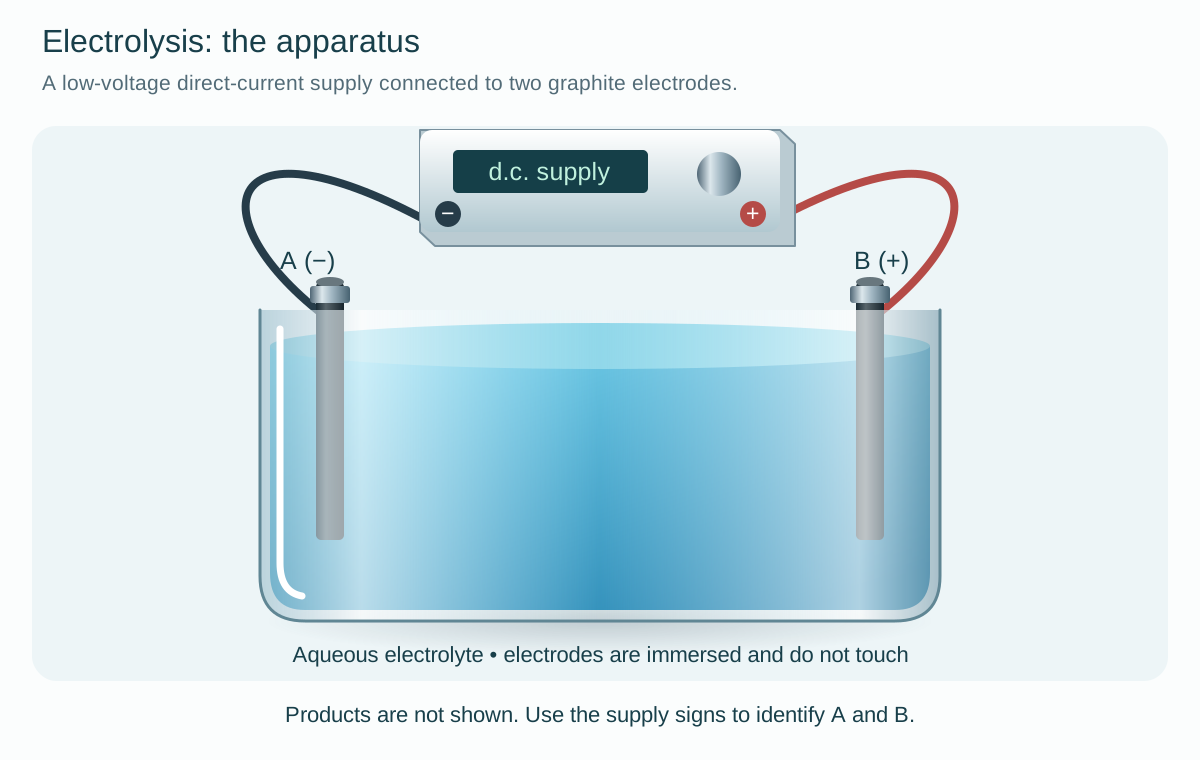
Task 2: Predict what forms at A and B for aqueous copper sulfate. Explain how you would test the gas, keep the comparison fair and work safely. Use these two practicals to build a clear written plan; your answer saves with this topic.
Add excess copper oxide to use up acid; filter to remove the insoluble excess. Gently remove some water, cool to crystallise, collect and dry. In aqueous copper sulfate, A is the cathode and copper forms there; oxygen forms at positive B and relights a glowing splint. Keep voltage, time, concentration, volume and electrode geometry consistent. Wear eye protection, keep electrodes apart and switch off before adjustments. Test only a small collected gas sample as directed.
When connected with your pupil code, your answers save online for Kevin to see. Click Submit to Kevin when you have finished. Downloads are optional.
Connect with your pupil code above to submit.
Use a scientific idea and a specific example in your reflection.