Atomic structure
Work through one section at a time. Higher-only material is labelled explicitly; optional challenges can also use Foundation content.
 GCSE PHYSICS · AQA TRILOGYTutor dashboardSaves on this device
Your answers save automatically as you work.
Saved in this browser on this device.
How did we discover what is inside an atom, and how can we use radiation safely? Follow the evidence, read decay graphs and explain the science.
Supported GCSE version · Clear examples, worked calculations and optional challenges.
Work through one section at a time. Higher-only material is labelled explicitly; optional challenges can also use Foundation content.
The small central region of an atom containing protons and neutrons.
Atoms of the same element with different numbers of neutrons.
An atom or group of atoms with an overall electrical charge.
An allowed electron energy, associated with a particular distance from the nucleus.
A random change in an unstable nucleus that emits radiation.
The rate of nuclear decay, measured in becquerels.
One nuclear decay per second; symbol Bq.
The number of counts a radiation detector records per unit time.
Removing electrons from atoms, leaving charged ions.
Time for the number of radioactive nuclei, activity or corrected count rate to halve.
Exposure to nuclear radiation without necessarily transferring radioactive material.
Unwanted radioactive material on or inside something.
Checking research methods, evidence and conclusions by other scientists.
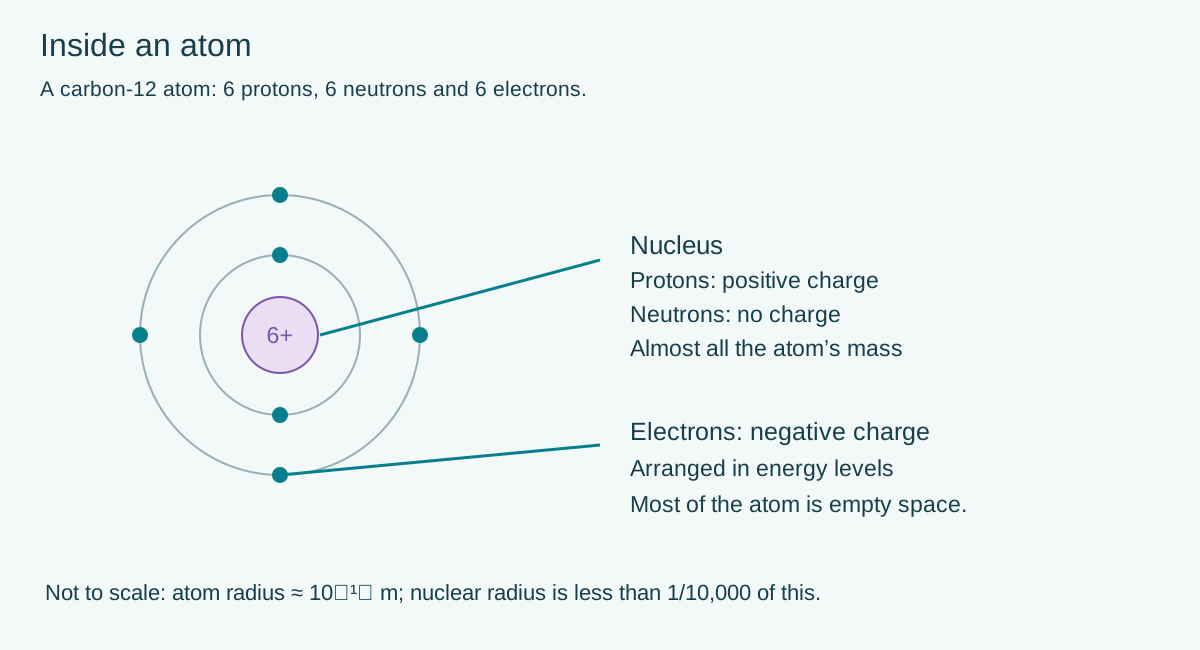
An atom has a positive nucleus surrounded by negative electrons. The nucleus contains protons and neutrons.
| Particle | Relative charge | Relative mass |
|---|---|---|
| Proton | +1 | 1 |
| Neutron | 0 | 1 |
| Electron | −1 | Very small |
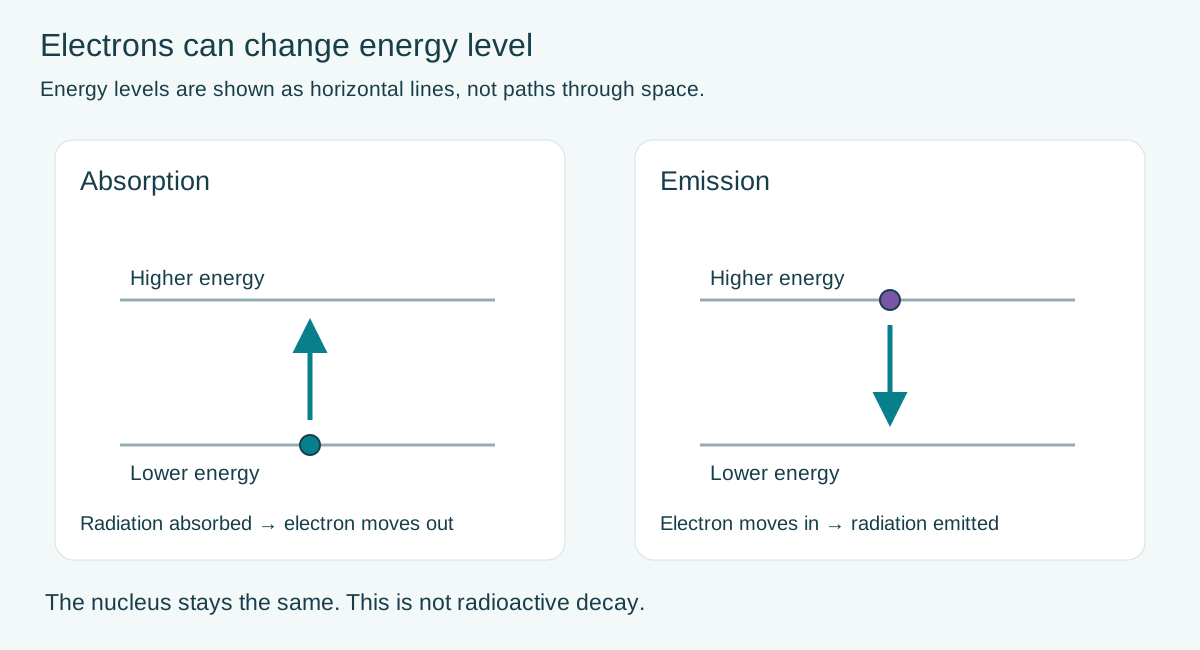
Electrons occupy particular energy levels at different distances from the nucleus. They can move between these levels when energy is transferred.
The atomic number counts protons. The mass number counts protons plus neutrons. In the notation 2311Na, 23 is the mass number and 11 is the atomic number.
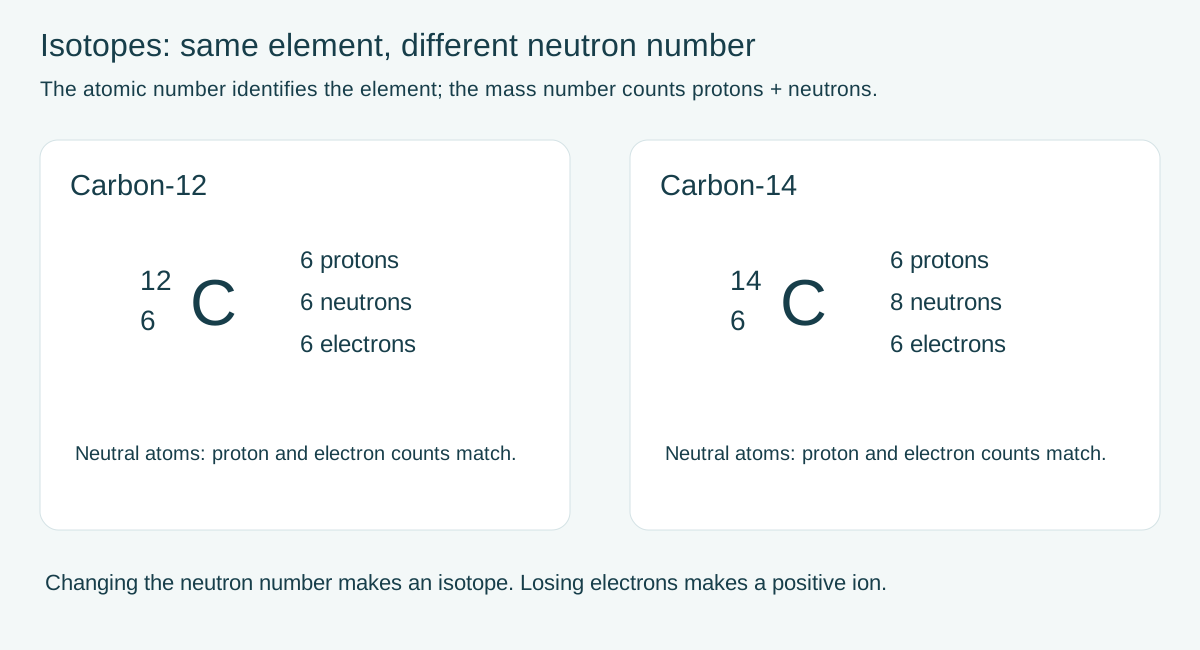
Isotopes are atoms of the same element with different numbers of neutrons. A positive ion forms when an atom loses one or more outer electrons.
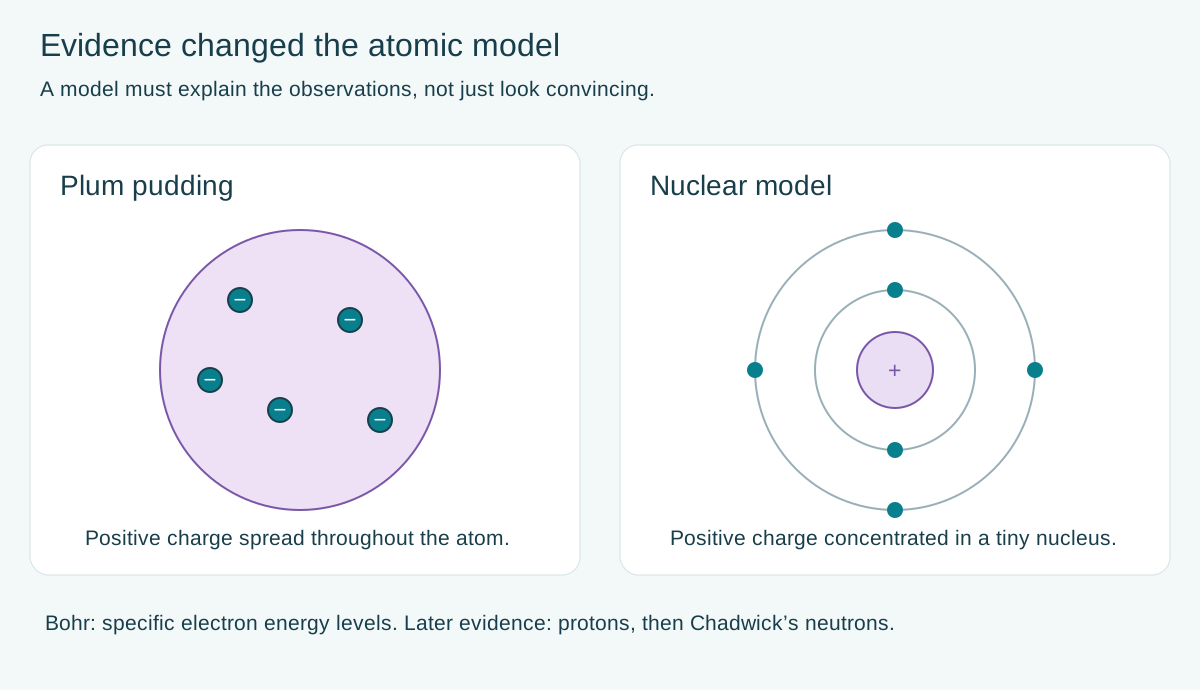
A scientific model must fit the evidence. New results can force scientists to change or replace it.
| Evidence or development | How the model changed |
|---|---|
| Early idea | Atoms were tiny spheres that could not be divided. |
| Electrons discovered | Atoms had smaller parts; plum pudding placed negative electrons in a ball of positive charge. |
| Alpha scattering | A small, dense, charged nucleus replaced the spread-out positive charge. |
| Bohr’s calculations matched observations | Electrons occupy specific energy levels. |
| Later experiments | Nuclear positive charge occurs in whole units: protons. |
| Chadwick’s evidence | Uncharged neutrons are also in the nucleus. |
Positive alpha particles were directed at thin metal foil. Most passed straight through. Some were deflected, and very few turned back.
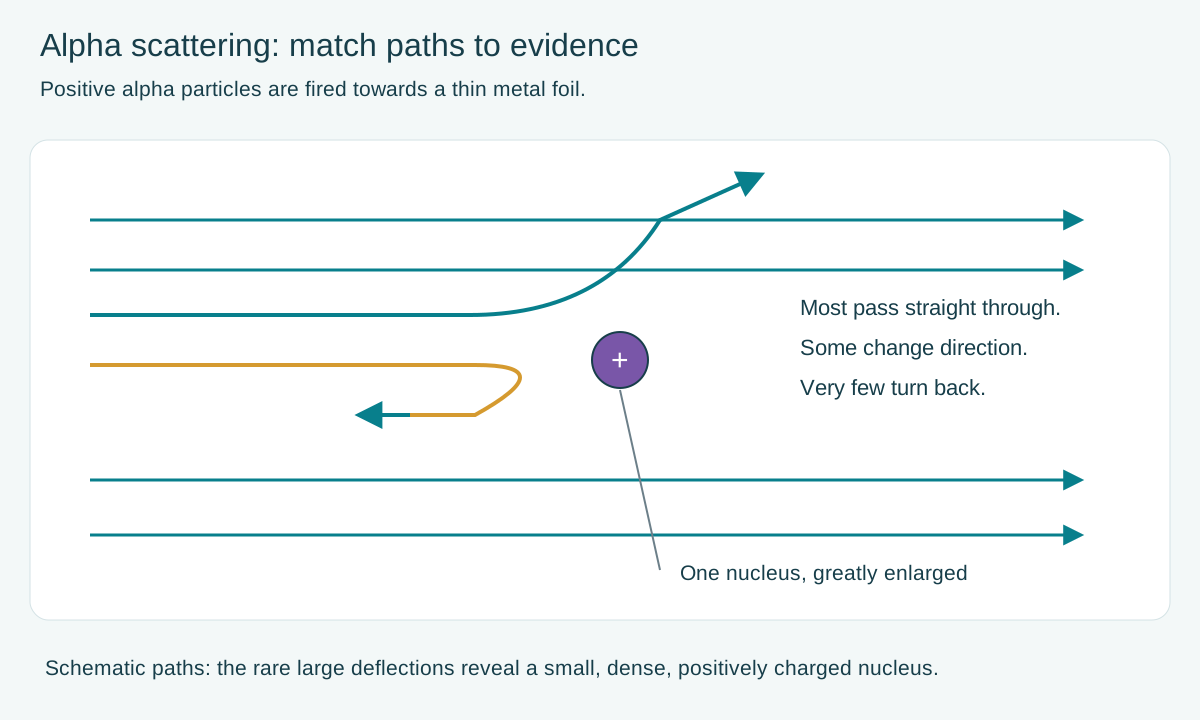
| Observation | What it suggests |
|---|---|
| Most pass straight through | Most of an atom is empty space. |
| Very few are strongly deflected | The nucleus is very small. |
| Some positive particles turn back | Mass and positive charge are concentrated in a small, dense centre. |
Some nuclei are unstable. They emit radiation as they change to become more stable. This is radioactive decay.
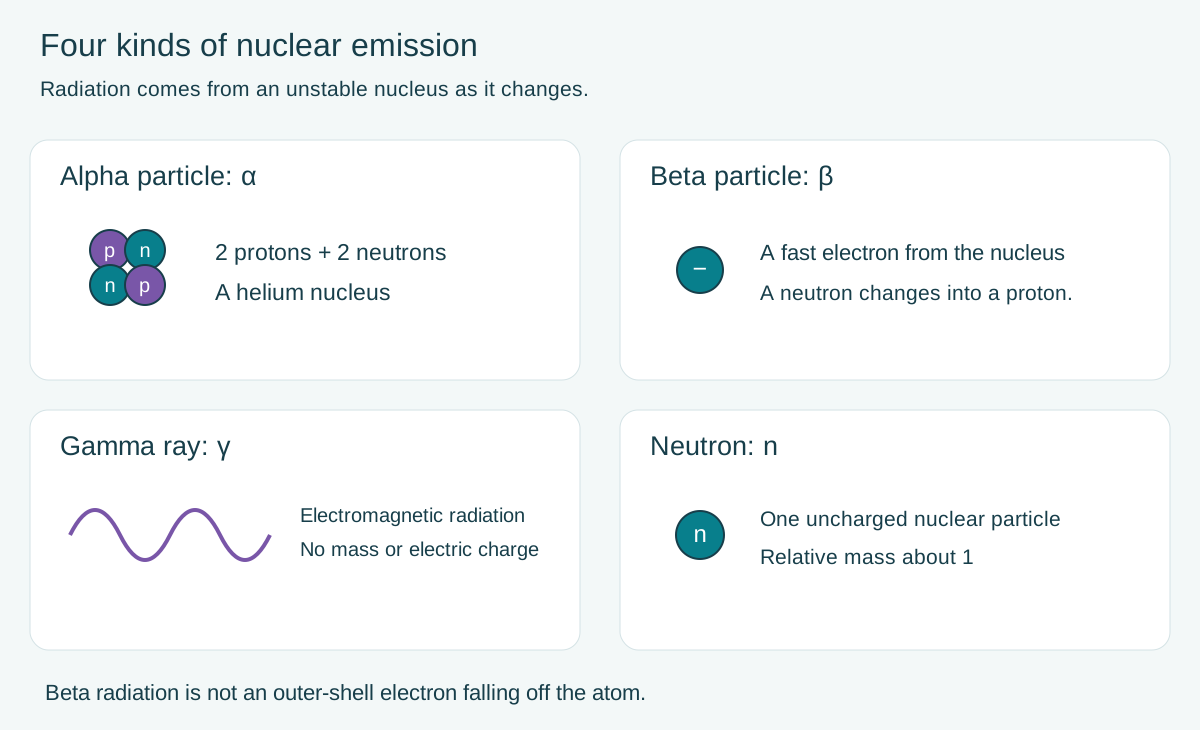
A detector can record radiation from the surroundings too. Measure this background count rate with the source absent, using the same counting time.
Ionisation means removing electrons from atoms, leaving ions. Ionising radiation can damage living cells.
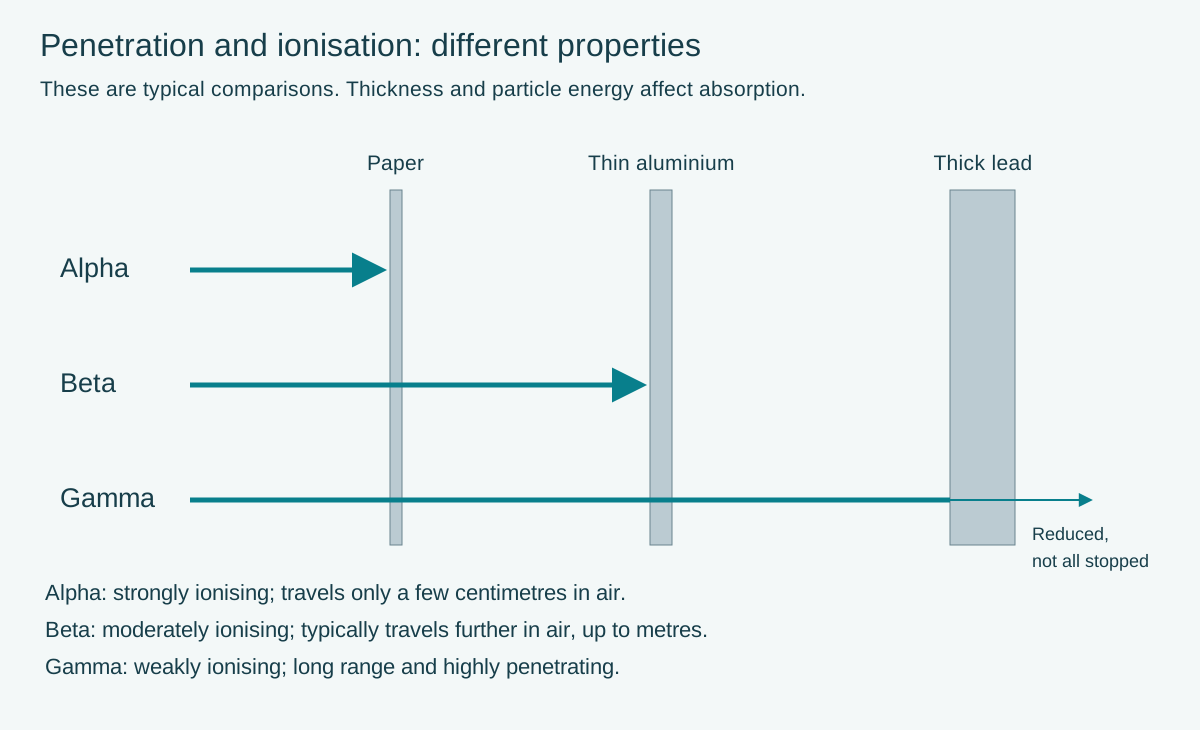
| Radiation | Range and penetration | Relative ionising power |
|---|---|---|
| Alpha | Short range in air; stopped by paper or outer skin | Strong |
| Beta | Further in air; absorbed by thin aluminium | Medium |
| Gamma | Long range; thick lead or concrete reduces it | Weak |
Choose a source for its job. For example, a detector on the other side of a thin sheet needs radiation that can pass through some of the sheet but is affected by changes in thickness. A question will give the context: explain your choice using the properties.
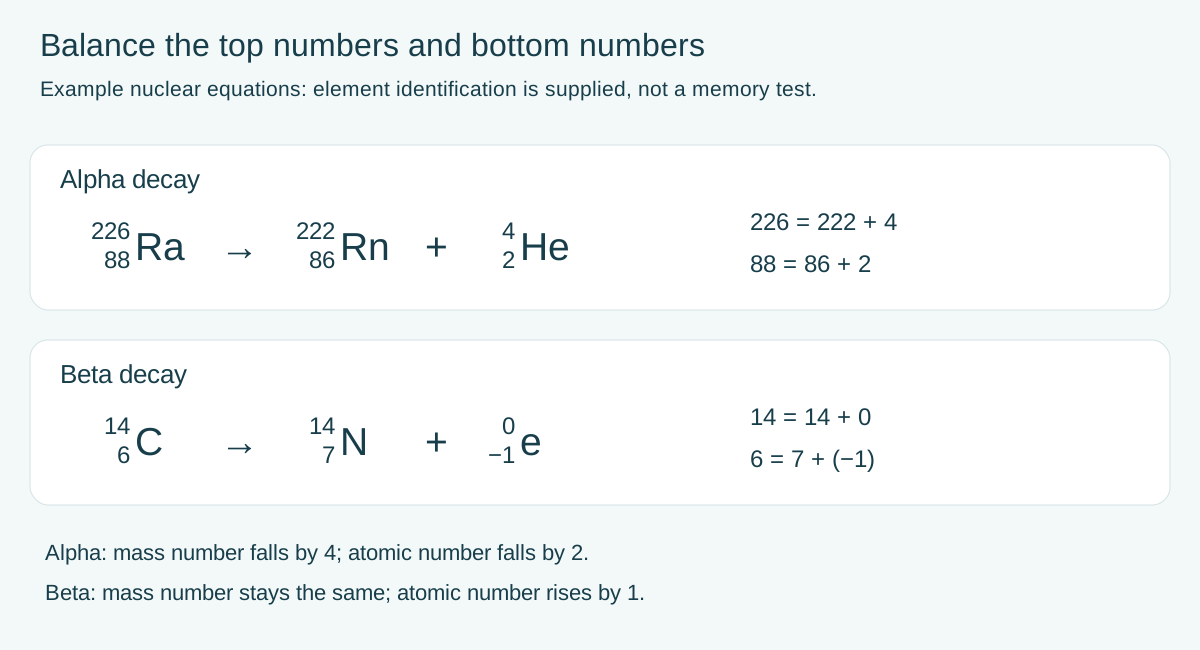
In a nuclear equation, balance the mass numbers at the top and the atomic numbers at the bottom. The emitted particle must be included.
The half-life is the time for half the radioactive nuclei in a sample to decay. It is also the time for its activity, or corrected count rate, to halve.
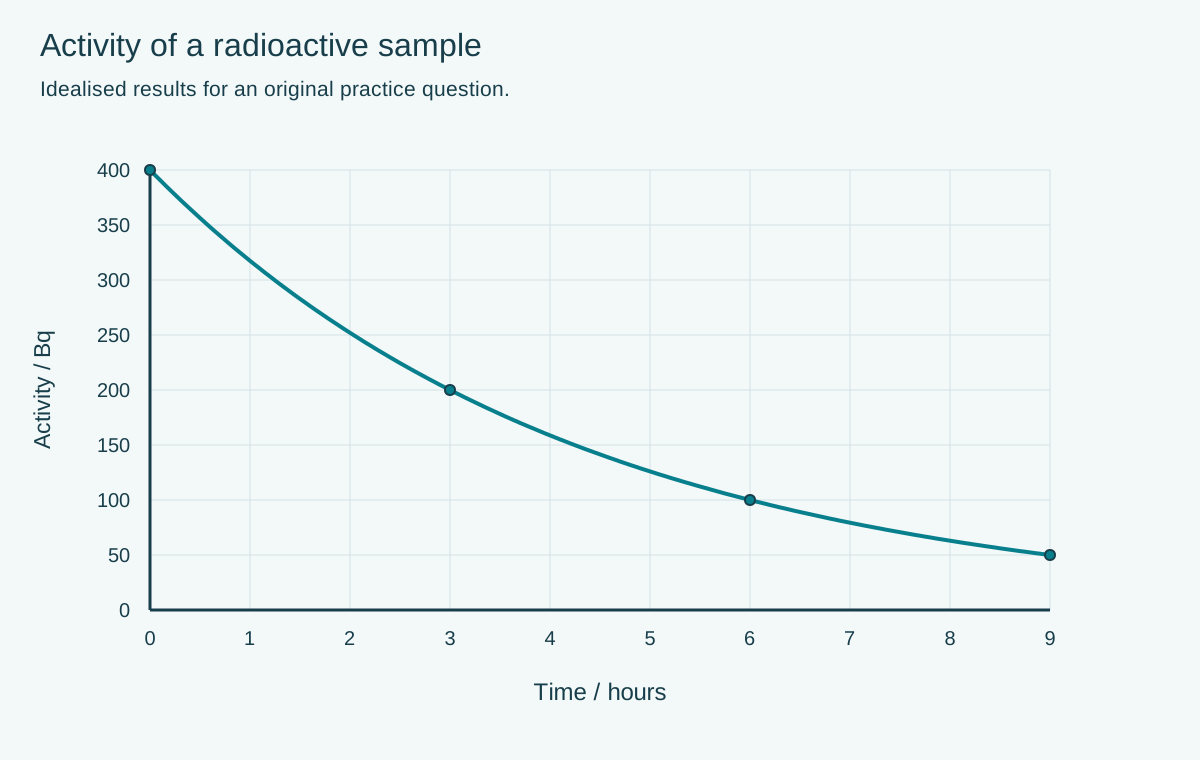
A large sample produces a smooth overall trend, although individual decays are random. Actual count-rate readings fluctuate, so repeated measurements improve the estimate.
After 1, 2 and 3 half-lives, the fractions remaining are 1/2, 1/4 and 1/8. After 3 half-lives, remaining : original = 1 : 8, and the fraction that has decayed is 7/8.
For an initial 800 Bq, three halvings give 400 → 200 → 100 Bq. Net decrease = 800 − 100 = 700 Bq. Always check whether the question asks for what remains or what has been lost.
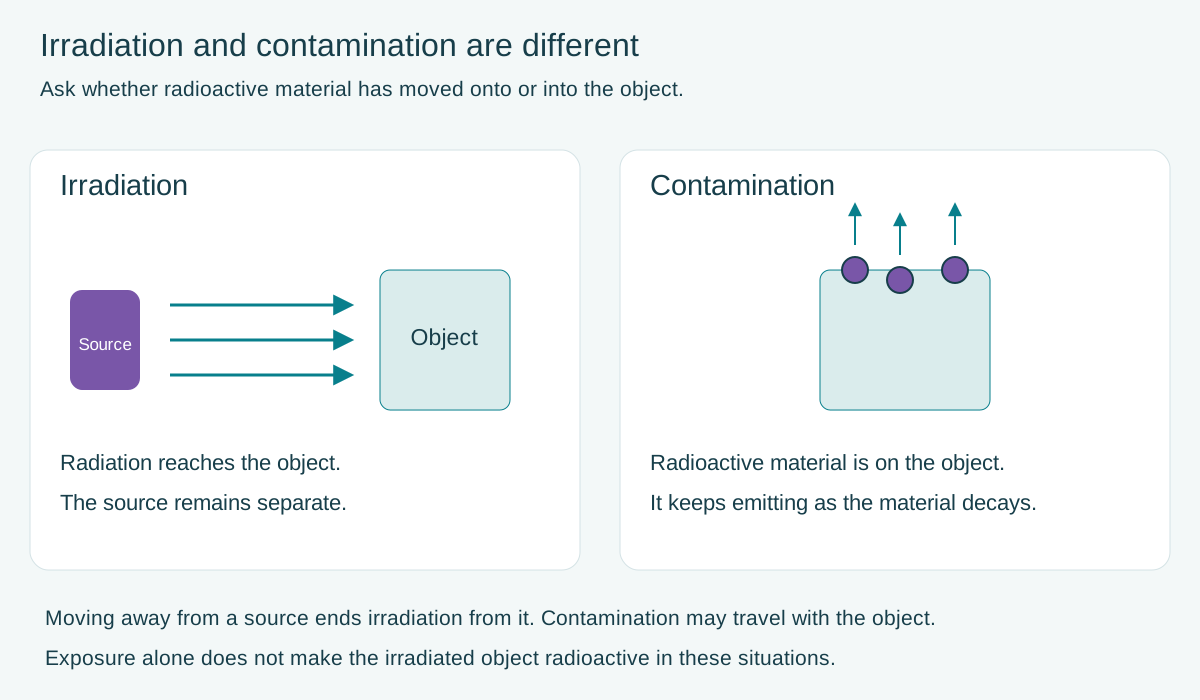
Irradiation is exposure to radiation. Contamination is unwanted radioactive material on or inside something.
| Situation | Why it matters |
|---|---|
| Source outside the body | Gamma can penetrate to internal tissues. Alpha is usually stopped by the outer skin. |
| Alpha-emitting material inhaled or swallowed | Strong ionisation occurs close to internal living cells; it can be very hazardous. |
| Contaminated clothing | Radioactive material may move to other surfaces and keep emitting until removed or decayed. |
| Irradiated object with no transferred material | It does not become radioactive just because it was exposed. |
Radioactive sources belong in controlled, supervised work. Students should not obtain or handle sources independently.
| Precaution | Reason |
|---|---|
| Minimise time near a source | Reduces exposure time. |
| Increase distance; use suitable handling tools | Reduces radiation reaching the person. |
| Use appropriate shielding and safe storage | Absorbs or reduces radiation. |
| Contain radioactive material; prevent spills and inhalation | Reduces contamination and its spread. |
Peer review means other scientists checking a study’s methods, evidence and conclusions. Publishing and sharing studies of radiation’s effects allows weaknesses to be identified and results to be compared. Peer review helps reliability; it does not guarantee a conclusion is perfect.
Start with the 39 main questions. Higher-only questions are labelled. You can complete this topic over several sessions; your answers save as you go. Use a hint if you get stuck, then compare your work with an example answer. Your tutor can mark written answers.
Use the graph to estimate the half-life twice, starting from different activities. Explain why the activity drop in the first three hours is larger than the drop in the next three hours even though both intervals are one half-life.
400→200 Bq takes 0→3 h; 200→100 Bq takes 3→6 h. Both give 3 h. The same fraction halves each time, but fewer radioactive nuclei remain, so the absolute decrease is smaller.
Write an alpha-decay equation using a parent with mass number 238 and atomic number 92. Use X for the daughter nucleus. Check the top numbers and bottom numbers separately.
The daughter has mass number 234 and atomic number 90; the emitted alpha particle has mass number 4 and atomic number 2.
When connected with your pupil code, your answers save online for Kevin to see. Click Submit to Kevin when you have finished. Downloads are optional.
Connect with your pupil code above to submit.
Use a scientific idea and a specific example in your reflection.