Atomic structure and the periodic table
Work through one section at a time. Higher-only material is labelled explicitly; optional challenges can also use Foundation content.
 GCSE CHEMISTRY · AQA TRILOGYTutor dashboardSaves on this device
Your answers save automatically as you work.
Saved in this browser on this device.
Use atomic structure to explain elements, separate mixtures and predict patterns in the periodic table.
Supported GCSE version · Clear examples, worked calculations and optional challenges.
Work through one section at a time. Higher-only material is labelled explicitly; optional challenges can also use Foundation content.
The smallest part of an element that can exist.
A substance containing only one type of atom.
Different elements chemically combined in a fixed ratio.
Substances together without being chemically combined.
The number of protons in the nucleus.
The total number of protons and neutrons.
An atom with the same proton number but a different neutron number from another isotope of the same element.
An atom or group of atoms with an electrical charge.
A weighted average of isotope masses, accounting for abundance.
An energy level occupied by electrons around the nucleus.
A vertical column of elements in the periodic table.
A horizontal row in the periodic table.
The reduction in nuclear attraction experienced by outer electrons because of inner electrons.
Made of molecules containing two atoms.
A reaction in which a more reactive element replaces a less reactive element in a compound.
The liquid collected after vapour condenses during distillation.
The solid left on filter paper after filtration.
The liquid that passes through filter paper.
An ion unchanged during a reaction and omitted from the net ionic equation.
The periodic table puts the elements in a useful order. You do not need to memorise every box: start by learning how to read it.
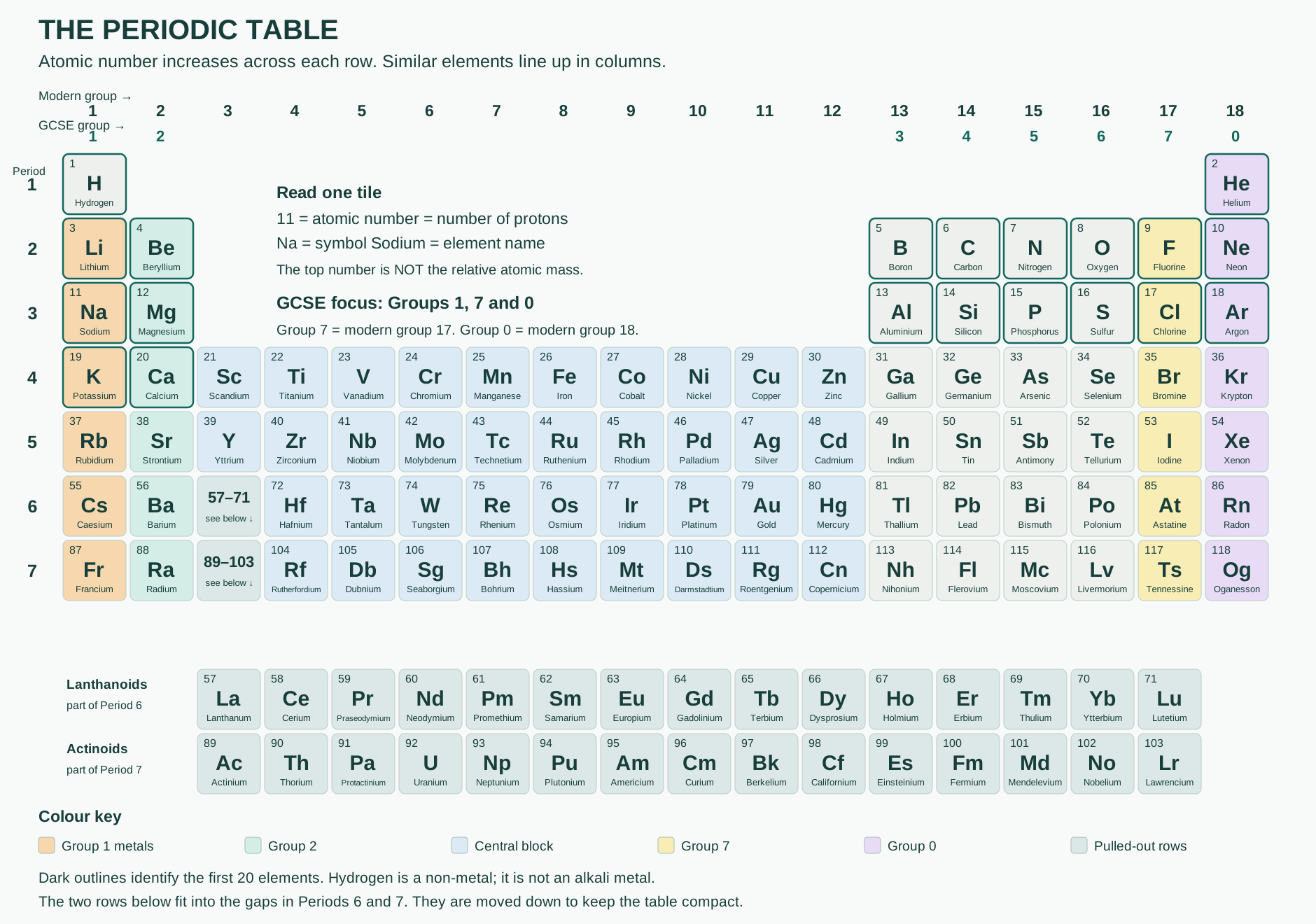
Elements are arranged by increasing atomic number. This is the number of protons in an atom’s nucleus. Hydrogen has 1 proton, helium has 2 and lithium has 3. Each step to the next element adds one proton.
In the sodium box, 11 is the atomic number, Na is the chemical symbol and sodium is the element’s name. A neutral sodium atom also has 11 electrons. The number at the top of this table’s boxes is not the relative atomic mass.
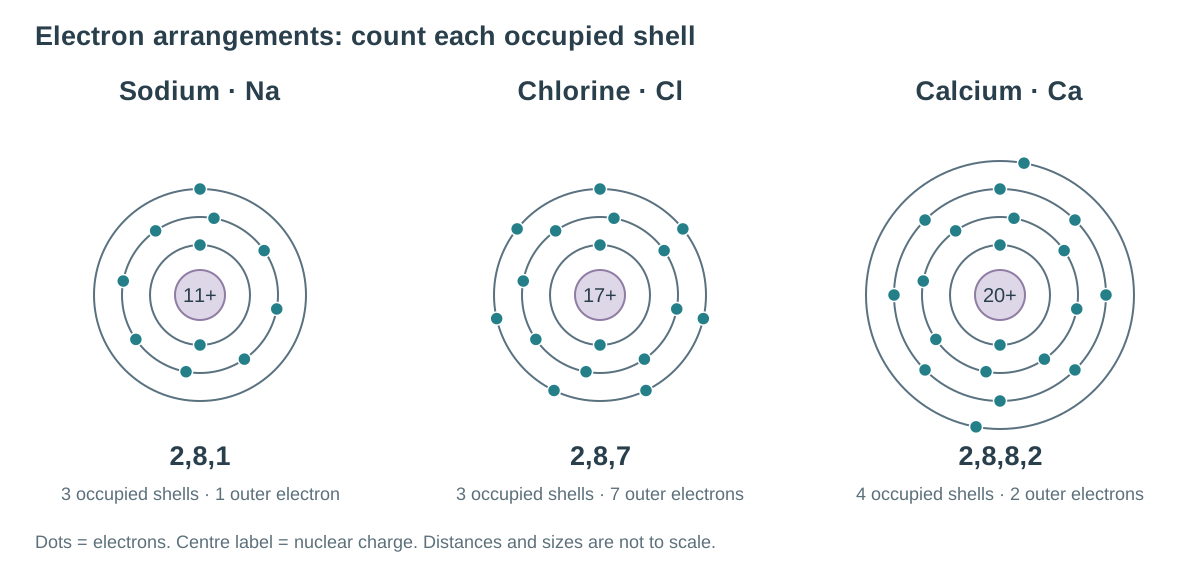
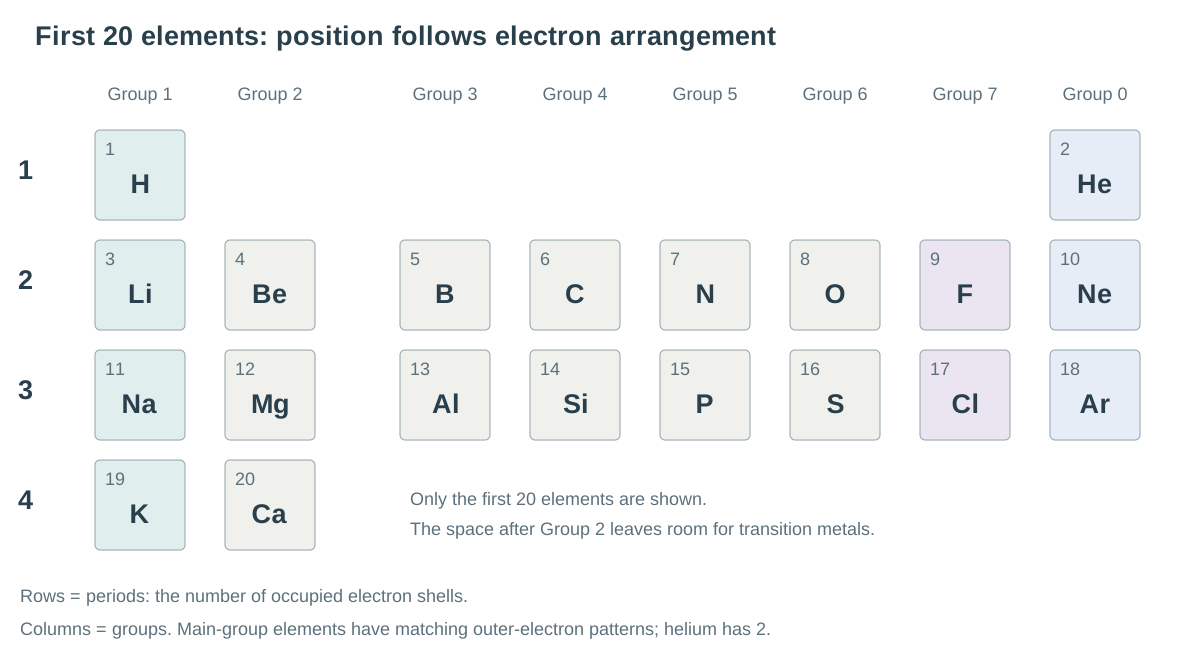
A period runs horizontally across the table. Its number tells you how many electron shells are occupied. Sodium is in Period 3 and has three occupied shells: 2,8,1.
A group runs vertically down the table. Elements in the main groups studied at GCSE have the same number of outer-shell electrons. This gives them similar chemical reactions.
Most metals are on the left and in the centre. Non-metals are mainly towards the top right. Hydrogen is a non-metal, even though it sits on the left. The two rows underneath belong in Periods 6 and 7; moving them down stops the table becoming extremely wide.
Magnesium has atomic number 12, so it has 12 protons. A neutral atom has 12 electrons arranged 2,8,2. Three occupied shells place it in Period 3; two outer electrons place it in Group 2.
Element names and modern numbering checked against IUPAC. This learning table shows atomic numbers, symbols and names; it does not include relative atomic masses.
An atom is the smallest part of an element that can exist. An element contains only one type of atom. Oxygen gas contains pairs of oxygen atoms, O₂, but it is still an element: both atoms are oxygen.
A compound contains atoms of different elements chemically joined in a fixed ratio. Water, H₂O, contains two hydrogen atoms for every oxygen atom. The small subscript belongs to the symbol immediately before it. If there is no subscript, there is one atom of that element. Carbon dioxide, CO₂, contains one carbon and two oxygen atoms per molecule.
Compounds have different properties from their elements. Sodium is a reactive metal; chlorine is a poisonous gas; sodium chloride is a white crystalline compound. Making a compound is a chemical reaction: new substances form, often with a detectable energy change. Splitting a compound into its elements also requires a chemical reaction.
| Atomic number | Element | Symbol | Electrons in shells |
|---|---|---|---|
| 1 | Hydrogen | H | 1 |
| 2 | Helium | He | 2 |
| 3 | Lithium | Li | 2,1 |
| 4 | Beryllium | Be | 2,2 |
| 5 | Boron | B | 2,3 |
| 6 | Carbon | C | 2,4 |
| 7 | Nitrogen | N | 2,5 |
| 8 | Oxygen | O | 2,6 |
| 9 | Fluorine | F | 2,7 |
| 10 | Neon | Ne | 2,8 |
| 11 | Sodium | Na | 2,8,1 |
| 12 | Magnesium | Mg | 2,8,2 |
| 13 | Aluminium | Al | 2,8,3 |
| 14 | Silicon | Si | 2,8,4 |
| 15 | Phosphorus | P | 2,8,5 |
| 16 | Sulfur | S | 2,8,6 |
| 17 | Chlorine | Cl | 2,8,7 |
| 18 | Argon | Ar | 2,8,8 |
| 19 | Potassium | K | 2,8,8,1 |
| 20 | Calcium | Ca | 2,8,8,2 |
Other useful symbols include iron Fe, copper Cu, zinc Zn, silver Ag, gold Au, lead Pb, bromine Br and iodine I. Use the periodic table to check unfamiliar names.
A word equation gives the names of reactants on the left and products on the right. The arrow means “react to form”. For example: magnesium + oxygen → magnesium oxide.
A symbol equation uses formulae. Atoms are rearranged in a reaction; they are not created or destroyed. Balance the equation so that each element has the same number of atoms on each side. Change numbers in front of formulae, never the subscripts in correct formulae.
A binary compound contains two elements. Many names end in -ide: MgO is magnesium oxide, NaCl is sodium chloride and MgBr₂ is magnesium bromide. Names ending in -ate usually include oxygen as well as another element: calcium carbonate is CaCO₃. Learn common formulae from the course; an ending alone does not tell you every atom count.
A half equation shows electron loss or gain. Sodium loses one electron: Na → Na⁺ + e⁻. Chlorine gains electrons: Cl₂ + 2e⁻ → 2Cl⁻. Check both atoms and total charge. Electrons have a charge of −1.
An ionic equation leaves out spectator ions that remain unchanged. In chlorine displacing bromine from sodium bromide solution, Na⁺ ions are spectators: Cl₂ + 2Br⁻ → 2Cl⁻ + Br₂. Each side contains two Cl atoms, two Br atoms and a total charge of −2.
In a mixture, substances are together but are not chemically combined. Their proportions can vary and each substance keeps its chemical properties. Air is a mixture of gases; salt water is a mixture of salt and water. Separating a mixture by physical methods does not make a new substance.
| Method | Suitable example | Why it works |
|---|---|---|
| Filtration | Sand and water | Insoluble sand is trapped as the residue; water passes through as the filtrate. |
| Crystallisation | Recovering salt from salt solution | Evaporate some solvent, then cool the concentrated solution. Dissolved solid forms crystals. |
| Simple distillation | Recovering water from salt solution | Water evaporates and then condenses in a cooled condenser; salt stays in the flask. |
| Fractional distillation | Separating a mixture of liquids with different boiling points | Repeated evaporation and condensation in a column improves separation. |
| Chromatography | Separating soluble dyes in ink | Dyes move at different speeds because of different attractions to the paper and solvent. |
Heat a solution gently in an evaporating basin to remove some solvent. Stop before all the liquid has gone; allow the solution to cool and crystals to form. Filter the crystals and dry them. A dissolved substance will pass through ordinary filter paper, so filtering salt solution alone cannot remove the salt.
In simple distillation, heat the solution. The vapour passes through a condenser and cools to a liquid, the distillate. A thermometer bulb at the entrance to the condenser measures vapour temperature. Cooling water enters the lower condenser connection and leaves the upper connection, keeping its jacket full. The apparatus must not be a sealed pressure vessel.
A fractionating column sits between the heated flask and condenser. Vapour repeatedly condenses and evaporates. The liquid with the lower boiling point is collected first. A simple distillation can give a poor separation when liquid boiling points are close.
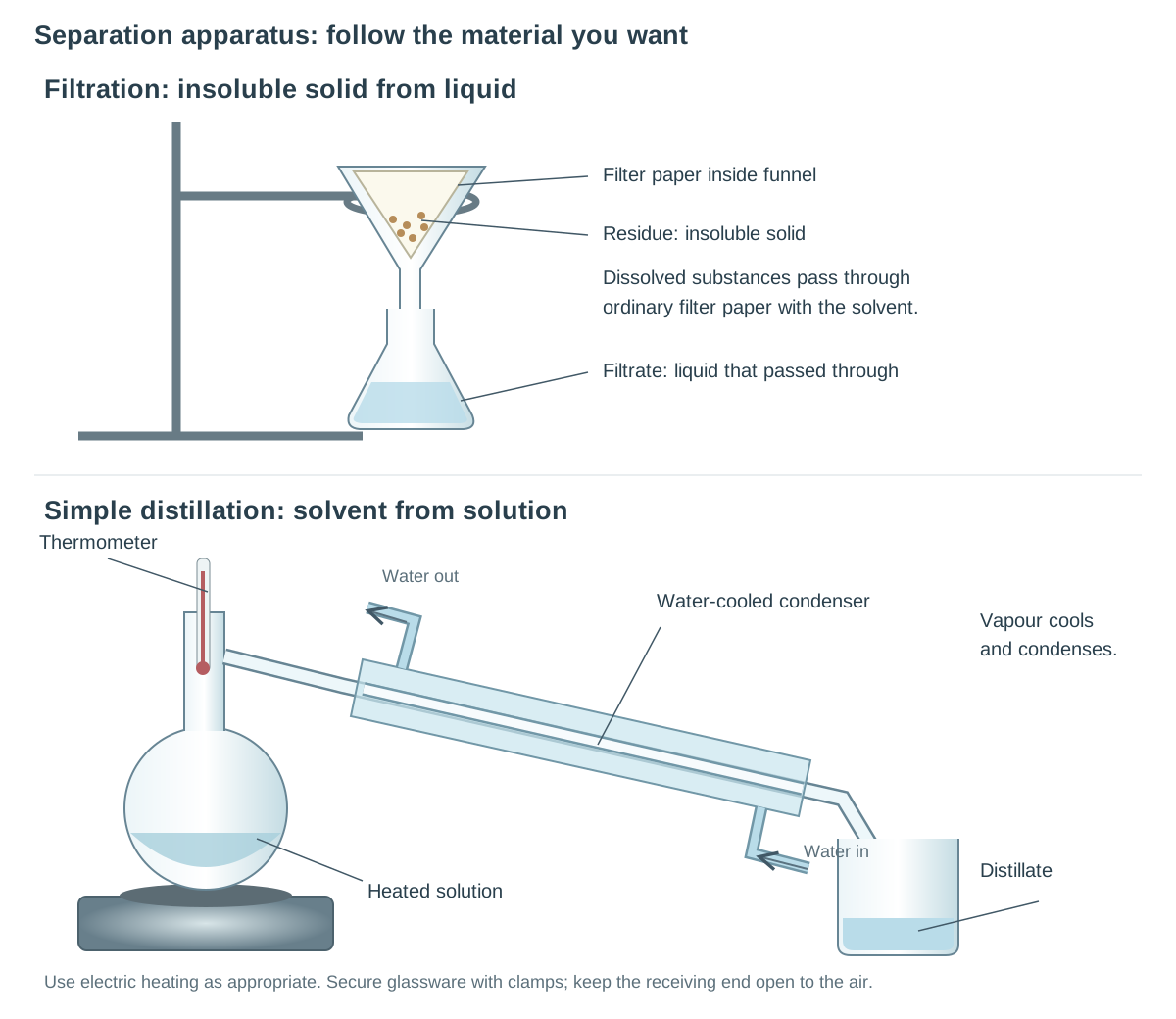
These separation methods are practical skills in this topic. AQA’s numbered chromatography required practical belongs to Chemical analysis; it is not an additional required practical for section 5.1. Use eye protection and follow teacher instructions for hot glassware and solvents. Keep flammable liquids away from naked flames.
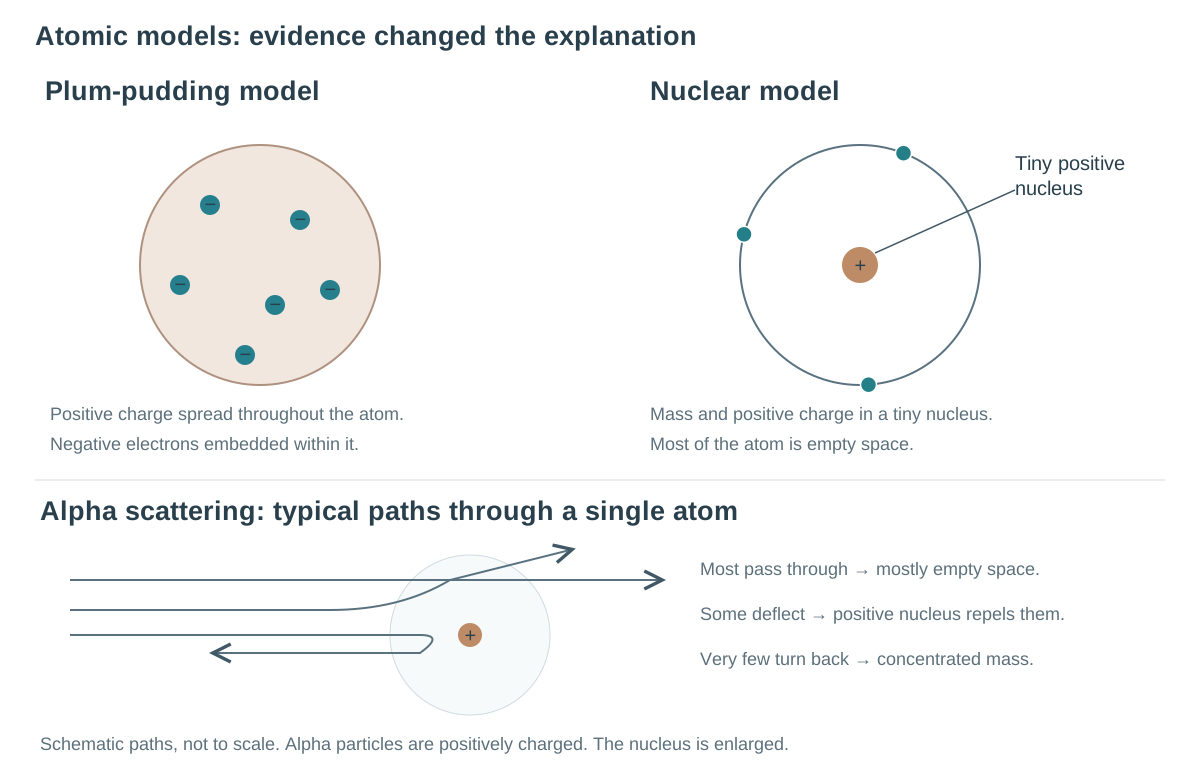
A scientific model is an explanation or representation supported by evidence. It can change when new observations cannot be explained by the old model.
| Particle | Location | Relative charge | Relative mass |
|---|---|---|---|
| Proton | Nucleus | +1 | 1 |
| Neutron | Nucleus | 0 | 1 |
| Electron | Shells around nucleus | −1 | Very small: about 1/1836 |
The atomic number is the number of protons. It identifies the element. Every carbon atom has six protons. A neutral atom has equal numbers of protons and electrons, so the positive and negative charges cancel.
The mass number is protons + neutrons. Therefore neutrons = mass number − atomic number. In isotope notation, the mass number is above the atomic number to the left of the symbol.
An ion is a charged atom or group of atoms. Losing negative electrons gives a positive ion; gaining negative electrons gives a negative ion. A chloride ion, Cl⁻, has one more electron than a chlorine atom. Ion formation in ordinary chemical reactions does not change the nucleus.
A typical atomic radius is about 0.1 nm = 1 × 10⁻¹⁰ m. Nano means one billionth: 1 nm = 10⁻⁹ m. A nucleus has a radius of roughly 10⁻¹⁴ m, less than about one ten-thousandth of an atom’s radius. Almost all the mass is in this tiny nucleus.
To compare sizes, divide the larger by the smaller. Using the approximate powers of ten, 10⁻¹⁰ ÷ 10⁻¹⁴ = 10⁴, or 10,000. If an atom’s radius were enlarged to 100 m, a nucleus on that approximate scale would have a radius of about 1 cm. Diagrams cannot usually show both clearly at the same scale.
Isotopes are atoms of the same element with the same number of protons but different numbers of neutrons. Carbon-12 and carbon-14 both have six protons; they have six and eight neutrons respectively. Their mass numbers differ, but they are still carbon.
The relative atomic mass, Aᵣ, is a weighted average that accounts for the natural abundances of the isotopes. It is not necessarily a whole number. Do not confuse it with the whole-number mass number of one isotope.
If abundances are counts or a ratio rather than percentages, divide by the total count or sum of the ratio parts. For three atoms of mass 10 and one of mass 11, the weighted average is (3 × 10 + 1 × 11) ÷ 4 = 10.25.
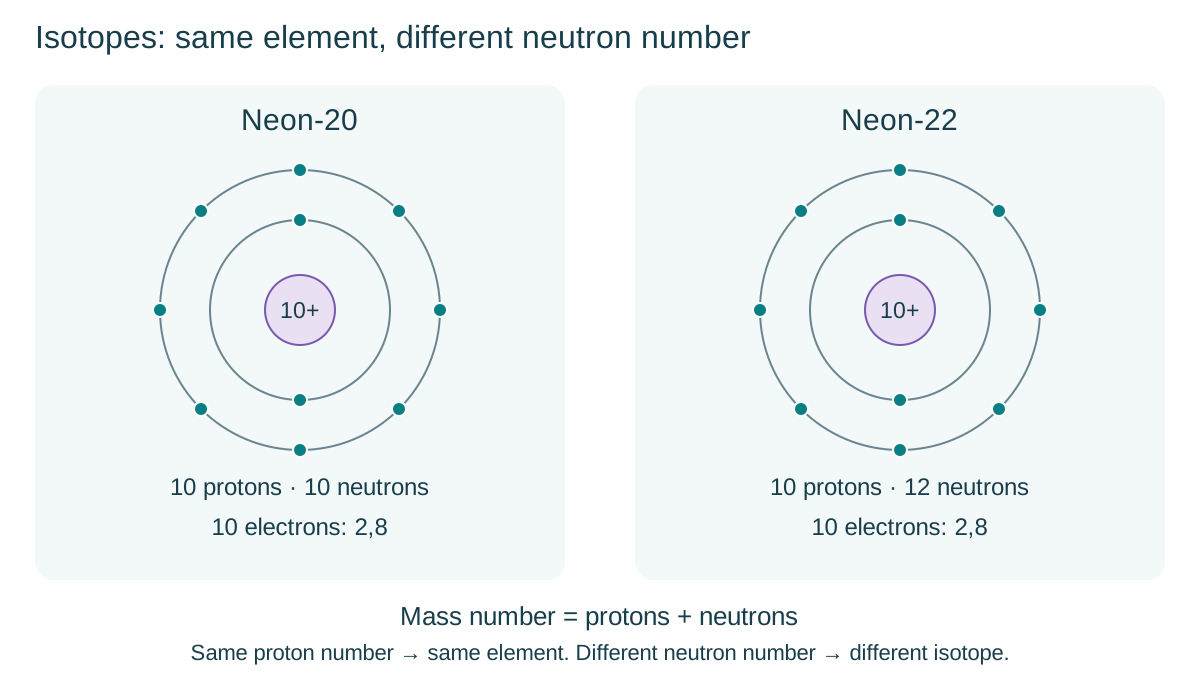
Electrons fill the lowest available energy levels first. For the first 20 elements, use shell arrangements of up to 2 in the first shell, then 8 in the second, then 8 before starting the fourth. Use this pattern for the first 20 elements; larger atoms can have more complicated arrangements.
Sodium has atomic number 11, so a neutral sodium atom has 11 electrons: 2,8,1. Chlorine has 17: 2,8,7. Calcium has 20: 2,8,8,2. Count the dots as well as the shells when checking a drawing.
The modern periodic table is arranged by increasing atomic number. A horizontal row is a period; a vertical column is a group. For the main groups studied here, elements in a group have the same number of outer-shell electrons and similar reactions.
Potassium, 2,8,8,1, is in Period 4 and Group 1. Magnesium, 2,8,2, is in Period 3 and Group 2. This allows you to predict chemical behaviour from an element’s position.
The periodic table developed as scientists found better ways to organise the elements.
Why can mass order differ? Isotopes have different neutron numbers; average mass depends on their abundances. Argon (18, Aᵣ ≈ 39.9) comes before potassium (19, Aᵣ ≈ 39.1), despite its larger average mass.
Most elements are metals, found mainly on the left and towards the bottom of the periodic table. Non-metals are mainly towards the top right; hydrogen is a non-metal despite its position on the left.
Metals usually conduct heat and electricity well, are shiny when freshly cut and can be shaped without breaking. Most are solid at room temperature, although mercury is liquid. Non-metals often conduct poorly and, when solid, tend to be brittle; graphite is an important conducting exception.
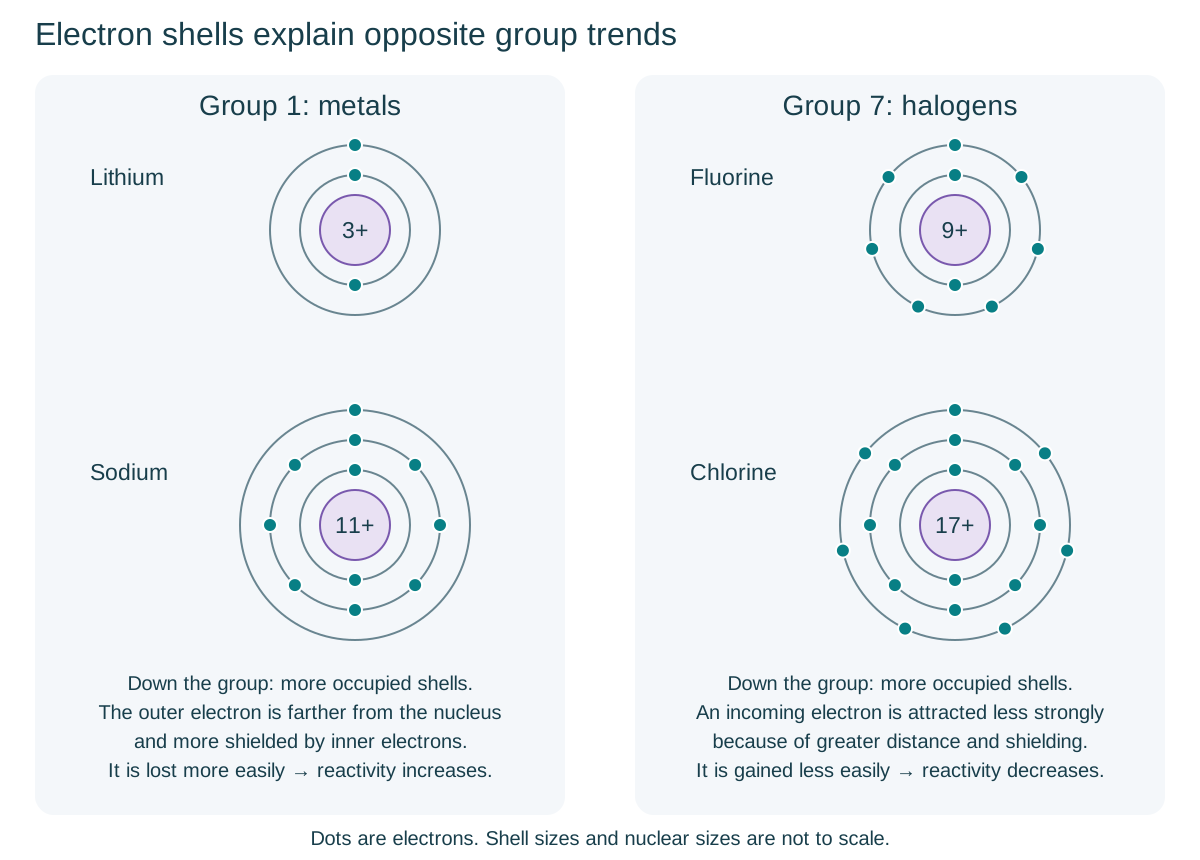
Metals react by losing electrons to form positive ions. Non-metals do not normally form positive ions in these reactions: they may gain electrons to form negative ions or share electrons in covalent bonds. Outer-shell arrangement helps explain these differences. A Group 1 atom can lose its one outer electron; a Group 7 atom can gain one to complete its outer shell.
The noble gases include helium, neon and argon. They exist as separate atoms and are very unreactive under ordinary conditions. Their outer shells are full: helium has two electrons; the others have eight outer electrons. These stable arrangements mean the atoms do not readily gain, lose or share electrons.
Going down Group 0, relative atomic mass and boiling point increase. You can use data to predict an unknown value or describe a trend. All the noble gases are gases at room temperature, but they can be liquefied at low temperatures.
| Element | Boiling point / °C |
|---|---|
| Helium | −269 |
| Neon | −246 |
| Argon | −186 |
| Krypton | −153 |
Remember that −153 °C is higher than −186 °C. “Higher boiling point” does not necessarily mean a positive temperature.
Lithium (Li), sodium (Na) and potassium (K) are soft metals with one outer-shell electron. Rubidium (Rb), caesium (Cs) and francium (Fr) are further down Group 1. They form ions with charge +1 by losing that outer electron.
On water, lithium floats and fizzes relatively gently. Sodium usually melts into a moving ball because of heat released. Potassium reacts more vigorously and may burn with a lilac flame. These are teacher demonstrations: do not attempt them yourself.
Reactivity increases down Group 1. The outer electron is farther from the nucleus and more shielded by inner electrons. The attraction to it is weaker, so it is lost more easily, even though the nucleus has more protons.
The halogens have seven outer electrons and occur as diatomic molecules: F₂, Cl₂, Br₂ and I₂. Fluorine is a pale yellow gas; chlorine a green gas; bromine a red-brown liquid; iodine a grey-black solid that produces purple vapour when warmed. Astatine (At) lies below iodine in the group.
Going down Group 7, relative molecular mass, melting point and boiling point increase. At room temperature, chlorine is a gas, bromine a liquid and iodine a solid.
Halogens react with metals to form ionic metal halides. For example, Mg + Cl₂ → MgCl₂. With non-metals, they form covalent compounds: hydrogen + chlorine → hydrogen chloride, H₂ + Cl₂ → 2HCl.
Reactivity decreases down Group 7. A halogen atom reacts by gaining an electron. Down the group, the outer region is farther from the nucleus and more shielded. Attraction for an incoming electron is weaker, so gaining it is harder.
A more reactive halogen displaces a less reactive halogen from its salt solution. Chlorine displaces bromine from potassium bromide: Cl₂ + 2KBr → 2KCl + Br₂. Bromine displaces iodine from potassium iodide: Br₂ + 2KI → 2KBr + I₂. Iodine cannot displace chlorine from a chloride solution.
Use solutions only under teacher instructions with eye protection; halogens and their vapours can be harmful. A colour change can provide evidence of a displacement, but name the new halogen and explain the reactivity order rather than relying on colour alone.
Start with the 35 main questions. Higher-only questions are labelled. You can complete this topic over several sessions; your answers save as you go. Use a hint if you get stuck, then compare your work with an example answer. Your tutor can mark written answers.
A flask contains water, dissolved sodium chloride and insoluble sand. You must collect clean sand, salt crystals and a sample of water. Use the separation illustration in Learn to plan an order of methods. Explain where each substance is collected and include one safety precaution.
Filter first; wash and dry the sand residue. Distil some of the salt solution, collecting condensed water. Stop with solution remaining, then cool the concentrated solution to form crystals; filter and dry them. Wear eye protection, handle hot apparatus carefully and do not seal the distillation system.
On one chromatogram, sample A produces a blue spot 2 cm above the baseline and a red spot 5 cm above it. Pure dye B produces a blue spot at 2 cm using the same solvent and paper.
A is a mixture of at least two separated dyes. Its blue component may be the same as B because both travel the same distance under the same conditions. A matching distance supports this suggestion but is not absolute proof of identity.
On paper, draw the electron shells of oxygen (atomic number 8) and magnesium (12). Draw every electron once. Then write each arrangement as numbers.
Oxygen: two occupied shells, with 2 electrons in the first and 6 in the second (2,6). Magnesium: three occupied shells, with 2, 8 and 2 electrons (2,8,2). The nucleus should be inside the shells. A shell diagram is a model, not a scale drawing.
When connected with your pupil code, your answers save online for Kevin to see. Click Submit to Kevin when you have finished. Downloads are optional.
Connect with your pupil code above to submit.
Use a scientific idea and a specific example in your reflection.