Chemical analysis
Work through one section at a time. Higher-only material is labelled explicitly; optional challenges can also use Foundation content.
 GCSE CHEMISTRY · AQA TRILOGYTutor dashboardSaves on this device
Your answers save automatically as you work.
Saved in this browser on this device.
How can you find out what is in a sample? Use melting points, chromatography and gas tests to build a clear answer from evidence.
Supported GCSE version · Clear examples, worked calculations and optional challenges.
Work through one section at a time. Higher-only material is labelled explicitly; optional challenges can also use Foundation content.
A single element or compound, not mixed with another substance.
Another substance mixed with the substance being tested.
A mixture designed as a useful product, with carefully measured ingredients.
A method that separates substances as they move between a stationary and a mobile phase.
The phase that stays in place; in paper chromatography, the paper.
The phase that moves; in paper chromatography, the solvent.
A liquid that dissolves a substance.
The pencil starting line on which samples are placed.
The furthest point reached by the solvent during chromatography.
Distance moved by a substance divided by the distance moved by the solvent front, both from the baseline.
A known substance used for comparison with an unknown.
Calcium hydroxide solution; it turns cloudy when carbon dioxide is added.
Having its colour removed; damp litmus turns white in chlorine.
Something directly seen or measured in a test.
In chemistry, a pure substance contains just one element or one compound. Pure oxygen is an element. Pure sodium chloride is a compound. Both can be pure.
Everyday labels use “pure” differently. “Pure orange juice” might mean nothing has been added, but it still contains water, sugars and other substances. It is a mixture in chemistry.
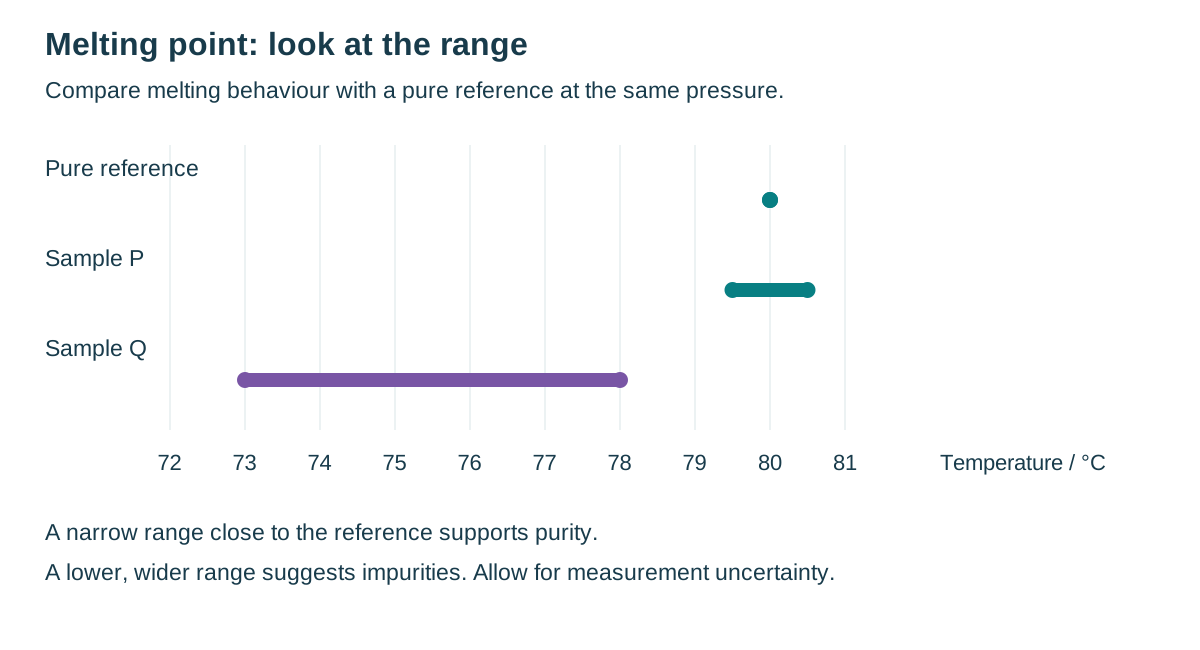
At a specified pressure, a pure substance has a characteristic melting point and boiling point. A sample that melts over a range or at a different temperature may contain impurities. Impurities often lower a solid’s melting point and broaden its melting range. Compare with reliable reference data under the same conditions.
| Sample | Observed melting behaviour |
|---|---|
| Reference pure solid | Melts sharply at 80 °C |
| Sample P | Melts between 79.5 and 80.5 °C |
| Sample Q | Starts at 73 °C; finishes at 78 °C |
P is more consistent with the pure reference. Q’s lower, broader range suggests impurities. Allow for measurement uncertainty: one reading does not prove identity or purity with complete certainty.
A formulation is a mixture deliberately made to have useful properties. Its ingredients are measured carefully, and each has a purpose. Not every mixture is a formulation: a puddle of muddy water was not designed to meet a recipe.
| Product | Why its ingredients are chosen |
|---|---|
| Paint | Pigment gives colour; other ingredients help it spread, dry and stick. |
| Medicine | An active ingredient has the intended effect; other ingredients may control taste or delivery. |
| Cleaning product | Ingredients help remove dirt and allow the product to be used conveniently. |
| Fuel blend | The proportions are adjusted to give suitable burning properties. |
| Alloy, fertiliser or food | Measured proportions produce the intended strength, nutrient supply or taste. |
You are not expected to memorise a manufacturer’s recipe. Use the information supplied to explain how the quantities or roles of ingredients help the product work.
A dark ink can contain several coloured substances. Chromatography separates them as a solvent moves across paper. The paper is the stationary phase; the solvent that travels is the mobile phase.
The substances spend different proportions of time in the two phases. A substance that dissolves readily in the solvent and is less strongly attracted to the paper usually travels further. A substance more strongly held by the paper travels less far. This makes the substances separate into spots.
Colour is not the only evidence: two different substances may be the same colour. Compare their positions or Rf values under the same conditions.
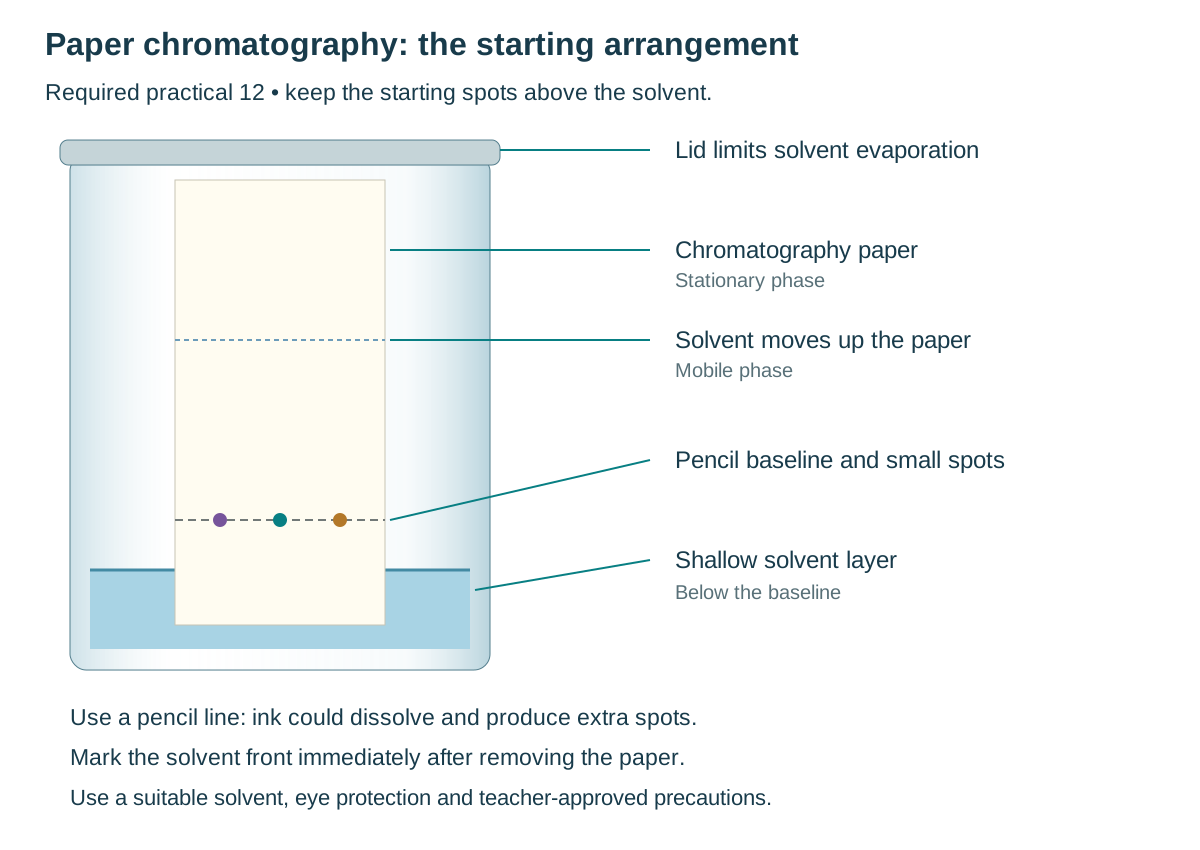
Why these details matter: pencil does not dissolve like many inks; spots above the liquid travel up the paper instead of dissolving into the beaker; small spots reduce overlap; a lid limits evaporation; the front must be marked before the solvent evaporates.
Safety: wear eye protection, avoid contact with dyes and use only teacher-approved solvents. Some solvents are flammable: keep them away from flames and follow ventilation instructions. Do not assume every solvent is safe because it looks like water.
The Rf value compares how far a substance moves with how far the solvent front moves. Measure both distances from the pencil baseline, not from the bottom edge of the paper.
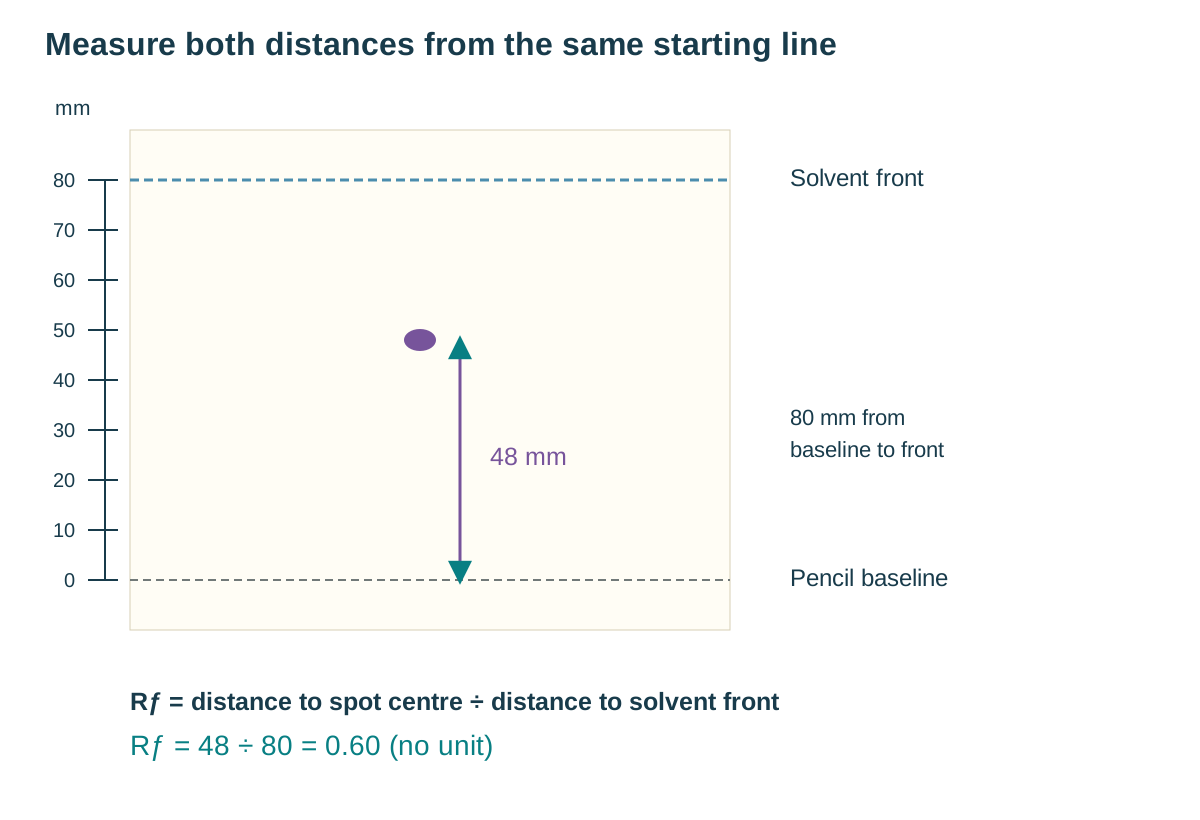
Rf = distance moved by substance ÷ distance moved by solvent front
Use the same distance unit in the numerator and denominator. The units cancel, so Rf has no unit. It is normally between 0 and 1. An answer above 1 usually means the wrong distances were used or the division was reversed.
A substance’s Rf can change if the solvent changes. Only compare reference values from the same conditions. A matching Rf supports an identification but does not make it certain: different substances can sometimes travel together.
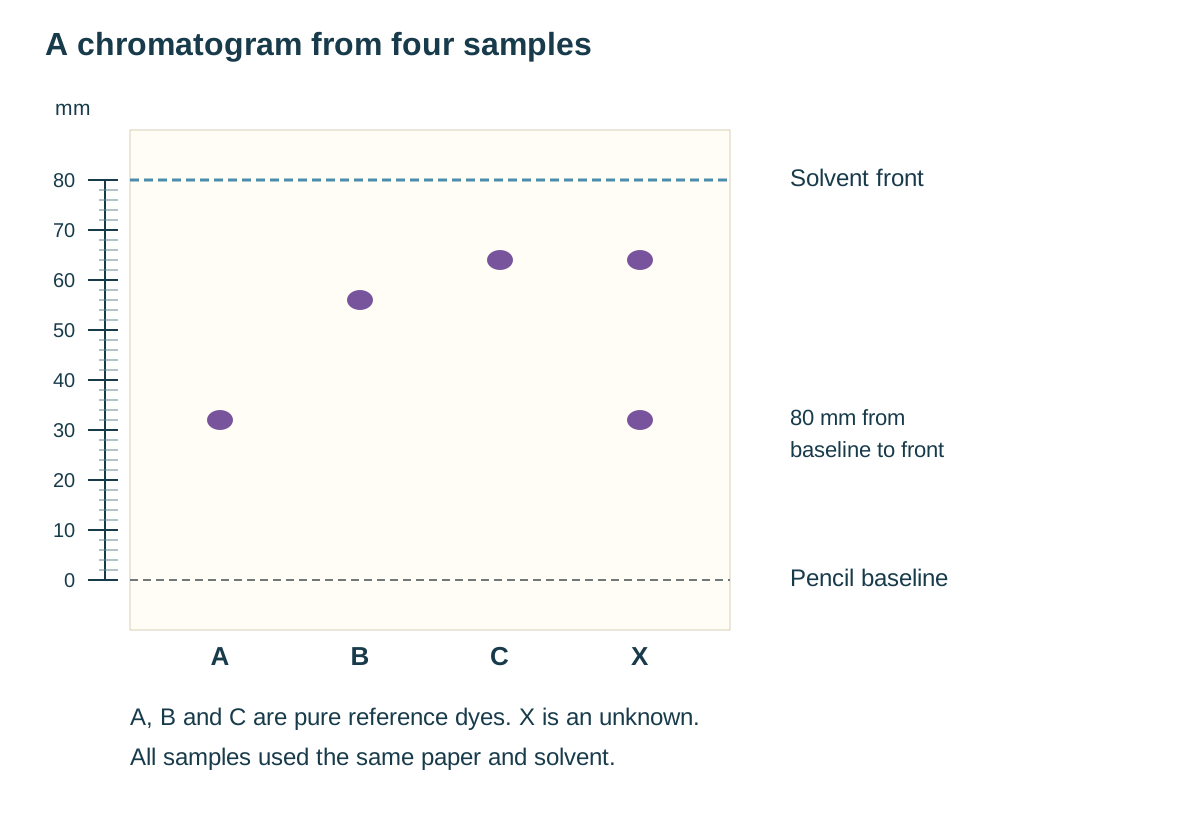
Several spots in one sample show that it contains a mixture. A pure coloured substance should give one spot in suitable solvents. One spot in just one solvent is not enough to prove purity: two substances might overlap or a substance might not be visible.
To compare an unknown with reference dyes, run them on the same paper. Matching heights give matching Rf values because they share the same baseline and solvent front. A second suitable solvent can provide extra evidence.
A gas test needs both a method and a positive result. “Use a splint” is not enough: you must say whether it is burning or glowing and what happens.
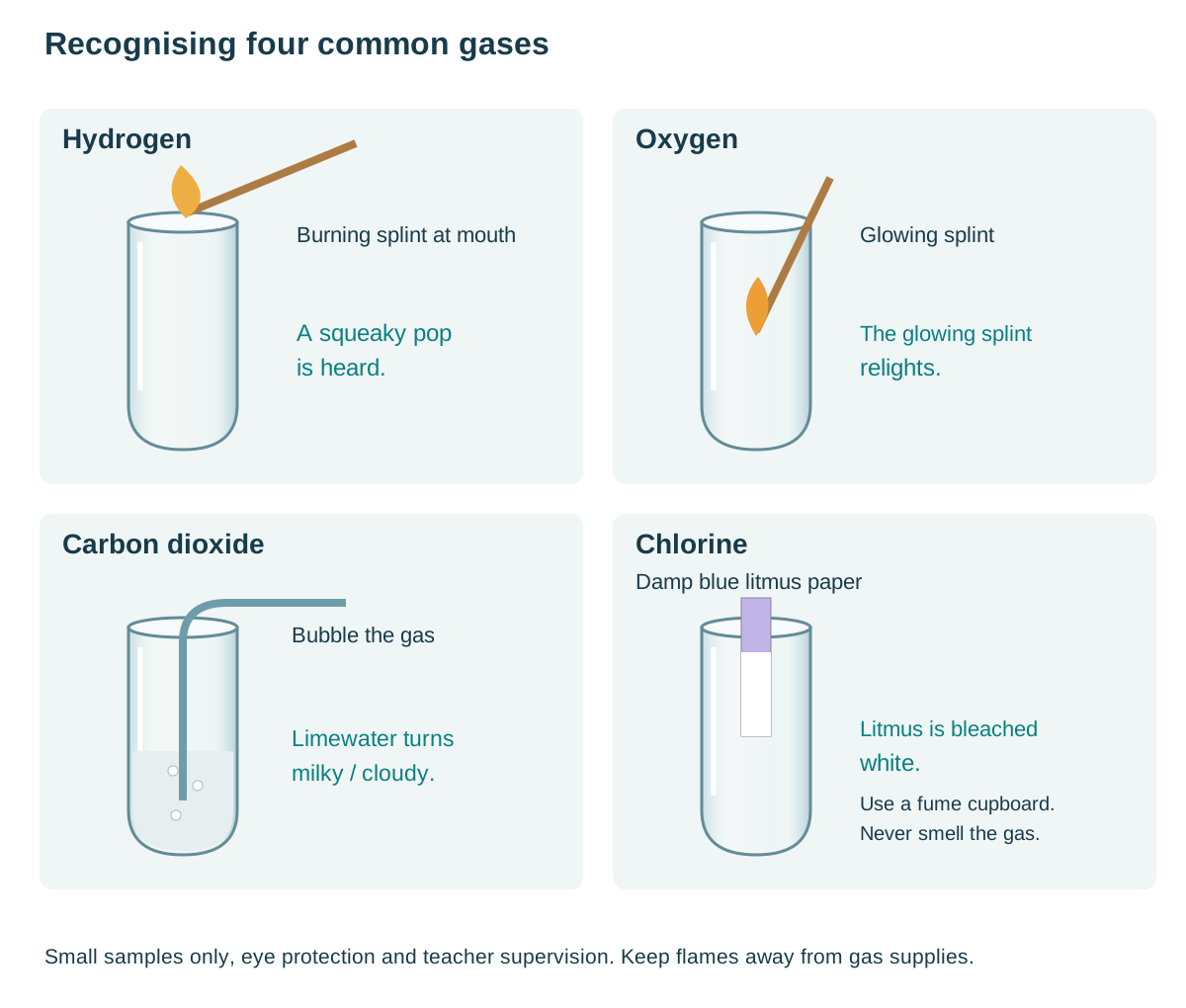
| Gas | Test | Positive result |
|---|---|---|
| Hydrogen | Hold a burning splint at the open end of a tube containing the gas. | A squeaky pop. |
| Oxygen | Insert a glowing splint into the gas. | The splint relights. |
| Carbon dioxide | Bubble the gas through limewater or shake it with limewater. | The limewater becomes milky/cloudy. |
| Chlorine | Expose damp blue litmus paper to the gas. | It is bleached white; it may turn red briefly first. |
Chlorine is toxic: testing it is teacher-controlled, with suitable extraction such as a fume cupboard. Never smell it. A flame going out is not a specific test for carbon dioxide—other gases can also fail to support burning.
Separate what you observe from what you infer. “The splint relit” is an observation. “The gas is oxygen” is a conclusion based on that test.
If a result is unclear, repeat with a fresh sample and suitable apparatus. For chromatography, do not compare distances from different solvent runs without calculating Rf and checking conditions. For melting points, compare with a reference and account for the thermometer’s resolution.
Use calculations carefully: record units for measured distances, but not for Rf. Quote sensible significant figures. All questions here are original exam-style practice. Topic 5.8 has no Higher-only specification content; optional challenges use the same science in less familiar situations.
Start with the 28 main questions. Higher-only questions are labelled. You can complete this topic over several sessions; your answers save as you go. Use a hint if you get stuck, then compare your work with an example answer. Your tutor can mark written answers.
A student draws an ink baseline, puts large sample spots below the solvent surface and leaves the paper to dry before marking the solvent front. Explain three changes that would improve the method and describe how to calculate an Rƒ value.
Use pencil because ink can dissolve and make extra spots. Use small, dried spots above the solvent surface so they do not dissolve into the beaker and are less likely to overlap. Mark the solvent front immediately before it evaporates. Measure from the baseline to the centre of a spot and to the front. Rƒ = spot distance ÷ front distance, using the same distance units; the answer has no unit.
When connected with your pupil code, your answers save online for Kevin to see. Click Submit to Kevin when you have finished. Downloads are optional.
Connect with your pupil code above to submit.
Use a scientific idea and a specific example in your reflection.